
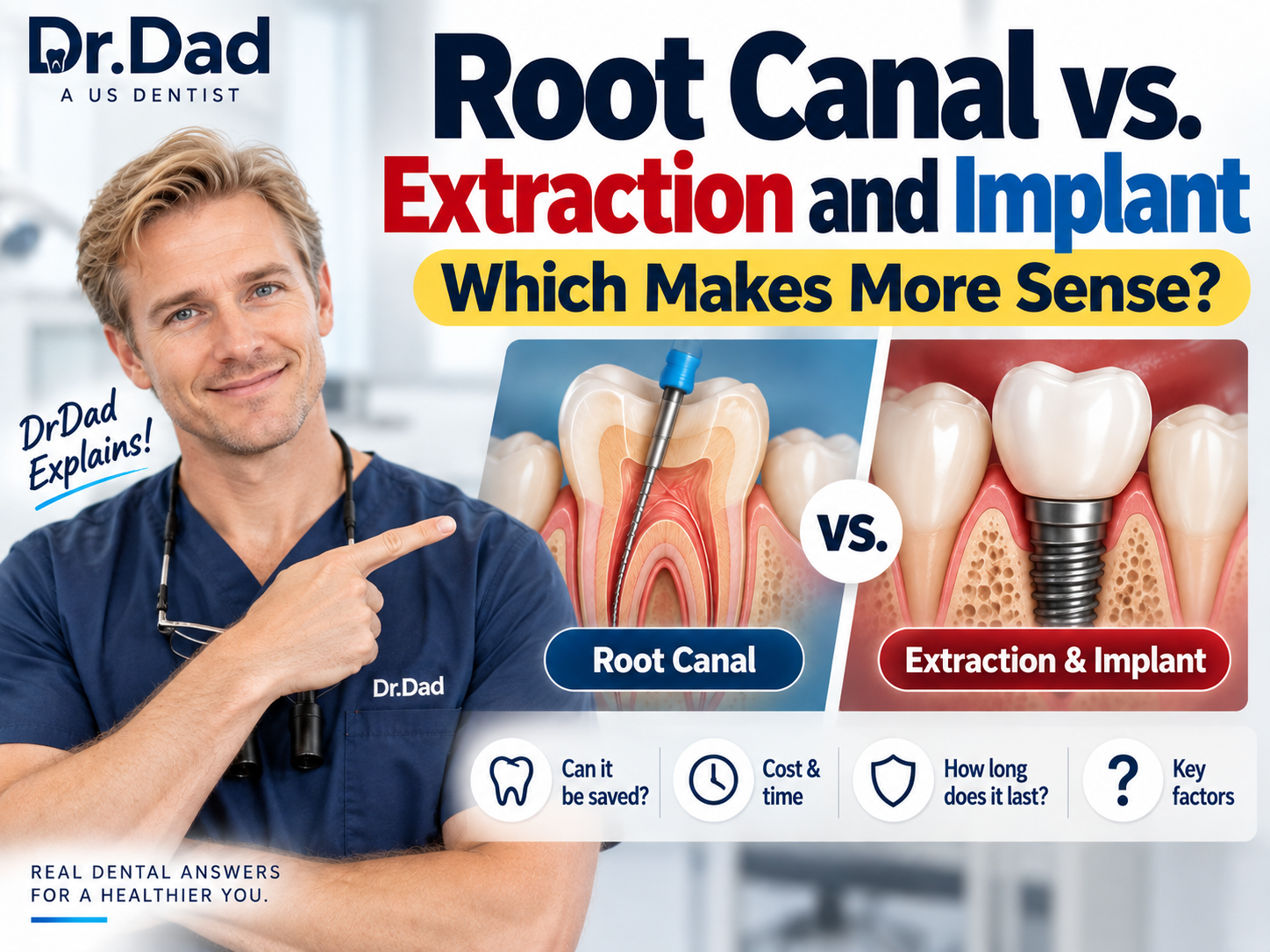
“Doctor, can you save this tooth? Or should I just pull it and get an implant?”
I got this question again today. And I hear some version of it all the time in my dental office.
At first, it sounds like a simple choice: Root canal or implant?
But that’s not really the question I’m trying to answer when I examine the tooth. The question I care about is:
Is this tooth worth saving—and can I restore it predictably enough to function for years?
A root canal may be technically possible. That does not automatically mean I would recommend doing one. And an implant can be an excellent replacement for a tooth that truly cannot be saved. But that doesn’t mean I would remove a restorable natural tooth simply because an implant is available.
First: A Root Canal and an Implant Solve Different Problems
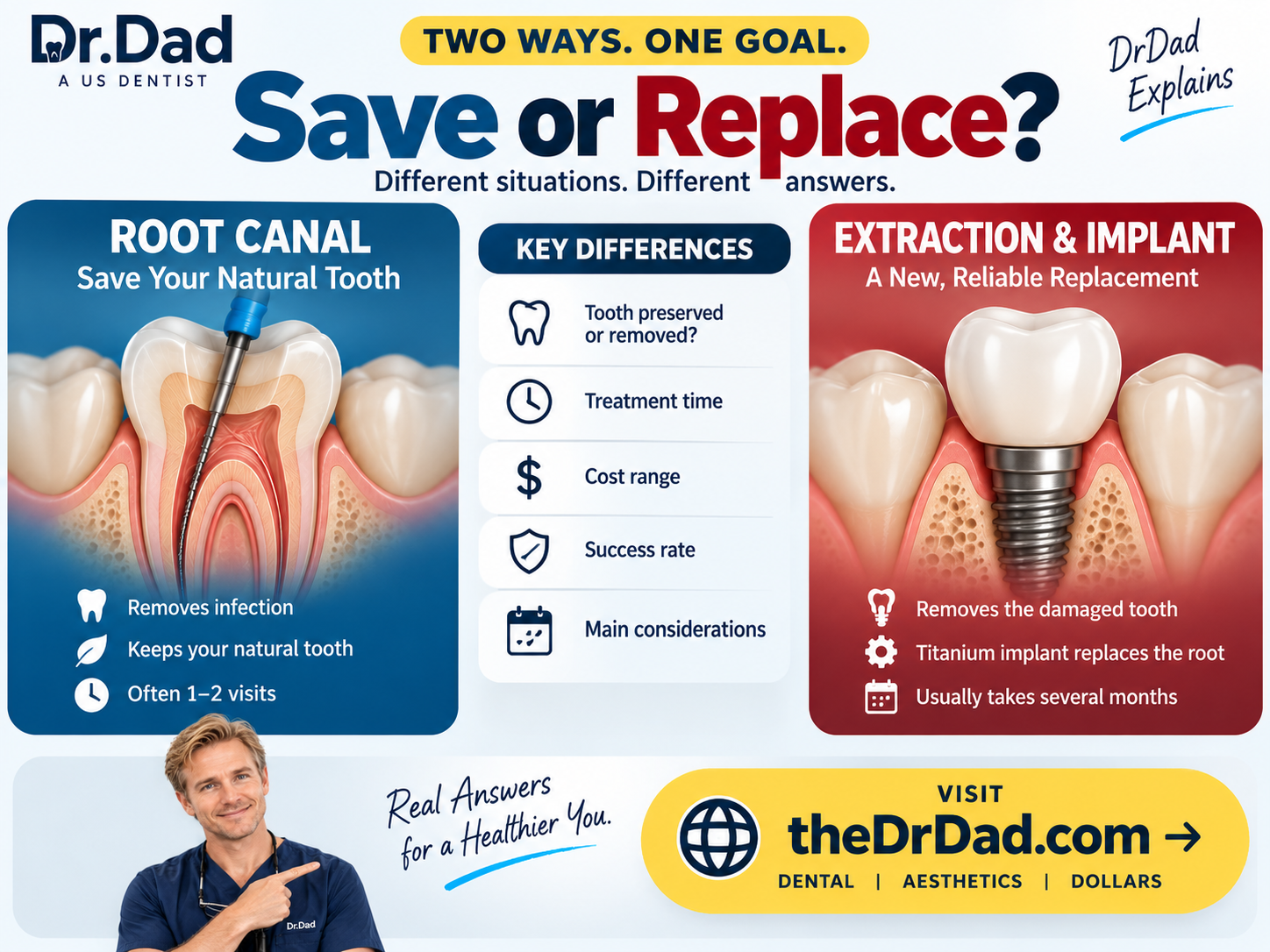
A root canal treats disease inside your natural tooth. The infected or inflamed pulp is removed, the canals are cleaned and sealed, and the tooth is then restored so it can function again. Depending on the tooth and how much structure has been lost, that final restoration may include a build-up and crown.
An implant is different. With an implant, the natural tooth is removed. A titanium implant is placed into the jawbone to replace the root, and a crown is eventually attached to it.
Depending on the situation, treatment may involve extraction → possible bone graft → healing → implant placement → healing → abutment → implant crown. Some cases can be treated faster, including certain immediate implant situations. Others require several months of healing.
So when someone compares the price of a root canal with the price of an implant, I don’t think that’s always an apples-to-apples comparison. You need to compare the entire treatment plan.
Is an Implant Better Than a Root Canal?
There isn’t a universal answer. A systematic review comparing endodontically treated teeth with implant-supported prostheses found conflicting survival results among the included studies. The evidence did not establish one treatment as universally superior in terms of survival.
That makes sense clinically. One treatment preserves a natural tooth. The other replaces a missing tooth. The condition of the natural tooth changes the entire equation.
When Would I Actually Try to Save the Tooth?
This is probably the most important part of the decision.
You may have heard: “If a tooth can be saved, save it.” I agree with preserving natural teeth when it makes clinical sense. But I would add something important:
Just because I can technically perform a root canal does not mean the tooth is predictably restorable.
1. Is There a Fracture?
This is one of my first questions. A tooth with pulpal disease but otherwise favorable structure is one situation. A tooth with a significant crack or vertical root fracture is another.
Before asking, “Can you do a root canal?” I want to know: “What exactly am I doing a root canal on?”
2. How Good Is the Periodontal Support?
The root canal isn’t the whole tooth. The tissues supporting the tooth matter too. I look at the periodontal condition, bone support, mobility, probing findings, and the overall foundation supporting that tooth.
A beautifully performed root canal does not solve a poor periodontal prognosis.
3. How Much Real Tooth Structure Is Left?
This is huge. Patients sometimes see a damaged tooth and think, “There’s still some tooth there. Can’t you just put a crown on it?” Not necessarily.
A root canal treats the inside of the tooth. It does not replace missing tooth structure.
What I’m looking for is enough healthy, useful remaining tooth structure to build a restoration that can withstand chewing forces over time.
The Ferrule Effect
Think of the crown as needing to grab and surround a band of solid natural tooth structure. That remaining tooth structure helps the restored tooth resist forces trying to flex, separate, or fracture it. This is called the ferrule effect.
A 2026 systematic review and meta-analysis involving 33 studies found that ferrule height of 2 mm or greater significantly improved fracture resistance. A complete 360-degree ferrule showed the most favorable reinforcement, while partial ferrules with at least two opposing walls also showed benefit.
That is very close to what I’m looking for clinically:
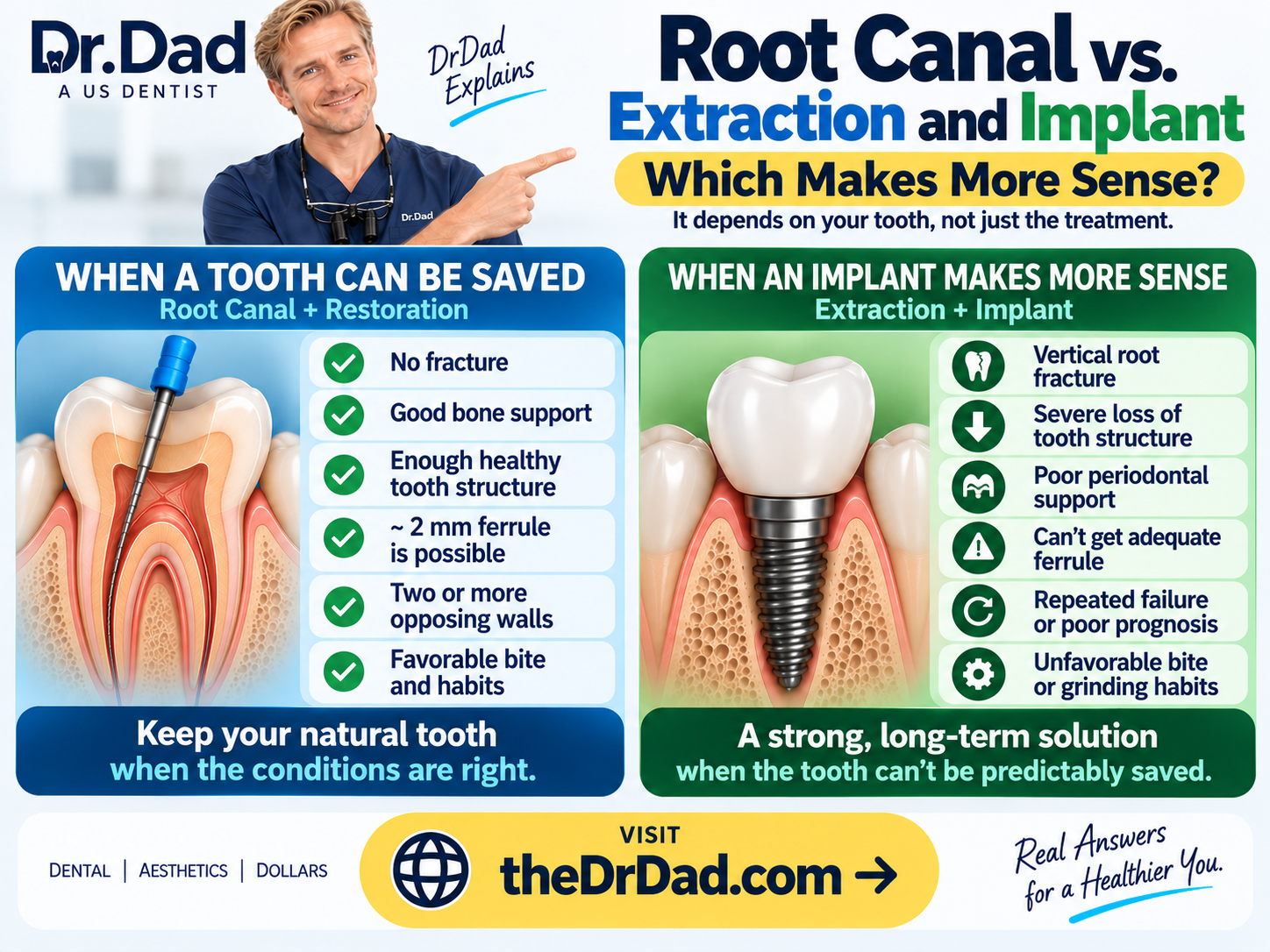
- Can I get approximately 2 mm of useful tooth structure for the crown to engage?
- Do I have solid opposing walls of remaining tooth structure?
- Can I create a meaningful ferrule rather than simply placing a crown over a severely compromised foundation?
The better question isn’t “Is there enough tooth left to put something on it?” It’s “Is there enough good tooth left to build something I trust?”
4. Can I Predictably Restore the Tooth After the Root Canal?
Sometimes the endodontic part of the case isn’t what worries me. The restorative part does.
Before treatment, I’m already thinking about what happens after the root canal. Where will the crown margin be? How much sound tooth structure will remain? Can I obtain an adequate ferrule? What will support the build-up? What kind of forces will this tooth experience?
Endodontic success and restorative success have to work together.
5. How Does This Patient Actually Use Their Teeth?
I don’t only look at the tooth. I look at the person attached to the tooth.
What do you eat? Do you regularly chew very hard foods? Do you clench? Do you grind your teeth? Have you already fractured other teeth or restorations? How heavy is your bite?
Two patients can have teeth that look very similar on an X-ray and still have very different functional environments. If someone has an extremely heavy bite, aggressive chewing habits, or significant bruxism (teeth grinding), I take that seriously when evaluating a structurally compromised tooth.
A root canal does not make a damaged tooth indestructible. Neither does a crown. And neither does an implant.
So When Might Extraction and an Implant Make More Sense?
There are situations where I may look at a tooth and decide that investing more treatment into it doesn’t offer the predictability I want for my patient.
- A non-restorable fracture or unfavorable root fracture
- Severe loss of tooth structure
- Inability to create an adequate final restoration or ferrule
- Poor periodontal support
- Repeated failure or an unfavorable overall prognosis
- An unfavorable combination of structural, periodontal, and functional problems
This doesn’t mean every tooth with one unfavorable feature automatically needs extraction. Dentistry isn’t that simple.
But there comes a point where we have to distinguish between saving a tooth and delaying the loss of a tooth. Those aren’t always the same thing.
What About Cost?
Patients may hear “root canal + build-up + crown” and think, “That’s expensive. Why don’t I just put that money toward an implant?” It’s a reasonable question.
But compare the complete treatments. For a root canal-treated tooth, the total may involve the endodontic treatment plus the restoration needed afterward. For an implant case, the total may include extraction, possible grafting, implant surgery, abutment, and the final crown.
The exact cost varies enormously based on the tooth, geographic area, insurance, specialists involved, grafting requirements, materials, and complexity. Ask for the expected total treatment plan on both sides. Then compare them.
What About Treatment Time?
Root canal treatment can often be performed in one or two visits, followed by the necessary final restoration. Implant treatment can sometimes be completed quickly in carefully selected cases, but other cases require staged treatment and months of healing.
That doesn’t make one treatment “better.” It simply means treatment time should be part of the decision.
But Aren’t Implants Permanent?
I would be careful with that word.
Nothing I put in someone’s mouth comes with a guarantee that it will last forever.
Natural teeth can develop new decay, fractures, periodontal disease, or recurrent endodontic problems. A previously root canal-treated tooth can sometimes require retreatment or endodontic surgery if disease persists or returns.
Implants can also develop biological and prosthetic complications. That’s why I don’t like presenting this decision as “old tooth versus permanent implant.” Both treatments can be excellent. Both can have complications.
Can I Get an Implant Later If the Root Canal Fails?
Often, yes. If a tooth ultimately becomes non-restorable, extraction and replacement—including an implant when clinically appropriate—may still be options.
And even a root canal that develops a problem does not necessarily mean immediate extraction. Depending on the cause, endodontic retreatment or surgery may sometimes allow the tooth to remain functional.
Root Canal vs. Implant: The Question I Would Ask
If you are sitting in the dental chair trying to make this decision, don’t ask only: “Can you save my tooth?”
Ask: “If we save this tooth, how predictable is the final restored tooth?”
How much tooth structure remains? Is there a fracture? How is the periodontal support? Can the dentist obtain an adequate ferrule? What will the final restoration require? How does your bite affect the prognosis? And if the tooth is removed, what exactly will be involved in replacing it?
DrDad Tips
“Can it be saved?” and “Should it be saved?” are not the same question. A root canal may be technically possible even when the final tooth has a poor restorative prognosis.
Remaining tooth structure matters—a lot. For me, adequate sound tooth structure, useful opposing walls, and the ability to create an appropriate ferrule are major considerations before I recommend investing in the tooth.
Don’t forget the foundation. Periodontal and bone support matter just as much as what’s happening inside the tooth.
Your bite and habits matter too. Heavy chewing, clenching, and bruxism can change how I evaluate a structurally compromised tooth.
Compare complete treatment plans—not single procedure prices.
My goal isn’t to save every tooth at any cost. It’s to identify the teeth that have the right conditions to be saved predictably—and recognize when they don’t.
Medical Disclaimer
This article is for general educational purposes only and is not a substitute for an examination, diagnosis, or individualized treatment plan from your dentist, endodontist, periodontist, prosthodontist, or other qualified healthcare professional. Whether a tooth can or should be saved depends on individual factors including remaining tooth structure, fractures, periodontal and bone support, infection, restorative options, bite forces, oral habits, medical history, and other clinical findings. Treatment outcomes vary from patient to patient. Please discuss your specific condition and treatment options with your treating dental professional.
References
- Hajeer O, Hasan A, Kanout C, Morad ML. Ferrule dimensions and restoration outcomes in endodontically treated teeth: A systematic review and meta-analysis. Journal of Prosthodontics. 2026;35(4):450–459. doi:10.1111/jopr.70099.
- Sinsareekul C, Saengthong-Aram P, Limpuangthip N. Survival, complications, and patient-reported outcomes of endodontically treated teeth versus dental implant-supported prostheses: A systematic review. Journal of Prosthetic Dentistry. 2025;133(3):669–676. doi:10.1016/j.prosdent.2024.02.007.
- American Association of Endodontists. Treatment Options for the Diseased Tooth.
- American Association of Endodontists. Dental Implant Resources.
- American Association of Endodontists. Root Canal Explained: Step-by-Step Treatment Guide.
- American Association of Endodontists. Other Endodontic Treatment Options.
- American Association of Endodontists. Endodontic Retreatment.