
DrDad Key Takeaways
Root canal treatment commonly costs $1,200–$1,500 out of network, but fees vary by tooth, complexity, location, and insurance. The final restoration may cost extra. Save the tooth when it can be restored predictably.
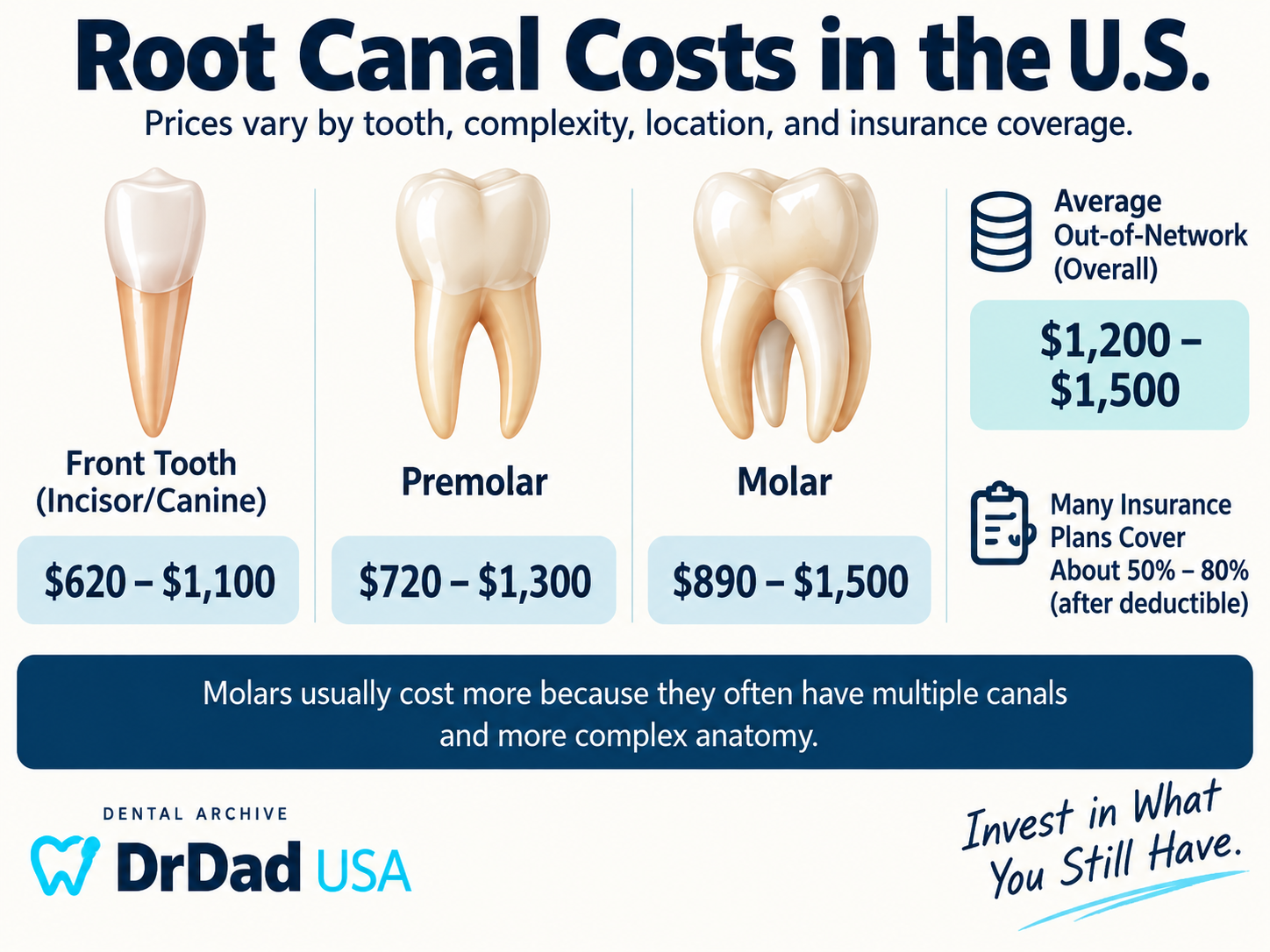
A root canal in the United States commonly costs roughly $1,200–$1,500 out of network overall, although the actual fee varies by tooth, complexity, location, provider, and insurance coverage. [3] And the root canal itself may not be the entire cost. Depending on the tooth and how much structure remains, a filling or crown may be needed afterward.
That price can make patients wonder whether it would be easier to simply remove the tooth. But cost should be considered together with prognosis. A 2022 systematic review reported pooled primary root canal treatment success of 92.6% using looser outcome criteria and 82.0% using strict radiographic criteria. [1] Those numbers are not a guarantee for an individual tooth, but they show why root canal treatment remains an established way to preserve restorable teeth.
The better question is often: If this tooth can predictably be saved, what does it cost to save it—and what will it cost me if I lose it instead?
How Much Does a Root Canal Cost in the United States?
Consumer pricing references show that fees vary substantially by tooth. Front teeth are generally less expensive, while molars tend to cost more because their internal anatomy is often more complex. [3][4]
| Tooth Type | Broad U.S. Reference Range |
|---|---|
| Front tooth | $620–$1,100 |
| Premolar | $720–$1,300 |
| Molar | $890–$1,500 |
Why Treatment Costs Vary
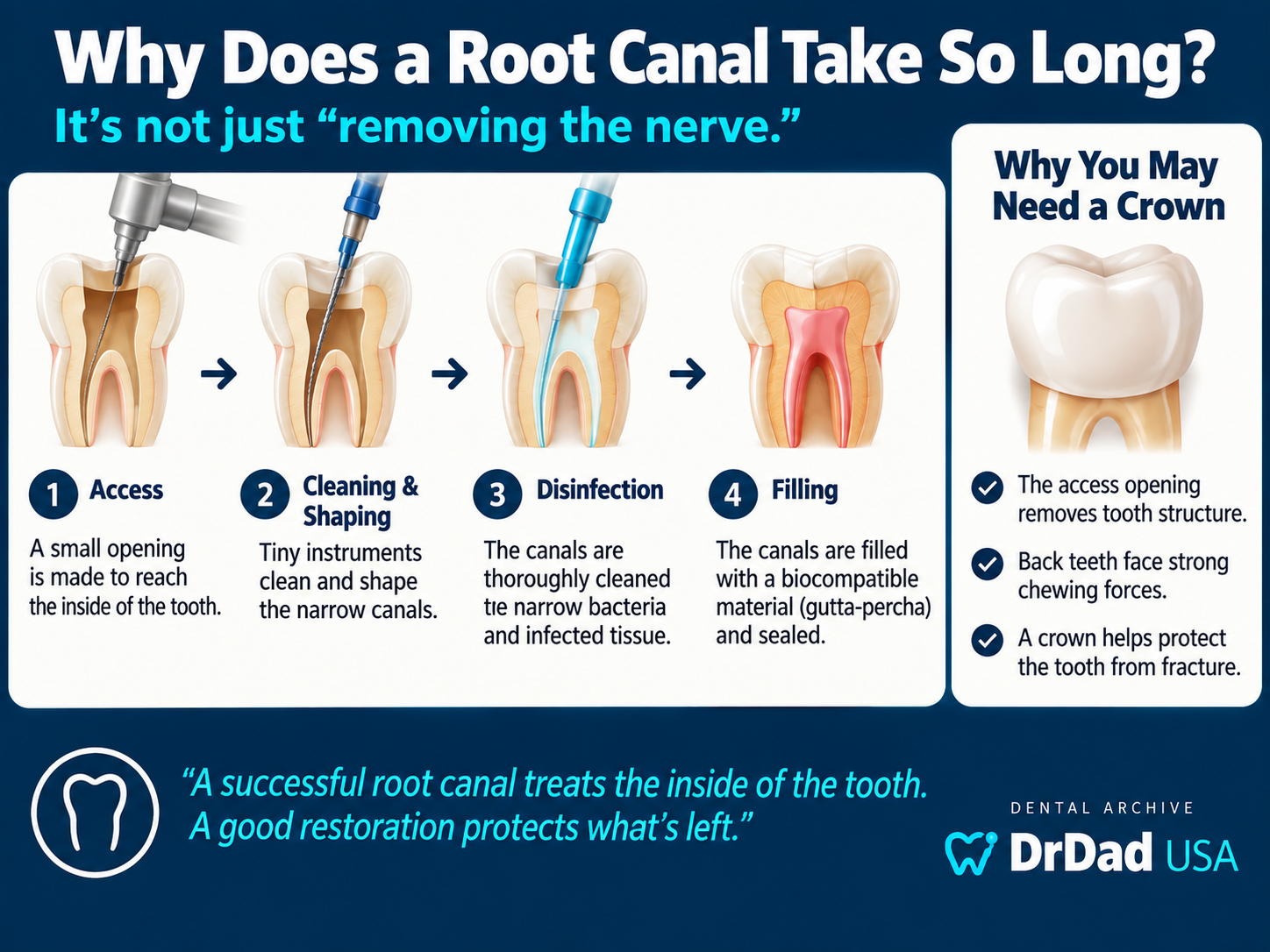
Molars often have multiple narrow, curved canals, requiring more time to clean, shape, disinfect, and seal. A dentist may use gutta-percha to fill the prepared canals. Complex anatomy and specialist care can increase the fee.
Is Saving the Tooth Worth It?
A 2022 review found root canal success rates of 82.0% under strict radiographic criteria and 92.6% under looser criteria; individual results vary. Tooth fractures, remaining structure, gum support, infection, and the quality of the final restoration all affect prognosis.
Remember the Crown Cost
A crown may add about $1,100–$2,000. A molar root canal plus crown could therefore total roughly $1,990–$3,500 before other procedures or insurance. Not every treated tooth needs a crown, but structurally weakened back teeth often need protection.
Root Canal or Extraction?
Extraction may cost less initially, but replacing the tooth with an implant or bridge can change the total significantly. Ask your dentist to show the X-ray, explain whether the tooth is restorable, and provide a complete estimate including the final restoration. Insurance benefits, waiting periods, deductibles, and annual maximums vary.
DrDad Tips
Root canal treatment is a long-established procedure, and modern evidence supports good outcomes in appropriately selected teeth. But I would not make the decision from a success-rate headline or a price tag alone.
Ask your dentist to show you why the tooth needs treatment. Look at the X-ray together. Ask about the diagnosis, whether the tooth is restorable, its individual prognosis, whether a crown is likely to be needed, and what happens if you choose extraction instead.
Do not remove a reasonably saveable tooth solely because extraction looks cheaper today. At the same time, do not spend heavily trying to save a tooth with a hopeless prognosis.
Save the tooth when the tooth is worth saving.
Disclaimer
This article reflects my professional experience and perspective as a practicing dentist and is provided for general educational and informational purposes only. It is not individualized dental or medical advice and does not establish a dentist-patient or doctor-patient relationship.
Root canal success, tooth survival, treatment cost, insurance coverage, the need for a crown, and whether a tooth can or should be saved depend on individual clinical circumstances. Factors may include the diagnosis, remaining tooth structure, fractures, decay, periodontal condition, infection, canal anatomy, previous treatment, bite, restorative options, medical and dental history, and other findings that cannot be assessed through a general article.
The cost figures in this article are broad U.S. reference ranges and are not treatment quotes. Actual fees and insurance benefits vary by provider, geographic area, treatment complexity, network status, deductible, annual maximum, and individual insurance plan.
Please consult your treating dentist or an appropriately qualified endodontist for an examination, diagnosis, prognosis, treatment options, and individualized cost estimate.
References
- Burns LE, Kim J, Wu Y, Alzwaideh R, McGowan R, Sigurdsson A. “Outcomes of primary root canal therapy: An updated systematic review of longitudinal clinical studies published between 2003 and 2020.” International Endodontic Journal. 2022;55(7):714–731. DOI: 10.1111/iej.13736. Used for pooled primary root canal treatment success estimates.
- “The tooth survival of non-surgical root-filled posterior teeth and the associated prognostic tooth-related factors: A systematic review and meta-analysis.” International Endodontic Journal. 2024. DOI: 10.1111/iej.14116. Used for pooled long-term survival estimates of root-filled posterior teeth.
- Delta Dental. “Root Canal Treatment Cost.” Used for broad U.S. consumer cost ranges and general insurance-cost context.
- American Association of Endodontists. “Root Canal Cost.” Used for the relationship between tooth location, treatment difficulty, and cost.
- American Association of Endodontists. “What Is a Root Canal?” and “Root Canal Explained.” Used for treatment steps, cleaning and shaping, gutta-percha, sealing, and post-treatment restoration guidance.
- Delta Dental. “Dental Crown Treatment Cost.” Used for broad consumer reference pricing for permanent crowns.