
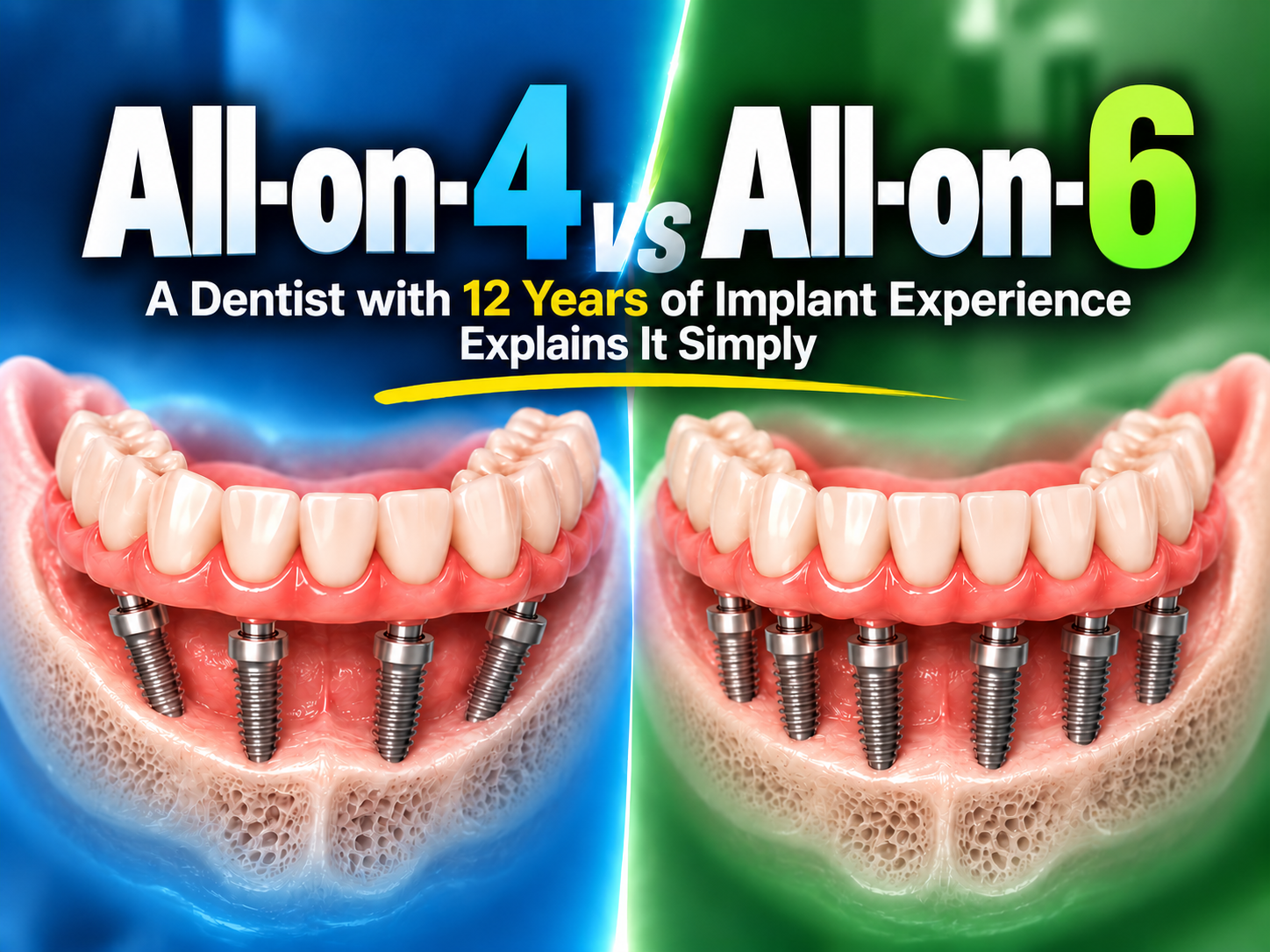
If you have lost most or all of your teeth, All-on-4 dental implants can sound almost too good to be true: four implants, a fixed set of teeth, fewer surgeries, and often a lower cost than treatments using more implants.
There is a reason All-on-4 has become popular. For the right patient, it can be a very useful treatment. But as a dentist, I would not automatically choose four implants simply because four implants can support a full arch of teeth.
There is an important difference between what is technically possible and what I believe is the better long-term choice for a particular patient. When a patient has enough healthy bone to support six or more dental implants, I generally prefer having more implant support rather than relying on only four.
What Are All-on-4 Dental Implants?
All-on-4 is a treatment concept in which an entire arch of fixed replacement teeth is supported by four dental implants. Instead of placing an implant for every missing tooth, four strategically positioned implants support a fixed prosthesis containing multiple teeth.
For someone who has been wearing removable dentures for years, this can be life-changing. A fixed implant-supported restoration does not move around like a traditional denture. Patients may feel more confident eating, speaking, and smiling. But that does not mean four implants are automatically the ideal number for every patient.
Two Implants Can Support Several Teeth — But Biology Is Not a Straight Line
Dentistry often uses bridges in which a relatively small number of implants support multiple replacement teeth. For example, two dental implants may sometimes support a bridge replacing as many as four teeth, depending on implant position, bone quality, bite forces, prosthetic design, and other clinical factors.
But a full dental arch introduces a different mechanical problem. Human teeth are not arranged along a straight line. They form a curved, roughly U-shaped dental arch. Chewing forces occur in different directions and at different distances from the supporting implants. The farther the replacement teeth extend away from implant support, the greater the potential mechanical leverage on the prosthesis and implants.
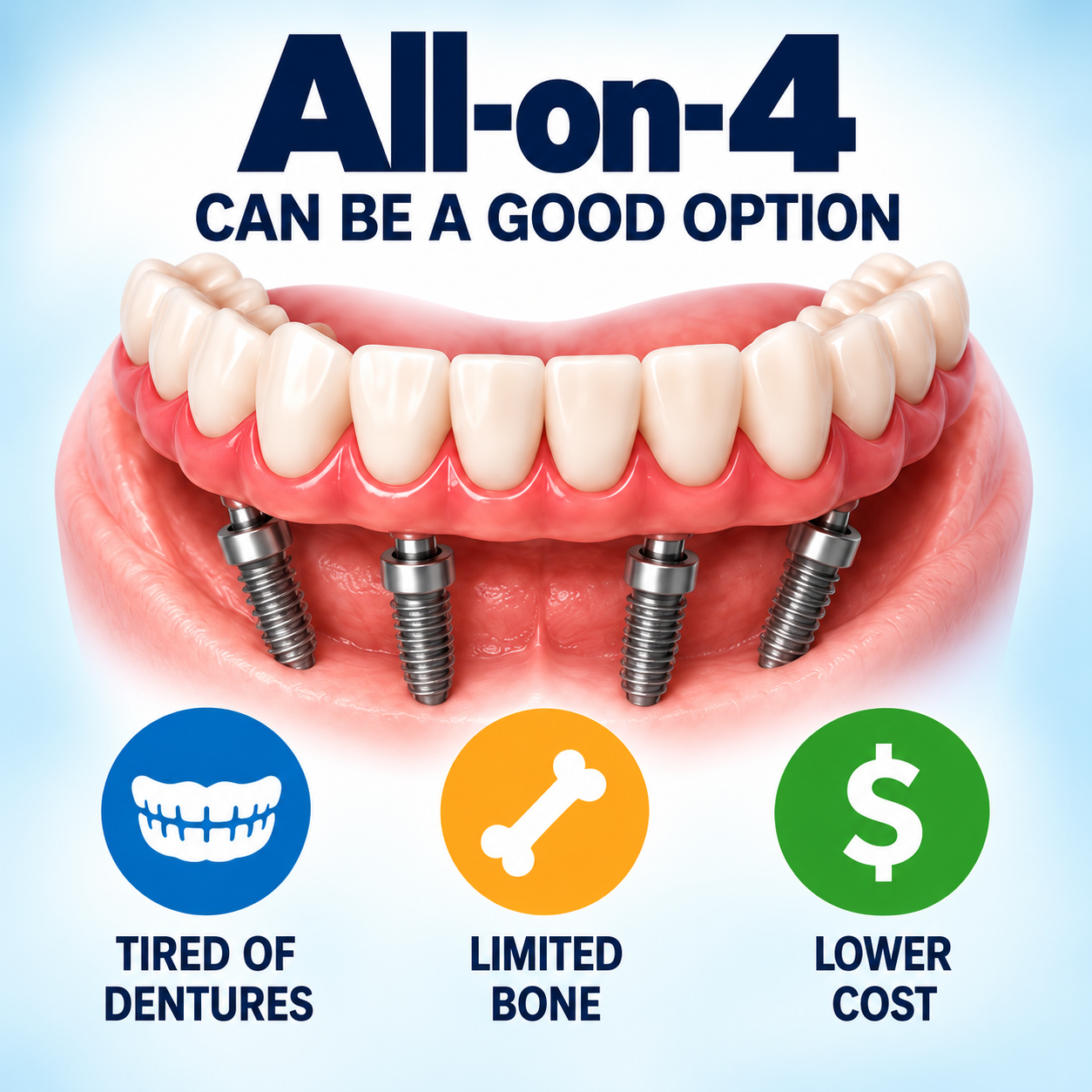
All-on-4 vs All-on-6: Why I Prefer More Support When Possible
Imagine supporting a large structure with four columns versus six. Both designs may work. But if the biological conditions allow additional well-positioned supports, distributing the forces across more implants can provide advantages.
With six dental implants, there may be more opportunities to distribute chewing forces throughout the arch and design the fixed bridge with favorable support. If an All-on-4 restoration depends on exactly four implants and one develops a serious problem, losing that implant can significantly complicate the entire prosthetic design.
That does not mean All-on-6 is always superior to All-on-4. More implants are not automatically better if there is insufficient bone, unfavorable anatomy, systemic health concerns, or other limitations. But when a patient has excellent bone and can predictably receive six or more implants, I personally would not choose four implants simply to reduce the initial treatment cost.
For me, dental implant longevity and long-term biomechanics matter more than minimizing the implant count.
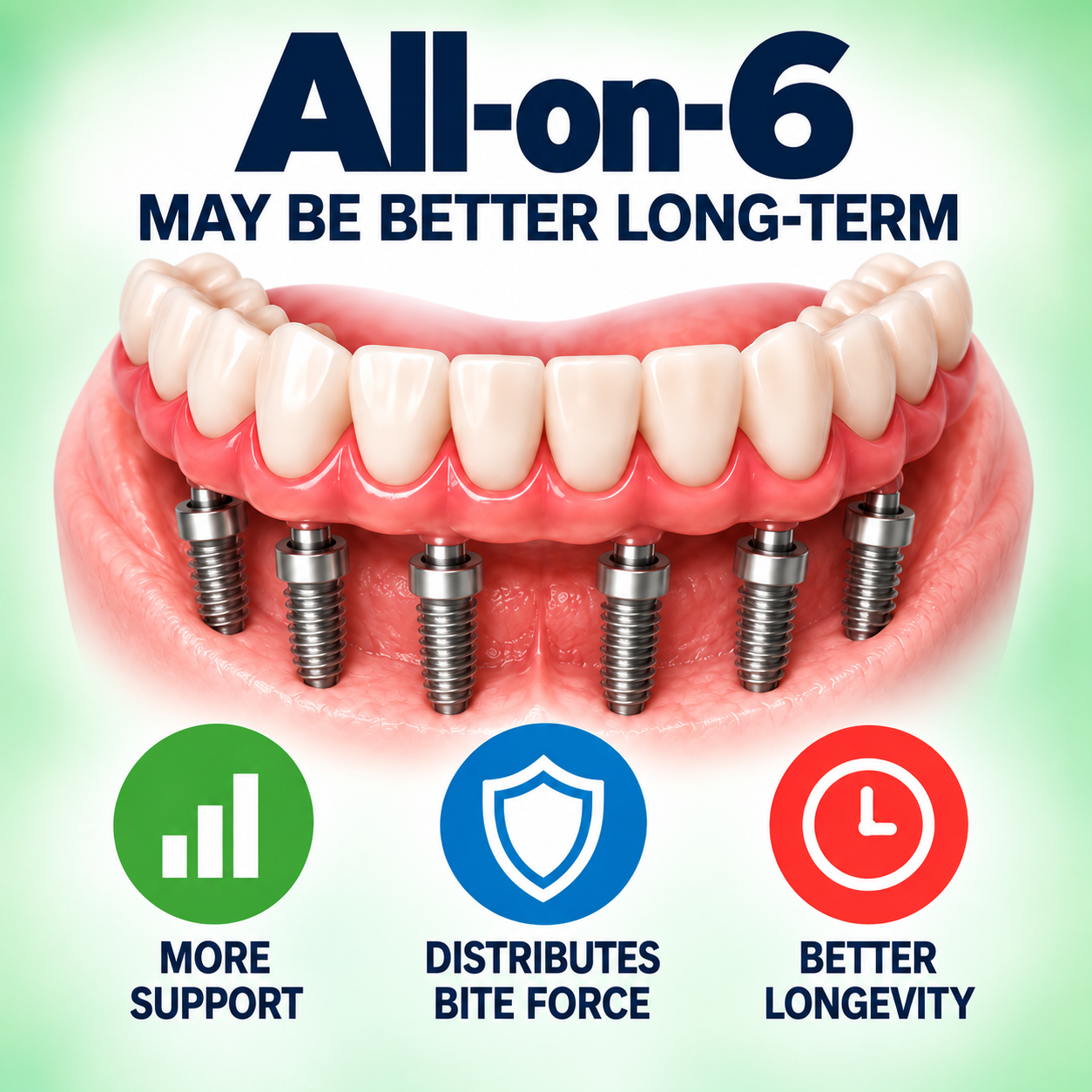
So Why Is All-on-4 So Popular?
One major reason is straightforward: cost. A treatment involving four implants can often cost less than one involving six or more implants.
There may also be situations where placing posterior implants is difficult because of bone loss or anatomical structures such as the maxillary sinus or the inferior alveolar nerve. The All-on-4 concept can sometimes use strategically angled implants to take advantage of the bone that remains and reduce the need for more extensive grafting.
The Patient for Whom I Would Seriously Consider All-on-4
Imagine someone who lost their teeth many years ago. Over time, the jawbone has resorbed significantly. They have worn traditional dentures for years and are tired of them moving when they eat or speak.
Their primary goal may simply be: “I don’t want removable dentures anymore. I want teeth that stay in my mouth.”
If the patient’s bone anatomy makes placement of six conventional implants difficult, but four implants can be predictably placed and support a fixed implant-supported bridge, All-on-4 may provide an enormous improvement in quality of life.
Who Would I NOT Recommend All-on-4 For?
If a patient has good bone volume, favorable anatomy, and can predictably receive six or more implants, I would hesitate to recommend All-on-4 simply because it is cheaper. Yes, the initial All-on-4 cost may be lower. But dental implant treatment should not be evaluated only by the bill you receive on the day of surgery.
You also have to think about what happens over the next 10, 15, or 20 years. Implants and their prosthetic components experience enormous numbers of chewing cycles over time. Patients who grind their teeth or have powerful bite forces can place even greater stress on the restoration.
How Much Does All-on-4 Cost?
The cost of All-on-4 dental implants in the U.S. varies substantially. The final price depends on geographic location, surgeon and restorative dentist, implant system, temporary restoration, final prosthetic material, extractions, bone grafting, sedation, and laboratory costs.
This is why advertisements promising one extremely low price for “full mouth dental implants” should be examined carefully. Ask what the advertised price actually includes and, most importantly, why four implants are the recommended treatment for you.
All-on-4 Risks You Should Understand
All-on-4 has many of the same potential complications as other dental implant treatments. Implants can fail to integrate with the bone. Infection and peri-implant disease can develop. Prosthetic screws or components can loosen or fracture. The fixed prosthesis itself can chip, wear, or require replacement.
Oral hygiene is also extremely important. “Fixed” does not mean maintenance-free. Patients still need to clean underneath the restoration and around the implants carefully and return for professional maintenance.
Smoking, uncontrolled diabetes, poor oral hygiene, severe bruxism, and certain medical conditions may also increase risk.
My View as a Dentist: Four Implants Are a Tool, Not a Goal
I do not think All-on-4 is a bad treatment. I think it is a specific treatment concept for specific situations.
For someone who has experienced severe bone loss after years without teeth and desperately wants to escape the limitations of removable dentures, four strategically placed implants supporting fixed teeth may be a very worthwhile treatment.
But if a patient has strong, healthy bone and can predictably accommodate six or more implants, I generally prefer the additional support. Yes, four implants may cost less initially. But if my priority is long-term function, force distribution, and longevity, I would not automatically reduce the treatment to four implants simply to make the initial price lower.
The best question is not: “Can four implants support my teeth?” They often can. The better question is: “Given my bone, bite, anatomy, age, and long-term goals, how many implants would give me the most predictable reconstruction?”
That is the conversation I would want to have before making a decision about All-on-4 vs All-on-6 dental implants.
This article is for general educational purposes and is not a substitute for an examination, imaging, diagnosis, or individualized treatment plan from your dentist or oral surgeon.