
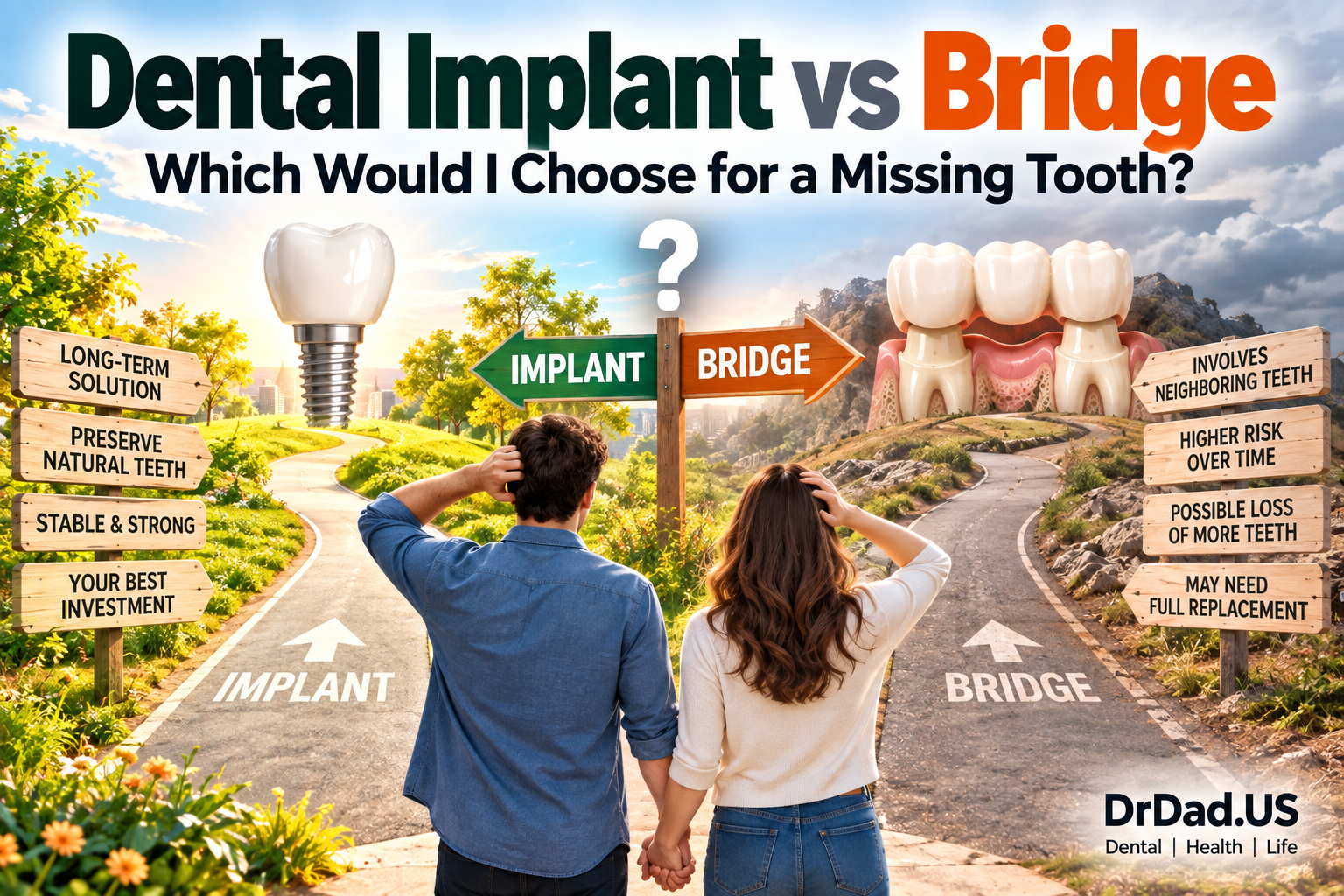
When a patient loses a tooth, one of the first questions is usually:
“Should I get a dental implant or a bridge?”
As a dentist, my answer depends heavily on where the missing tooth is located.
If I lost a back tooth and I were a good candidate for a dental implant, my decision would be easy.
For a missing posterior tooth, I would choose a dental implant.
For a front tooth, however, the decision can be different. A dental bridge can sometimes be a practical and long-lasting option, especially when the neighboring teeth already need crowns or when implant treatment is not ideal.
But in the back of the mouth, where chewing forces are much greater, I strongly prefer an implant.
And there is one major reason why.
Dental Implant vs Bridge: The Biggest Difference
Let’s imagine that you lose one back tooth.
With a dental implant, we replace that missing tooth independently. An implant fixture is placed into the jawbone, and eventually an implant crown is placed on top.
The teeth on either side don’t have to support the missing tooth.
A traditional dental bridge works differently.
To replace one missing tooth, the teeth on both sides of the space are prepared for crowns. Those two teeth become the abutment teeth, supporting the artificial tooth between them.
So instead of replacing one missing tooth independently, we connect three teeth together.
This is where my concern begins.
Three Teeth Were Doing the Work. Now Two Teeth Have to Do It.
Before the tooth was lost, there were three teeth sharing the chewing forces in that area.
After one tooth disappears, a bridge doesn’t bring that root back.
Instead, the two remaining supporting teeth are now being asked to support the replacement tooth as well.
In other words:
Three teeth used to do the work. Now two teeth are being asked to support the work of three.
In the posterior region, that matters.
Back teeth experience significant chewing forces and occlusal loading every day. Over many years, the supporting teeth of a bridge can develop problems.
That doesn’t mean every dental bridge will fail. Some bridges function successfully for many years.
But when a posterior bridge does fail, the consequences can sometimes be much bigger than simply replacing the bridge.
You Can Start With One Missing Tooth and End Up With Three
This is the part I really want patients to understand when comparing a dental implant vs bridge.
Imagine you originally have only one missing tooth.
The two teeth beside it are still healthy.
To make a three-unit dental bridge, those neighboring teeth have to become the supporting teeth.
Now imagine that years later one of those abutment teeth develops a serious problem.
It might develop decay underneath the crown. It might fracture. It might develop periodontal problems. The supporting structure may deteriorate, or the tooth may eventually become non-restorable.
Once a supporting tooth is lost, the entire bridge can be compromised.
And if both supporting teeth eventually fail, you can go from this:
One missing tooth.
To this:
Three missing teeth.
Now the patient who might originally have needed one dental implant may be facing a much larger reconstruction involving multiple implants.
That possibility is one of the biggest reasons I don’t like using a traditional bridge to replace a posterior tooth when implant treatment is a good option.
Why I Prefer a Dental Implant for a Missing Back Tooth
A dental implant has an important advantage:
It stands on its own.
I don’t have to cut down two healthy neighboring teeth to replace the tooth in the middle.
I don’t have to ask those two teeth to carry the missing tooth.
And if the implant crown eventually wears, fractures, or needs replacement, that does not automatically mean the implant fixture itself has failed.
The implant fixture and the implant crown are different components.
If the implant remains healthy and integrated with the bone, there are situations where the crown can be repaired or replaced while the implant remains in place.
Of course, dental implants can fail too.
There is no dental treatment that lasts forever for every patient.
Implant success depends on bone, periodontal health, oral hygiene, smoking, systemic health, bite forces, treatment planning, implant position, and long-term maintenance.
But if I personally lost a posterior tooth and had adequate bone and no medical reason preventing implant treatment, I would choose the dental implant over a bridge.
What About a Bridge for a Front Tooth?
This is where my answer changes.
A front tooth bridge can make more sense in selected situations.
The anterior teeth are not normally subjected to the same heavy chewing forces as posterior molars. If the bite is favorable and the patient uses the teeth appropriately, a well-designed anterior bridge can function for a very long time.
There is also a practical advantage.
If a front tooth has to be extracted, there are situations where the neighboring teeth can be prepared and a bridge can provide a relatively fast esthetic replacement.
That can be important when the missing tooth is visible every time the patient smiles.
I have seen anterior bridges last many years when the conditions are right.
But the fundamental disadvantage remains.
The teeth are connected.
If one supporting tooth develops a serious problem later, we may have to remove or replace the entire bridge.
So even in the front, I don’t consider a bridge automatically better than an implant.
I simply think the implant vs bridge decision is different for a front tooth than it is for a back tooth.
Dental Implant Cost vs Dental Bridge Cost
Patients also understandably compare dental implant cost vs dental bridge cost.
Sometimes a dental bridge may appear less expensive or faster initially.
But I don’t think patients should compare only today’s price.
Ask what happens to the neighboring teeth.
Ask what happens if one supporting tooth fails.
Ask how difficult the restoration will be to replace.
And ask what treatment might be required 10 or 20 years from now.
The cheapest treatment today isn’t necessarily the least expensive treatment over your lifetime.
That’s why, when considering the cost of replacing a missing tooth, I look beyond the initial treatment estimate.
How Long Do Dental Bridges Last Compared With Dental Implants?
Patients often search:
“How long do dental bridges last?”
They also ask:
“How long do dental implants last?”
Both can last many years.
But I don’t think lifespan should be reduced to a single number.
A bridge depends on the bridge and the supporting natural teeth.
An implant restoration has different components: the implant fixture in the bone and the crown above it.
Those are fundamentally different situations.
That’s why I care less about promising a patient an exact number of years and more about understanding what happens when something eventually needs repair.
So, Implant or Bridge? What Would I Choose?
If you ask me personally:
Posterior tooth? Dental implant.
If I lost a back tooth tomorrow and I were a good implant candidate, I would replace it with an implant.
I would rather replace the missing tooth independently than prepare two healthy neighboring teeth and ask them to support a three-unit bridge under posterior chewing forces.
Because the situation I want to avoid is simple:
You start with one missing tooth.
Years later, the supporting teeth fail.
Now you have three missing teeth.
And instead of discussing one implant, we may be discussing multiple implants and a much larger reconstruction.
For an anterior tooth, I would consider the situation differently. A dental bridge can still be a reasonable option in the right patient, particularly when the neighboring teeth already need restoration or when there are reasons not to place an implant.
But for a missing back tooth?
If the bone, health, and clinical conditions are appropriate, I would choose the implant.
That’s not because dental implants are perfect.
It’s because I want to replace the tooth that is missing without unnecessarily involving the healthy teeth that are still there.
And in my opinion, preserving those remaining natural teeth is one of the most important parts of deciding between a dental implant vs bridge.
This article is for general educational purposes only. The appropriate treatment for a missing tooth depends on your individual anatomy, bite, bone, periodontal health, neighboring teeth, medical history, and other clinical factors. A dentist who has examined you and reviewed the appropriate imaging can determine which options are appropriate for you.