
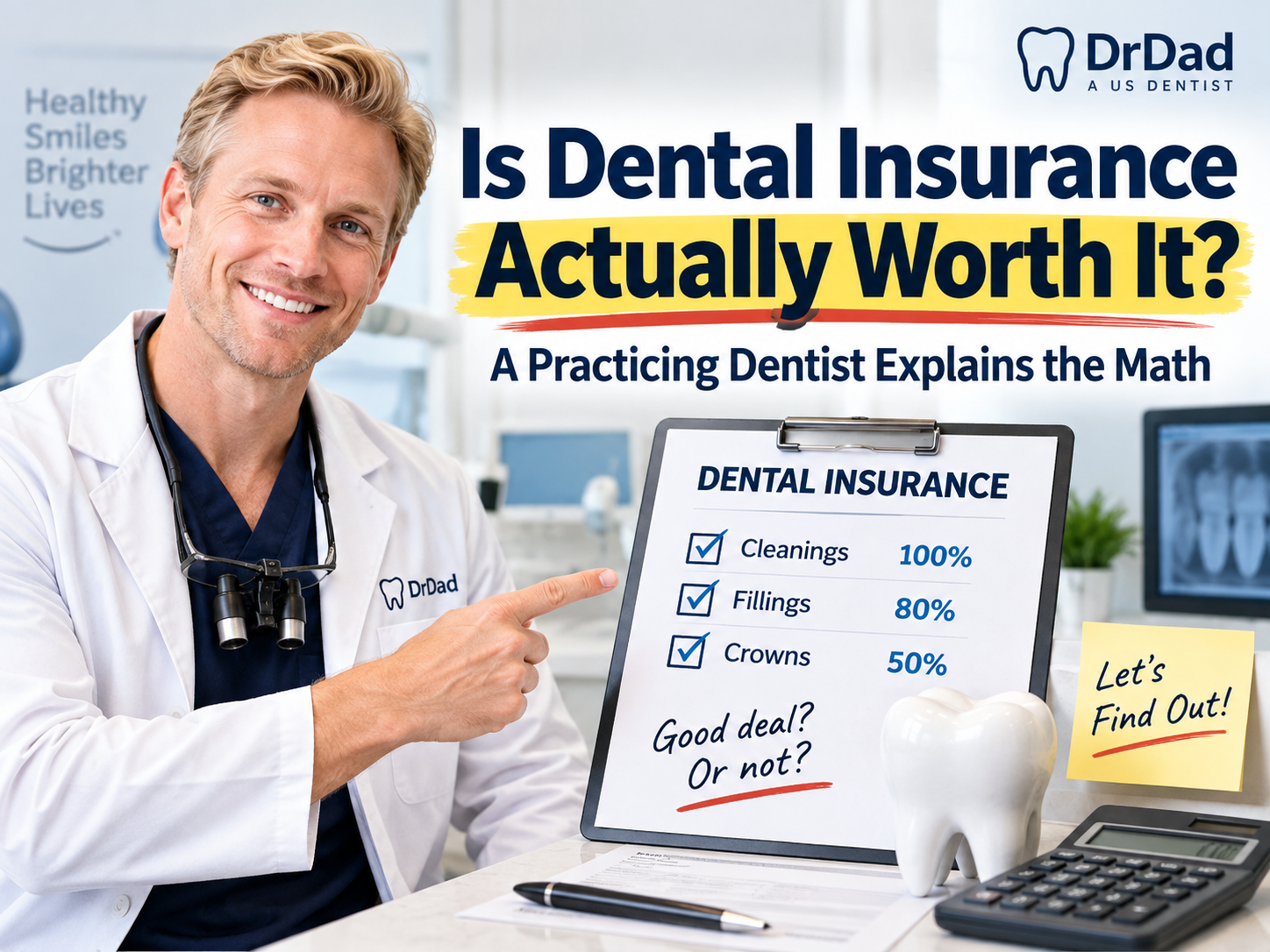
If you have ever looked at a dental insurance plan and thought, “Cleanings are covered, fillings are 80%, and crowns are 50%—this must be a good deal,” you are not alone.
But there is a more useful question: After I pay premiums for an entire year, how much money will dental insurance actually save me?
As a practicing dentist in my own dental office, I see this question from both sides. Some patients get significant value from dental benefits. Others pay premiums year after year and use relatively little of what they are paying for.
The Short Answer: Is Dental Insurance Worth It?
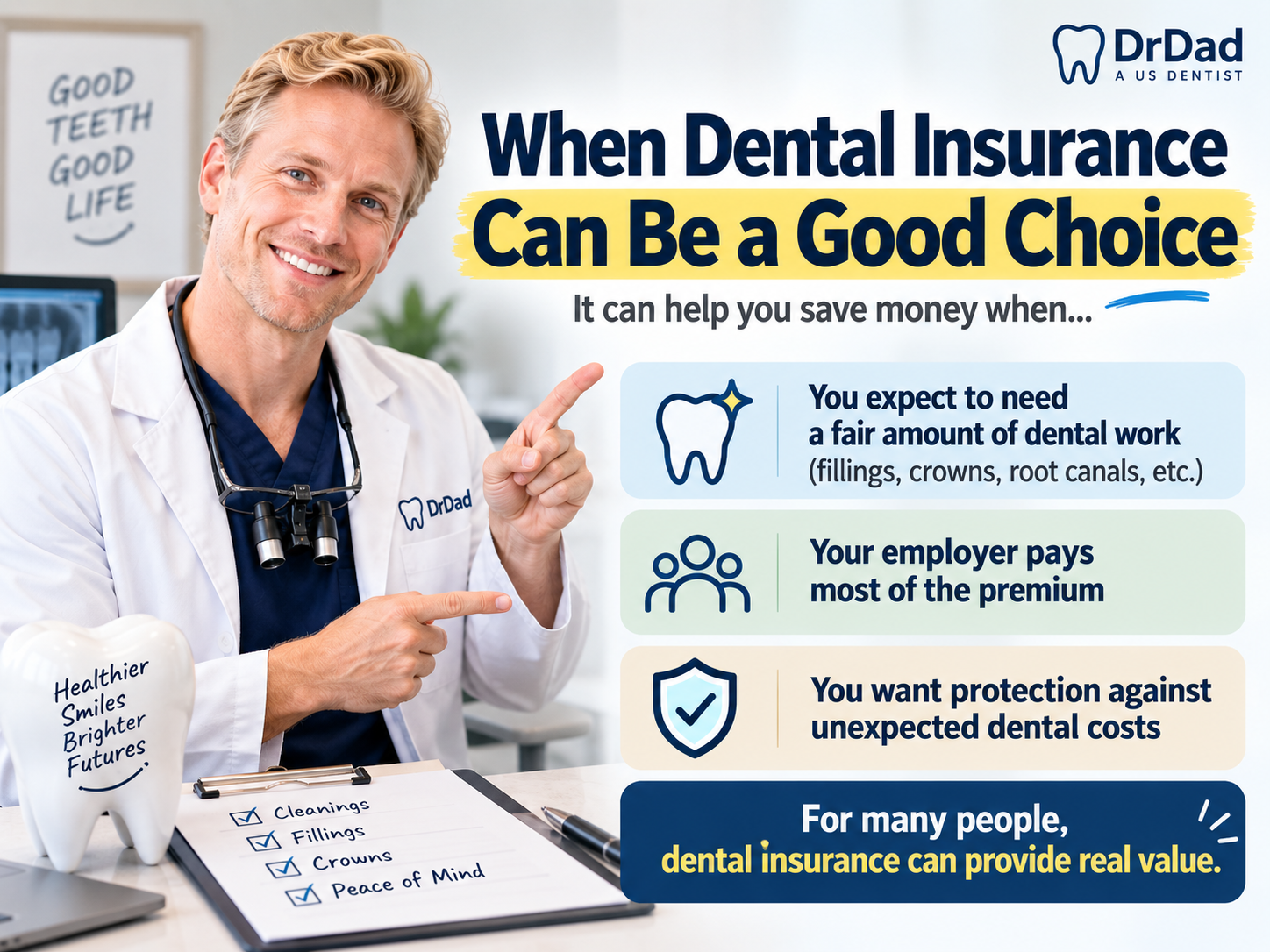
If you expect to need a fair amount of covered dental work, dental insurance can be a very good choice.
If you rarely need dental work beyond exams and cleanings, insurance can still be useful—especially when your employer pays most of the premium. But if you are buying an individual plan yourself and paying a substantial monthly premium, there may be years when paying directly for routine care is competitive with, or even less than, your total insurance cost.
So don’t ask only, “Do I have dental insurance?” Ask: “How much am I paying for it, and how much is it realistically likely to pay for me?”
Why Dental Insurance Is Different From Medical Insurance
Many dental plans have an annual maximum—the maximum amount the plan will pay toward covered treatment during a benefit year. The American Dental Association (ADA) uses a typical Preferred Provider Organization (PPO) example with 100% preventive and diagnostic coverage, a $50 deductible, 80% basic restorative coverage, 50% major restorative coverage, and a $1,500 annual maximum. That is an illustration, not a universal plan.
Once the plan has paid its annual maximum, additional expenses may become the patient’s responsibility for the rest of the benefit year.
The Four Numbers That Actually Matter
When someone shows me a dental plan, I look at four numbers together: premium, deductible, coverage percentage, and annual maximum.
For illustration, imagine a plan costing $40 per month ($480 per year), with a $50 deductible, preventive care at 100%, basic services at 80%, major services at 50%, and a $1,500 annual maximum. Your actual plan may be very different.
Let’s Do the Math: Three Patients, Three Very Different Years
Patient A: Healthy Teeth, Mostly Cleanings and Exams
Imagine a patient who receives two exams, two cleanings, routine X-rays when appropriate, and needs no fillings, crowns, or root canals. Suppose those preventive services would cost $450 if paid directly.
The hypothetical plan costs $480 per year in premiums. In this simplified example, the cash cost is $450 versus $480 in premiums. Insurance may still provide protection against unexpected covered needs, but if the patient is paying the entire premium personally, this is a calculation worth understanding. If an employer pays most of the premium, the equation changes substantially.
Patient B: Cleanings Plus a Filling
Now add a covered filling. The insurer begins contributing beyond routine preventive care. The patient still has premiums, a possible deductible, and coinsurance, but additional covered treatment can shift the math in favor of having insurance.
The more covered dental treatment you actually need, the more opportunity there is for benefits to exceed the premium you paid—up to the plan’s limits.
Patient C: Root Canal + Crown
Now imagine a restorable molar that requires root canal treatment followed by a crown. The patient sees “root canal: covered” and “crown: 50%.” That sounds reassuring, but the percentage alone does not tell you the final dollar benefit.
“My Crown Is Covered at 50%.” Why Am I Paying So Much?
Suppose the dental office’s crown fee is $1,600, and the patient sees a 50% major-service benefit. It is understandable for the patient to expect something close to an $800 insurance benefit.
But actual payment depends on the specific plan. Depending on the policy and network arrangement, the percentage may apply to a plan-defined allowed or maximum allowable fee rather than simply the dentist’s full billed charge. Deductibles, remaining annual maximums, network status, frequency limits, clinical requirements, exclusions, and other plan provisions can also change the final benefit.
The key point is that “50% covered” does not by itself tell you exactly how many dollars the insurer will ultimately pay.
What If Insurance Doesn’t Pay as Expected?
Imagine the office submits the requested information, the patient receives an estimate, and proceeds with the crown. The treatment is completed. Then the claim goes through review. Additional X-rays, a clinical narrative, or other documentation may be requested. Sometimes the final benefit is lower than expected, or the claim is denied under the plan’s terms.
For a patient, that can feel like a financial bolt out of the blue. The crown is already in your mouth, the dental office still has to be paid, and suddenly you may owe substantially more than expected.
A Pretreatment Estimate Is Not the Same as a Guarantee
MetLife recommends a pretreatment estimate for expected treatment costs over $300 and explains that actual benefit payments can vary because of annual maximums, deductibles, frequency limits, and other plan provisions. Delta Dental of Washington similarly recommends pretreatment estimates for larger treatments and states that an estimate is not a guarantee of payment.
An estimate is still an estimate.
What I Have Seen Practicing in My Own Dental Office
This is not a statistical comparison of insurance companies. It is what I have personally encountered while practicing in my own dental office.
Over nearly 10 years, I can remember only one or two situations involving Delta Dental where I encountered the type of unexpected claim or coverage problem that left my office and the patient seriously frustrated.
My personal experience with MetLife has been different. In my office, I have encountered claim delays, requests for additional documentation, and unexpected claim-payment problems with MetLife more frequently.
That does not mean Delta Dental always pays claims, and it does not mean MetLife will deny yours. It also does not establish a statistical difference in denial rates. Plans, employers, states, networks, procedures, documentation, annual maximums, exclusions, clinical circumstances, and contract provisions vary.
I also cannot say those contractual provisions caused the differences I have personally experienced. But my experience has taught me something important: two dental plans that look similar on a benefits sheet may not necessarily feel the same when a real claim has to be processed.
To Be Fair, There Are Public Complaints About Both Companies
Public consumer complaints exist involving both MetLife and Delta Dental, including disputes involving crown coverage, documentation, and claim processing. These reports can provide context, but consumer complaints are anecdotes, not insurer-wide denial-rate statistics. They should not be treated as proof that a particular company will or will not pay a specific claim.
Insurers may also have legitimate plan-based reasons for paying less than expected or requesting more information, including deductibles, annual maximums, frequency restrictions, eligibility, network status, alternative benefits, missing clinical documentation, or other contract provisions.
When Dental Insurance May Be Worth It—and When Paying Cash May Compete
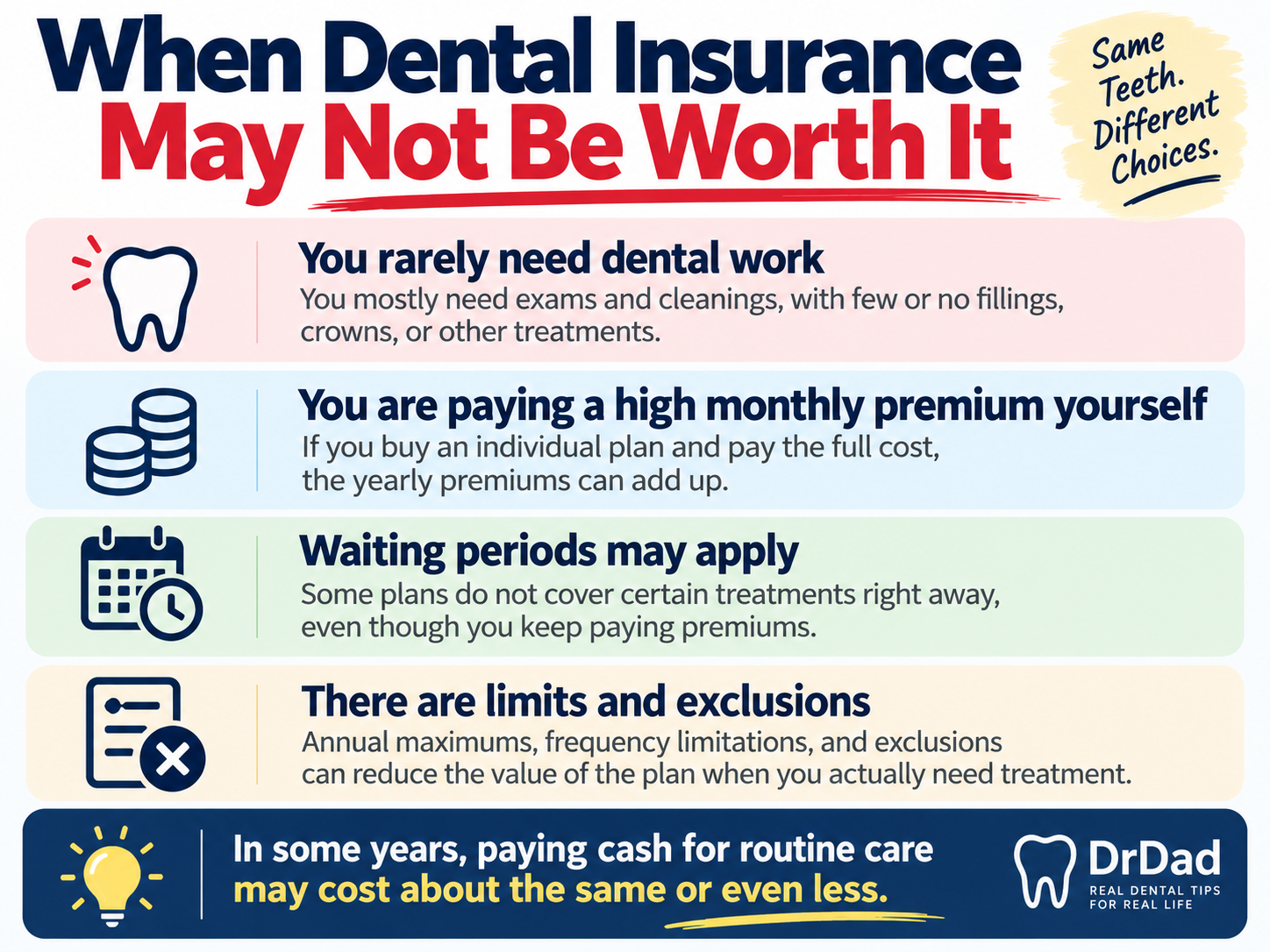
Dental insurance can be particularly valuable when you expect covered dental work, your employer pays a significant share of the premium, your dentist participates in the network, and the plan’s deductible, annual maximum, exclusions, and waiting periods make sense for your expected needs.
Now consider the opposite patient: healthy teeth, excellent oral hygiene, little restorative history, mostly exams and cleanings, no employer contribution, and a substantial individual premium paid entirely out of pocket. That’s when I would actually do the math.
Compare an entire year against an entire year: 12 months of premiums + deductible + expected coinsurance versus what you would realistically spend without the insurance.
Don’t Forget the Waiting Period
You cannot necessarily discover that you need a crown today, buy insurance tomorrow, and expect a new policy to immediately cover it. HealthCare.gov notes that stand-alone adult dental plans can have waiting periods. Check the waiting period before buying the plan—not after you need the crown.
Employer Dental Insurance vs. Buying Your Own Plan
If your employer provides dental insurance and pays most of the premium, the benefit can be valuable even if you do not need much treatment that year. If you are buying an individual policy yourself, compare much more than the headline percentages.
Look at the monthly premium, annual maximum, deductible, network, waiting periods, applicable fee basis, frequency limits, replacement rules, pretreatment estimates, claim reviews, denials, and appeal process.
Seven Questions I Would Ask Before Buying Dental Insurance
- What will I actually pay in premiums for the entire year?
- What is my deductible?
- What is the annual maximum the insurance company will pay?
- What percentage does the plan pay for treatment I am realistically likely to need?
- Are there waiting periods, frequency limitations, exclusions, clinical requirements, or replacement rules?
- Is my dentist in-network, and what allowed or negotiated fees apply?
- How do pretreatment estimates, claim reviews, denials, and appeals work?
DrDad Tips
Dental insurance is not automatically a good deal or a bad deal. If you expect substantial covered dental work, a good dental plan can be very valuable.
If you need very little dental work and your employer pays most of the premium, insurance can still make sense. But if you rarely need treatment and personally pay a substantial individual premium, run the numbers.
Don’t judge a plan by one attractive percentage. Look at the premium, deductible, applicable fee basis, annual maximum, waiting periods, exclusions, network, clinical requirements, and claim process together.
The best dental insurance for you is the plan whose actual benefits make sense for your teeth, expected treatment, and budget—not simply the plan with the prettiest percentages.
Medical & Dental Disclaimer
This article is for general educational purposes only and does not constitute individualized medical or dental advice, diagnosis, or treatment planning. It does not establish a dentist-patient relationship. Dental conditions and treatment needs vary by individual. Discuss your specific oral health and treatment options with your treating dentist.
Financial & Insurance Disclaimer
This article is for general educational purposes only and is not individualized financial, insurance, tax, or legal advice. Dental insurance benefits vary significantly by insurer, employer, state, network, and individual policy. Premiums, deductibles, annual maximums, waiting periods, exclusions, frequency limitations, allowed amounts, pretreatment estimates, claim decisions, and appeals can differ. Review your actual plan documents and verify benefits directly with your insurer before making financial or treatment decisions.
The author’s descriptions of insurance claim experiences are personal observations from practicing in his own dental office and are not a statistical analysis of insurer performance or denial rates.
References
- American Dental Association. Dental Insurance 101: PPO Plan Basics. https://www.ada.org/-/media/project/ada-organization/ada/ada-org/files/resources/practice/dental-insurance/ada_dental_insurance_101_ppo_plan_basics.pdf
- American Dental Association. Typical Dental Plan Benefits and Limitations. https://www.ada.org/resources/practice/dental-insurance/typical-dental-plan-benefits-and-limitations
- HealthCare.gov. Dental Coverage in the Health Insurance Marketplace. https://www.healthcare.gov/coverage/dental-coverage/
- MetLife. Group Dental Insurance. https://www.metlife.com/insurance/dental-insurance/group-dental/
- Delta Dental of Washington. Patient FAQs. https://www2.deltadentalwa.com/guest/public/patient-faqs
- Delta Dental of Washington. Individual & Family Resources FAQ. https://www.deltadentalwa.com/Individual-family-resources/faq
- Better Business Bureau. MetLife Consumer Reviews. https://www.bbb.org/us/ny/new-york/profile/insurance-companies/metlife-inc-0121-345/customer-reviews
- Better Business Bureau. Delta Dental of Washington Complaints. https://www.bbb.org/us/wa/seattle/profile/dental-plans/delta-dental-of-washington-1296-27026440/complaints