

Mortgage rates are high. Does that automatically mean you should keep renting?
Not necessarily. But before you sign a 30-year mortgage, you should understand what your monthly payment is actually buying.
DrDad Key Takeaways
- A mortgage payment is not the same thing as building equity.
- Early in a 30-year mortgage, a large share of principal-and-interest payments can go toward interest.
- Higher mortgage rates make the cost of borrowing especially important.
- Renting is not automatically “throwing money away,” and buying is not automatically “building wealth.”
- How long you realistically expect to stay in the home can matter enormously.
- Refinancing later may help, but it cannot refund interest you already paid.
- There is no free lunch. And there is no free loan.
I Got Ripped Off by Interest
I got ripped off.
Not because somebody cheated me. Not because a bank committed fraud. And not because there was anything hidden in the contract.
I got ripped off because I didn’t understand what I was really paying for.
When I was younger and had just started making real money, I wanted the coolest car in town. So I bought one.
The problem? There wasn’t just one cool car.
There was another one. And then another one. The car that looked incredible when I bought it eventually became an older model. That’s normal.
But instead of keeping the car, I would finance one, drive it for two or three years, trade it in, and start another loan. Then I would do it again.
At the time, I thought I understood what I was doing. I could afford the payment. I was making good money. The payment came out every month. What’s the problem?
Years later, I finally understood the trap.
I was making payments, but I wasn’t building ownership nearly as quickly as I thought.
With an amortizing loan, early payments generally contain a larger interest component. The principal balance declines slowly at first and faster later in the loan. Every time I traded a car after only a few years and financed another one, I started another borrowing cycle.
Don’t ask only, “Can I afford the payment?” Ask, “How long am I actually going to keep what I’m financing?”
A House Isn’t a Car. But Money Still Has a Price.
A house is not a car. Cars generally depreciate. A house may appreciate. A house gives you somewhere to live, can build equity, may provide stability, and can become a significant long-term asset.
But the financing taught me the same fundamental lesson: borrowed money has a price.
When a bank gives you hundreds of thousands of dollars for 30 years, that money isn’t free. Interest is the price of using borrowed money.
As of September 17, 2026, Freddie Mac reported an average U.S. 30-year fixed mortgage rate of 6.95%.
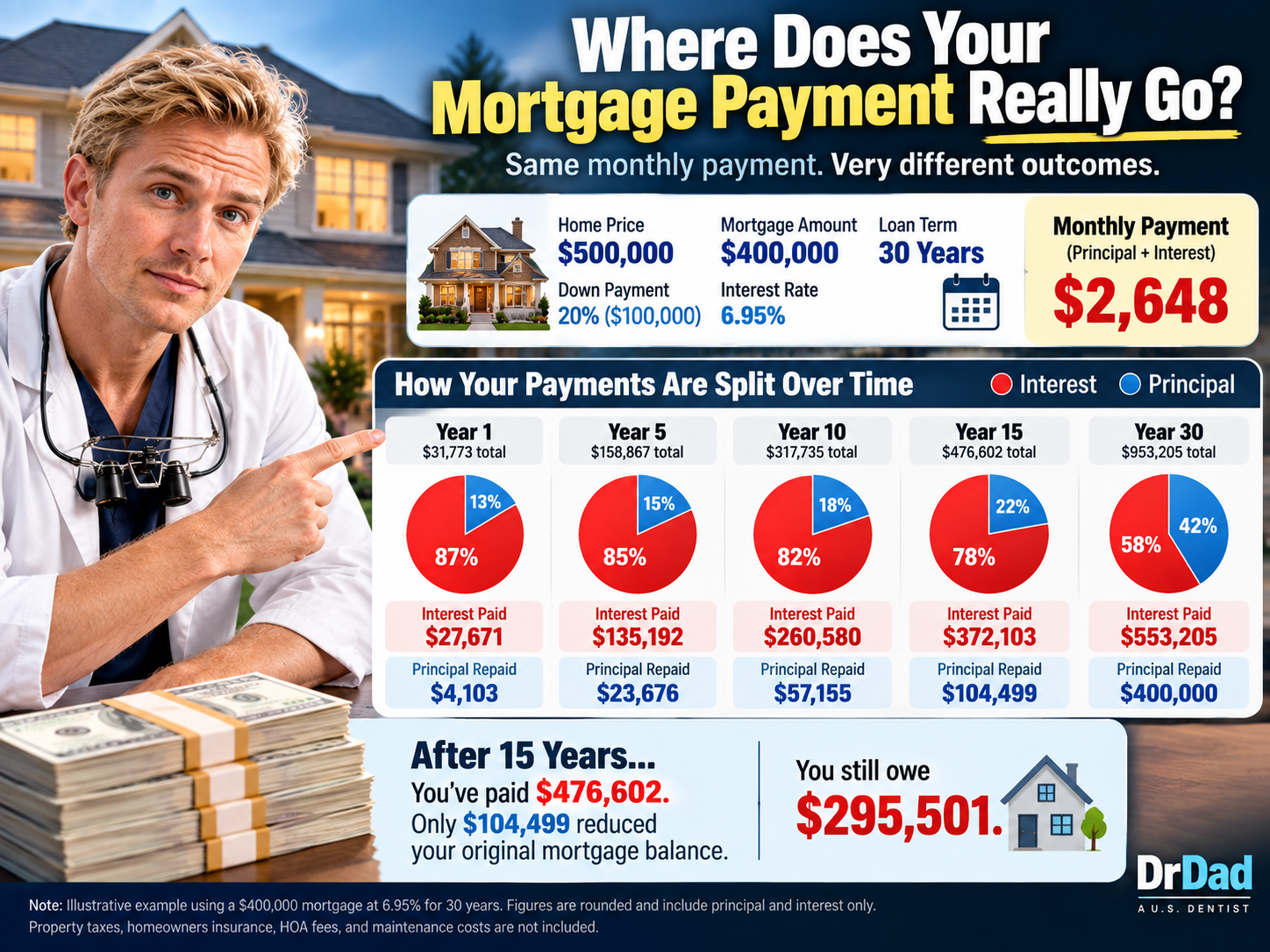
Where Does Your Mortgage Payment Actually Go?
Imagine a $500,000 home with 20% down. You borrow $400,000 on a 30-year fixed mortgage at 6.95%.
Your monthly principal-and-interest payment is approximately $2,648.
But that $2,648 does not all go toward buying more of your house. Part reduces principal. The rest is interest—the cost of borrowing the money.
| Time | Total P&I Paid | Principal Repaid | Interest Paid | Mortgage Still Owed |
|---|---|---|---|---|
| 1 year | ~$31,773 | ~$4,103 | ~$27,671 | ~$395,897 |
| 5 years | ~$158,867 | ~$23,676 | ~$135,192 | ~$376,324 |
| 10 years | ~$317,735 | ~$57,155 | ~$260,580 | ~$342,845 |
| 15 years | ~$476,602 | ~$104,499 | ~$372,103 | ~$295,501 |
| 20 years | ~$635,470 | ~$171,448 | ~$464,022 | ~$228,552 |
| 30 years | ~$953,205 | $400,000 | ~$553,205 | $0 |
Illustrative amortization calculation using a $400,000, 30-year fixed-rate mortgage at 6.95%, assuming scheduled payments. Figures are rounded and exclude taxes, insurance, HOA fees, maintenance and other costs.
Stop at year 15. You have made approximately $476,602 in principal-and-interest payments, yet reduced the original mortgage by only about $104,499. You still owe approximately $295,501.
You had a home to live in and may have gained equity through appreciation. But $476,602 of mortgage payments does not mean you purchased another $476,602 of the house.
Where Is Your Mortgage Payment Really Going?
Interactive DrDad Mortgage Calculator
“But Renting Is Throwing Money Away.”
I’ve heard this my entire adult life: “Why pay somebody else’s mortgage?”
I don’t think the math is that simple.
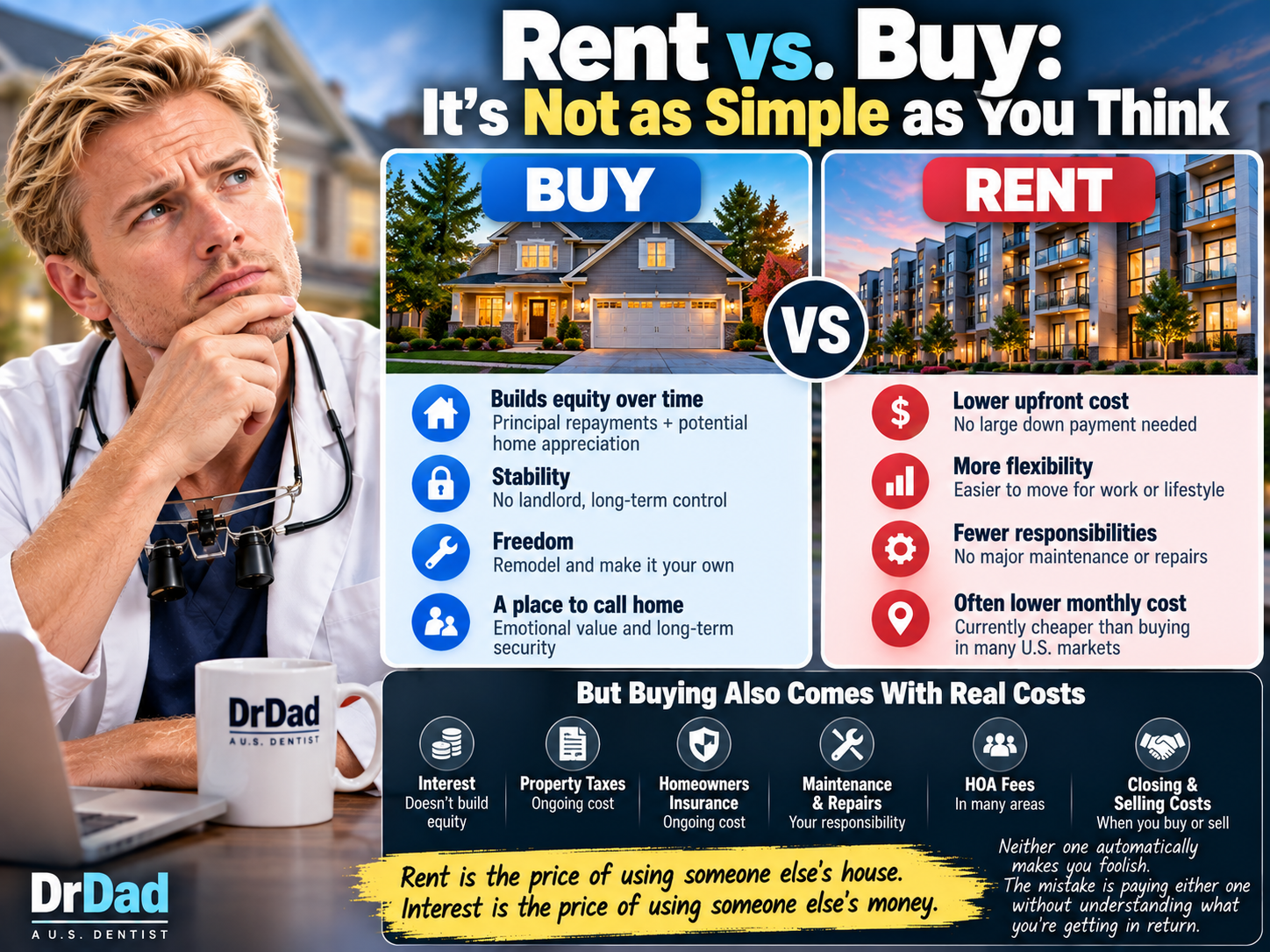
When you rent, your rent does not build ownership in the property. But when you buy, your interest doesn’t build equity either. Neither do property taxes, homeowners insurance, many maintenance expenses, HOA fees, or buying and selling costs.
Rent is the price of using someone else’s house.
Interest is the price of using someone else’s money.
Neither one automatically makes you foolish.
High Mortgage Rates Change the Math
Realtor.com’s July 2026 analysis found that renting a starter home was cheaper on a monthly basis than buying one in all 50 of the largest U.S. metropolitan areas under its methodology. The average difference was approximately $858 per month.
That does not mean renting automatically wins. Long-term ownership can build equity and home values can appreciate. Meanwhile, renters can potentially invest the money they did not use for a down payment or the monthly difference between renting and owning.
That is why a serious comparison needs another variable: time.
How Long Are You REALLY Going to Stay?
This is the question I wish somebody had forced me to ask when I was buying cars.
Not: Can I afford this month’s payment?
But: How long am I actually going to keep this thing?
Zillow’s June 2026 rent-versus-buy analysis estimated that under its assumptions, the typical U.S. buyer reached the financial break-even point versus renting after approximately six years. But the geographic variation was enormous.
There is no universal five-year rule or ten-year rule. The point is to run your own numbers.
My Personal Rule About Long-Term Loans
My experience made me conservative about taking out long loans for things I don’t expect to keep.
If I’m going to finance something for a long period, I want to be reasonably confident that I’ll keep it for a meaningful portion of that loan. That is my personal rule—not a financial law.
If you are fairly certain you are moving again in two years, that matters. If your career may move you across the country, that matters. If you are buying a starter home but already know you will need something much larger in three years, that matters.
“I’ll Just Refinance When Rates Go Down.”
Maybe. I have refinanced loans myself, and refinancing can absolutely be useful.
But I have learned not to build today’s financial decision around tomorrow’s hypothetical interest rate.
Rates might fall. They might not fall when you need them to. Refinancing may involve costs. And most importantly, refinancing does not give you back the interest you already paid.
A smaller monthly payment is not automatically a cheaper loan. Look at the new rate, the new term, closing costs, total interest, and how long you expect to keep the loan.
Renting Has a Catch, Too
Suppose renting saves you $1,000 every month compared with owning. Great. What are you doing with the $1,000?
If you spend all of it, you have not necessarily built wealth simply because renting was cheaper. But if you consistently invest the difference, the comparison becomes much more interesting.
The same is true of a down payment. Money placed into a house cannot simultaneously be invested somewhere else. That is an opportunity cost.
Owning a Home Has Something a Spreadsheet Can’t Measure
I like owning. There is something psychologically different about coming home and knowing: This is mine.
You can change things. You don’t need permission from a landlord. You don’t have to wonder whether your lease will be renewed. You can put down roots.
There is real value in that. Not every financial decision has to maximize the last dollar.
But there is an enormous difference between “I understand the cost and I’m willing to pay it” and “I didn’t realize what I was paying.”
Don’t Let the Monthly Payment Fool You
This may be the biggest lesson I learned.
A monthly payment tells you whether you can make the payment this month. It does not tell you the total cost of the decision.
Today I want to know: What is the interest rate? What is the term? What is the total cost? How quickly am I reducing principal? And how long am I realistically going to own this?
There Is No Free Lunch. And There Is No Free Loan.
Banks are not charities. That is not criticism. That is how lending works.
You want to use someone else’s money today instead of waiting until you have saved enough of your own. They charge you for it. That is interest.
I learned that lesson with cars. It cost me money. But I have not forgotten it.
So when somebody tells me, “You should buy a house. Renting is just throwing money away,” my first thought is not buy. My first thought is not rent.
My first thought is: Show me the numbers.
Frequently Asked Questions
Is renting better when mortgage rates are high?
Not automatically. Higher rates increase borrowing costs, but home prices, local rents, taxes, insurance, maintenance, transaction costs and your expected time in the home all affect the calculation.
Is renting just throwing money away?
Rent buys housing. It does not build home equity, but many costs of ownership—including mortgage interest, property taxes, insurance and some maintenance expenses—also do not directly build equity.
Does my entire mortgage payment build equity?
No. The principal portion reduces your balance. Interest does not. Your total housing payment may also include taxes, insurance and other costs.
Should I buy now and refinance when mortgage rates fall?
A future refinance may help if rates fall and the costs make sense, but future rates are not guaranteed. Understand whether today’s purchase works with today’s financing.
How long do I need to stay before buying makes sense?
There is no universal number. The answer varies with your market, financing, rent, home price, future appreciation, transaction costs and other assumptions.
DrDad Tips
When I was younger, I thought: If I can afford the payment, I can afford the thing.
I don’t think that way anymore.
- How long am I realistically going to keep this?
- How much of my early payments actually reduce principal?
- What is the total cost—not just the monthly payment?
- What else could I do with the money?
- Would I still make this decision if refinancing never became available?
Owning feels good. I understand that. But feeling like an owner and understanding the economics of ownership are two different things.
There is no free lunch. There is no free loan.
Know what you’re paying. Know how long you’re staying. And before signing your name to 30 years of payments: show yourself the numbers.
Disclosure
DrDad is a practicing U.S. dentist and business owner, not a mortgage broker, financial adviser, real-estate agent, tax professional, or attorney. Personal experiences discussed in this article—including experiences with auto financing and refinancing—are shared to illustrate general financial concepts and should not be interpreted as individualized financial advice or as a recommendation to buy, sell, rent, refinance, or invest.
References
- Freddie Mac — Primary Mortgage Market Survey
- Consumer Financial Protection Bureau — How Paying Down a Mortgage Works
- Consumer Financial Protection Bureau — Principal, Interest and Total Monthly Payment
- Consumer Financial Protection Bureau — Auto Loan Amortization
- Realtor.com Economic Research — July 2026 Rental Report
- Zillow — 2026 Rent vs. Buy Break-Even Analysis
Financial Disclaimer
This article and the DrDad mortgage calculator are provided for general educational and informational purposes only. They are not financial, investment, mortgage, real-estate, tax, accounting, or legal advice.
The calculator is an educational illustration of loan amortization and does not constitute a loan estimate, mortgage quote, underwriting decision, or prediction of future housing or investment performance. It may not include property taxes, homeowners insurance, private mortgage insurance, HOA fees, maintenance, repairs, closing costs, selling costs, tax consequences, adjustable rates, lender fees, points, prepayment terms, or other costs that may materially affect a real-world decision.
Before making a significant housing, mortgage, refinancing, investment, tax, or legal decision, consider discussing your individual circumstances with appropriately qualified professionals.