

I learned this one the painful way.
Years ago, I actually did something very responsible. I set aside money for my taxes about eight months early.
Why so early? Because I don’t like knowing that I have a big tax bill waiting for me. It makes me nervous. Yes, I know. Very exciting personality.
But then I had what seemed like a brilliant idea.
Why should this money just sit around doing nothing?
I wasn’t going to need it for months. Maybe I could put it in the stock market for a little while, make some money, and take it back out before the taxes were due.
And then another dangerous thought entered my head: Maybe I could double it.
Well… it didn’t double. It got cut roughly in half.
That was a very expensive lesson.
Since then, I’ve had a simple rule: Money I may actually need—especially emergency money—does not go into stocks.
My investments can take risks. My emergency fund cannot.
And that raises a much better question: If emergency money shouldn’t be invested in stocks, where should you keep it?
What Is an Emergency Fund Really For?
An emergency fund is money reserved for expenses you didn’t plan for: a major car repair, a broken furnace, an unexpected medical bill, a temporary loss of income—or, in my case, money that had a very specific job waiting for it.
The Consumer Financial Protection Bureau describes an emergency fund as a cash reserve set aside for unplanned expenses or financial emergencies. The practical goal is simple: keep it safe, accessible, and separate enough that you don’t casually spend it.
Your emergency fund has three jobs: stay safe, stay available, and earn something while it waits.
What Is a High-Yield Savings Account?
A High-Yield Savings Account (HYSA) is a savings account that pays a higher Annual Percentage Yield (APY) than many traditional savings accounts. You deposit cash, the bank pays interest, and you can generally access the money when you need it.
If the account is held at a Federal Deposit Insurance Corporation (FDIC)-insured bank, qualifying deposits receive FDIC protection within applicable limits. That combination makes an HYSA particularly useful for emergency savings.
You aren’t trying to turn $20,000 into $40,000. You’re trying to keep your $20,000 safe and accessible while earning a competitive return.
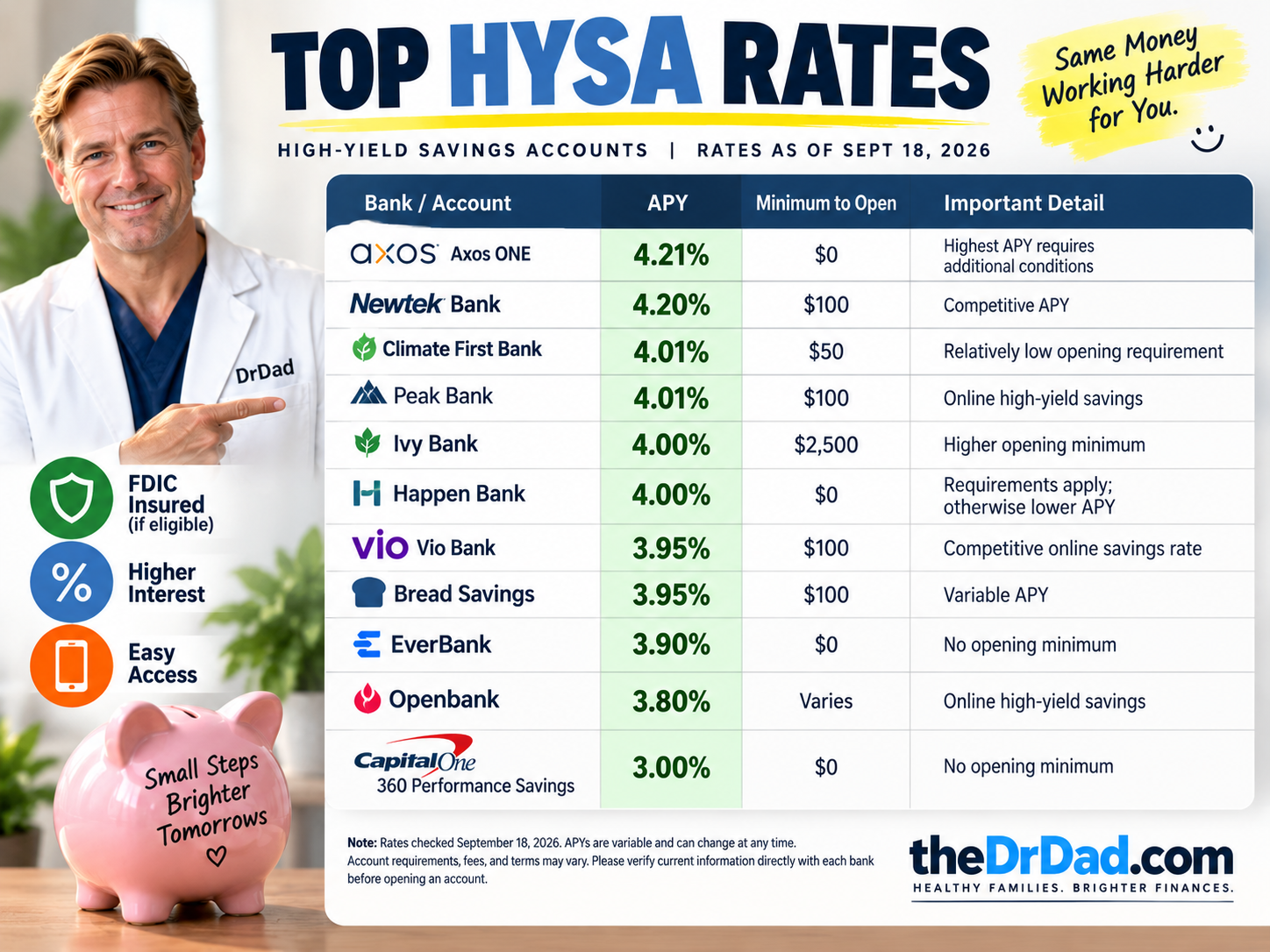
Current HYSA Rates
Rates checked September 18, 2026. APYs are variable and can change at any time. Always verify current rates and account requirements directly with the financial institution before opening an account.
| Bank / Account | APY | Minimum to Open | Important Detail |
|---|---|---|---|
| Axos ONE | Up to 4.21% | $0 | Highest APY requires additional conditions |
| Newtek Bank | 4.20% | $100 | Competitive APY |
| Climate First Bank | 4.01% | $50 | Relatively low opening requirement |
| Peak Bank | 4.01% | $100 | Online high-yield savings |
| Ivy Bank | 4.00% | $2,500 | Higher opening minimum |
| Happen Bank | Up to 4.00% | $0 | Requirements apply; otherwise lower APY |
| Vio Bank | 3.95% | $100 | Competitive online savings rate |
| Bread Savings | 3.95% | $100 | Variable APY |
| EverBank | 3.90% | $0 | No opening minimum |
| Openbank | 3.80% | Varies | Online high-yield savings |
| Capital One 360 Performance Savings | 3.00% | $0 | No opening minimum |
Don’t choose an emergency account just because one bank advertises the biggest number. The highest APY may require direct deposits, linked accounts, minimum balances, or other conditions. Sometimes a slightly lower APY with fewer hoops may make more sense.
What Should You Check Before Opening an HYSA?
- FDIC insurance: Understand who actually holds your deposit and whether it is insured.
- Monthly fees: Don’t let fees eat up the extra interest.
- Minimum balances: Check whether the advertised APY requires a certain balance.
- Rate conditions: Look for direct-deposit, linked-account, or monthly-deposit requirements.
- Transfer speed: If the furnace dies tomorrow, how quickly can you get the money?
- Ease of access: Remember why this money exists.
How Much Does a Higher APY Actually Matter?
Ignoring compounding differences for a simple illustration:
| Cash Balance | 3.00% | 4.00% | 4.21% |
|---|---|---|---|
| $10,000 | ~$300/year | ~$400/year | ~$421/year |
| $25,000 | ~$750/year | ~$1,000/year | ~$1,053/year |
| $50,000 | ~$1,500/year | ~$2,000/year | ~$2,105/year |
| $100,000 | ~$3,000/year | ~$4,000/year | ~$4,210/year |
On $10,000, the difference between 4.00% and 4.21% is only about $21 per year before compounding and taxes. I wouldn’t make emergency money difficult to access just to chase every last fraction of a percentage point.
But Wait—U.S. Treasuries May Pay More
As of September 18, 2026, the U.S. Treasury yield curve showed these market yields:
| U.S. Treasury Maturity | Yield |
|---|---|
| 3-Month | 4.14% |
| 6-Month | 4.24% |
| 1-Year | 4.44% |
| 5-Year | 4.93% |
| 10-Year | 5.01% |
These are Treasury market yields, not bank APYs, so they are not perfectly identical measurements. But the comparison raises an obvious question: If a 10-year Treasury yields around 5% while many HYSAs are around 4%, why wouldn’t I just put my emergency fund into Treasuries?
Because the highest number isn’t the whole story.
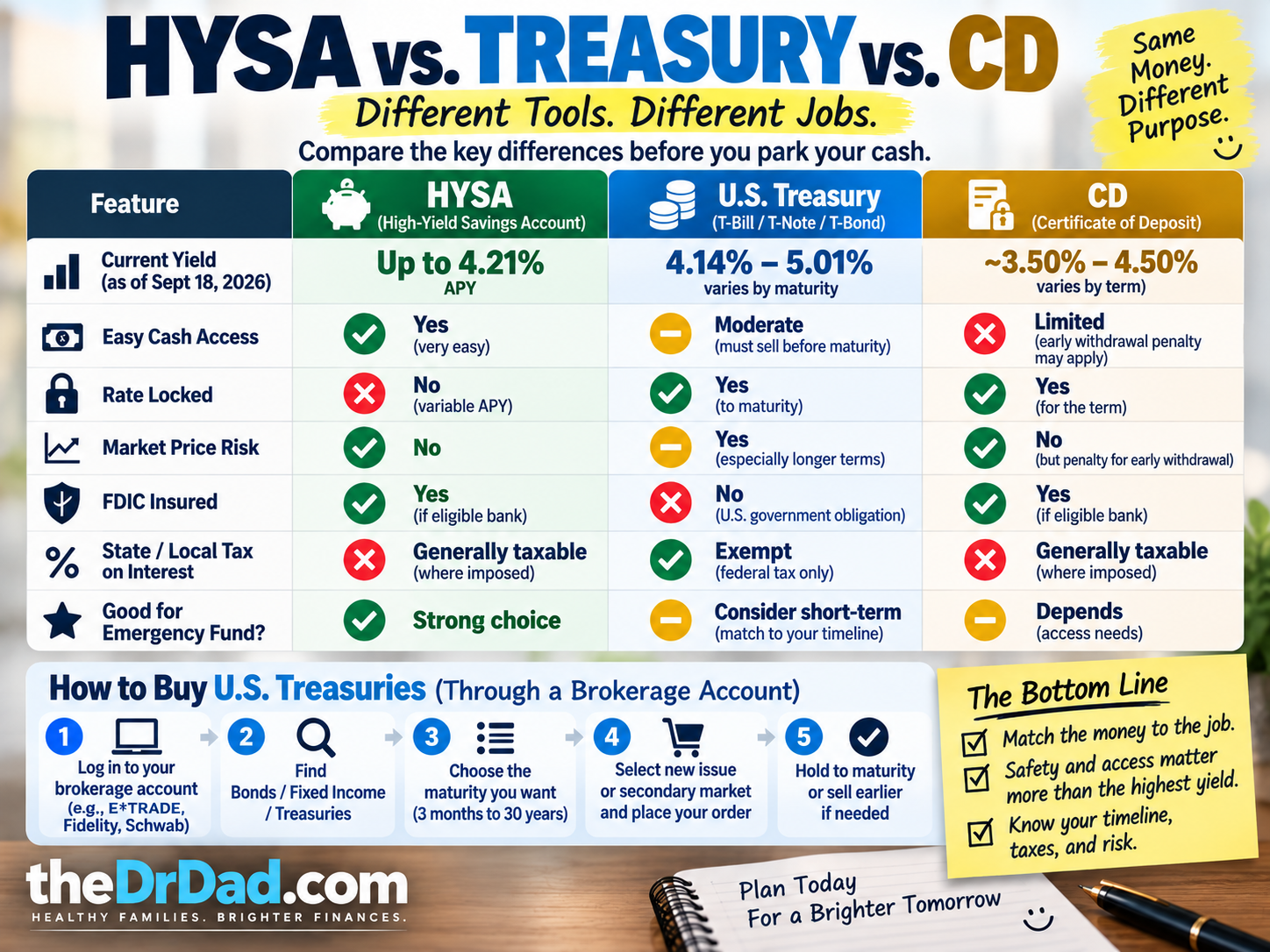
HYSA vs. Treasury vs. CD
| Feature | HYSA | Short-Term Treasury | 10-Year Treasury | CD |
|---|---|---|---|---|
| Easy cash access | High | Moderate | Moderate | Usually limited |
| Rate locked | No | To maturity | To maturity | Usually yes |
| Market price risk if sold early | No market-price fluctuation | Yes | Yes—more significant | Usually an early-withdrawal penalty instead |
| FDIC insured | Yes, if eligible | No—U.S. government obligation | No—U.S. government obligation | Yes, if eligible |
| State/local income tax on interest | Generally applicable where imposed | Exempt | Exempt | Generally applicable where imposed |
Buying U.S. Treasuries Is Actually Pretty Easy
For many people, one of the easiest ways to buy U.S. Treasury securities is through a brokerage account.
- Log into your brokerage account.
- Find Bonds, Fixed Income, or Treasuries.
- Choose the maturity you want.
- Review newly issued Treasuries or securities trading on the secondary market.
- Enter your order, then hold to maturity or sell earlier if necessary.
You can also buy eligible newly issued Treasury securities through TreasuryDirect. If you already use a brokerage account, however, buying and managing Treasuries there may feel more convenient.
Buying a Treasury is easy. Choosing the right maturity is the important part.
Why I Would Be Careful With a 10-Year Treasury for Emergency Money
Suppose you have $50,000 reserved for emergencies. You see an HYSA around 4% and a 10-year Treasury around 5%. The Treasury looks better. But ask another question: What if I need the $50,000 six months from now?
With an HYSA, the interest rate may change, but the savings balance itself isn’t being quoted every day in a bond market. With a 10-year Treasury, if you need to sell before maturity, the market determines what someone will pay for it.
Bond prices and interest rates generally move in opposite directions. If market rates rise after you buy a bond and you need to sell it early, its market value may be lower.
You don’t get to schedule your emergency for the most convenient time to sell a bond.
What About Short-Term Treasuries?
A 3-month, 6-month, or 1-year Treasury does not carry the same degree of long-duration interest-rate risk as a 10-year Treasury. For money you know you won’t need immediately, short-term Treasuries may deserve consideration.
But the principle remains the same: match the money to the timeline. The goal isn’t to squeeze every possible basis point out of every dollar. The goal is to understand what job each dollar has.
Don’t Forget FDIC Insurance
For deposits at an FDIC-insured bank, the standard insurance amount is $250,000 per depositor, per insured bank, per ownership category.
That does not simply mean every account you open automatically gets another $250,000. Deposits at the same insured bank within the same ownership category are generally aggregated when determining coverage.
FDIC insurance covers qualifying deposit products such as checking accounts, savings accounts, and Certificates of Deposit (CDs). It does not insure stocks, bonds, or mutual funds simply because you purchased them through an FDIC-insured bank.
There Is Also a Tax Difference
Interest from a savings account is generally taxable income. Interest from U.S. Treasury bills, notes, and bonds is subject to federal income tax but is generally exempt from state and local income taxes.
That means comparing a 4.2% HYSA with a 4.4% Treasury based only on the headline numbers doesn’t tell the entire story. Your tax situation matters—but taxes should not make us forget the original purpose of this money: it needs to be there when you need it.
The Lesson My Tax Money Taught Me
Looking back, my mistake wasn’t that I picked the wrong stock. The mistake happened before I picked any stock.
I invested money that already had a job.
That money wasn’t long-term investment capital. It was tax money. I knew I would need it. I just convinced myself that eight months was enough time to make some extra money.
The market disagreed. Very strongly.
I still invest. But I don’t ask my emergency fund to behave like my investment portfolio.
I let my investments make money. I let my emergency fund do its job.
DrDad Tips
- Your emergency fund is not an investment competition. The highest possible return isn’t necessarily the goal.
- Look beyond the advertised APY. Check FDIC coverage, fees, minimum balances, transfer speed, and rate requirements.
- Don’t confuse “safe investment” with “cash that can’t fluctuate.” A Treasury held to maturity and one sold unexpectedly in the secondary market are different situations.
- Short-term Treasuries deserve a different conversation from 10-year Treasuries. Maturity matters.
- Know what each dollar is supposed to do. Long-term money can be invested for growth. Emergency money should be ready for emergencies.
Emergency money has a job. Its job is not to double.
Financial Disclaimer
This article is provided for general educational and informational purposes only. It is not individualized financial, investment, tax, accounting, or legal advice.
Interest rates, Annual Percentage Yields (APYs), account requirements, fees, tax rules, and Treasury yields can change. Rates cited in this article reflect information available on the dates stated and may no longer be available when you read this article. Before opening an account, purchasing a security, or making financial or tax decisions, verify current terms directly with the financial institution or government source and consider consulting an appropriately qualified financial, tax, or legal professional regarding your individual circumstances.
References
- Consumer Financial Protection Bureau. An Essential Guide to Building an Emergency Fund.
- Federal Deposit Insurance Corporation. Deposit Insurance.
- U.S. Department of the Treasury. Daily Treasury Par Yield Curve Rates.
- U.S. Department of the Treasury. Treasury Marketable Securities.
- Internal Revenue Service. Publication 550: Investment Income and Expenses.
- NerdWallet. High-Yield Savings Account comparison data, rates checked September 18, 2026.