
Lip filler in the United States commonly costs several hundred dollars per treatment, with roughly $700–$800 being a useful national reference point.
But after treating patients myself, I’ve come to believe that price is not the hardest part of lip filler.
The hardest part is figuring out how much is enough.
That sounds simple until you actually do it.
A patient starts conservatively. We add a little volume. She likes it.
Then the swelling settles.
She looks in the mirror and says: “Maybe just a little more.”
So we add a little more.
A few weeks or months later: “Maybe just a little more.”
And sometimes, after repeating that process, the same patient eventually looks in the mirror and says: “Actually… I think this is too much.”
Then we may end up dissolving some of the filler and starting again.
I have seen this cycle enough times that it has changed the way I think about lip filler.
The question is not simply: How much filler can we put into the lips?
A much better question is: At what point does adding more stop making the lips look better?
That point is different for every face. And finding it may take more than one visit.
How Much Does Lip Filler Cost in the U.S.?
Prices vary considerably depending on the city, injector, product, practice, and how much filler is used.
As a general reference, national professional-society figures put the average cost of lip augmentation with dermal filler in the neighborhood of $700–$800 per treatment.
In the real world, however, patients may encounter prices both below and well above that range.
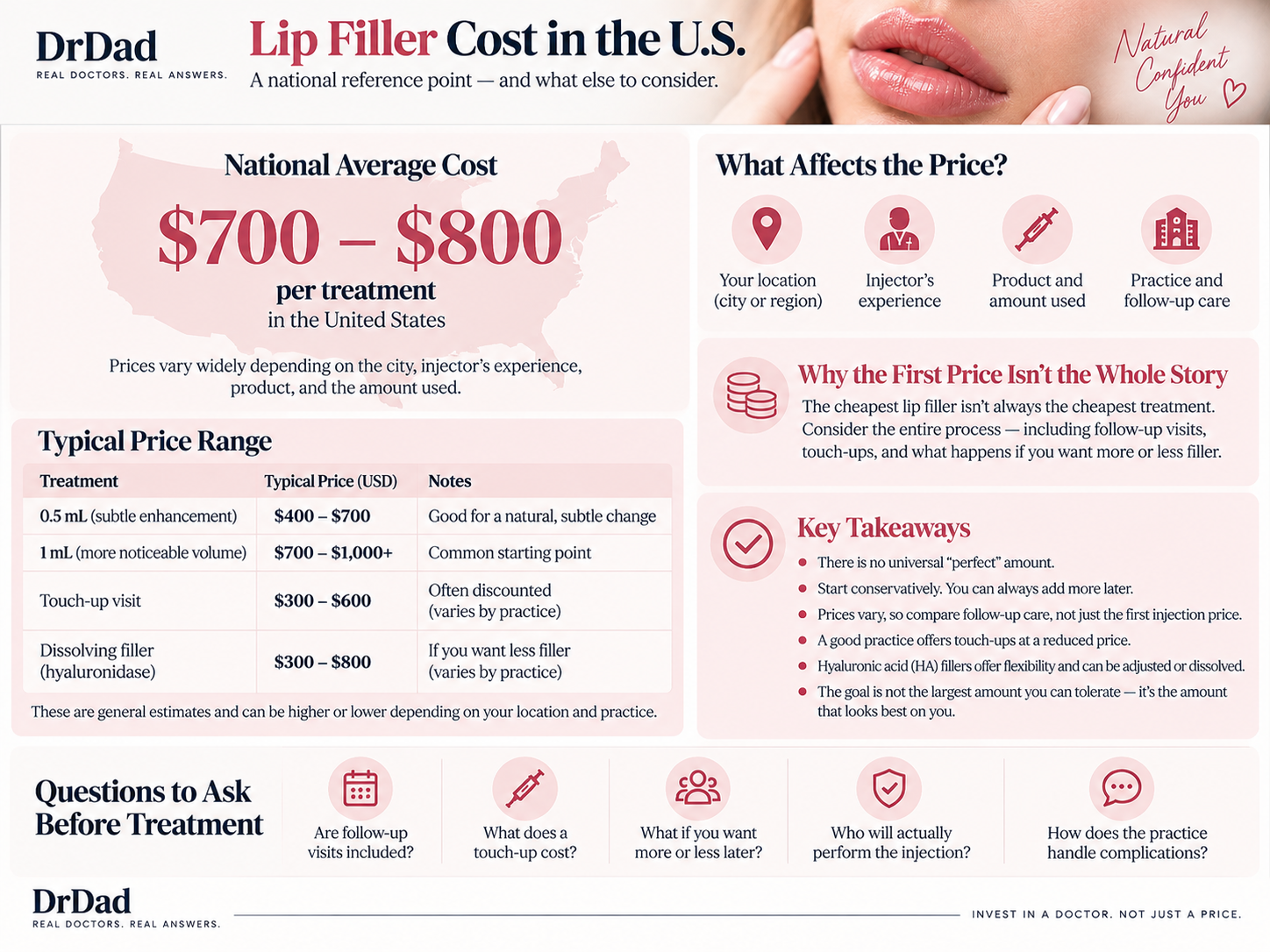
And this is where I think patients sometimes make a mistake. They compare only the advertised price of the first syringe.
For example: Clinic A: $650. Clinic B: $800. It seems obvious that Clinic A is cheaper.
But what happens afterward? What if you come back two weeks later and decide you want a small adjustment? What if the injector wants to evaluate the result after the swelling disappears? What if you need another small touch-up? What if you decide you went too far and want some filler dissolved?
Suddenly, the original price is only part of the story.
When comparing lip filler prices, I think patients should also compare the follow-up care.
0.5 mL vs. 1 mL of Lip Filler: Is There a “Right” Amount?
This is one of the most common ways people research lip filler.
Is 0.5 mL enough? Is 1 mL too much?
Those are reasonable questions. But there is no universal answer.
One milliliter is simply a measurement of volume. It does not tell you how that volume will look on your face.
Consider two patients. One has naturally thin lips and a relatively large facial structure. Another already has moderately full lips and a smaller face. Putting exactly the same amount of filler into both patients does not necessarily produce the same aesthetic result.
The result also depends on the patient’s natural lip anatomy, upper-to-lower lip proportions, facial proportions, previous filler, where the product is placed, the characteristics of the filler, the injection technique, and, most importantly, what the patient considers attractive.
That last factor is easy to underestimate.
There is no single definition of the perfect lip.
Some people genuinely like a fuller, more projected lip. Others want friends and family to have absolutely no idea they had anything done. Neither preference is automatically wrong.
The goal is to understand which result the patient actually wants—and whether that result fits comfortably with the rest of the face.
The Problem With “Just a Little More”
This is where lip filler becomes interesting.
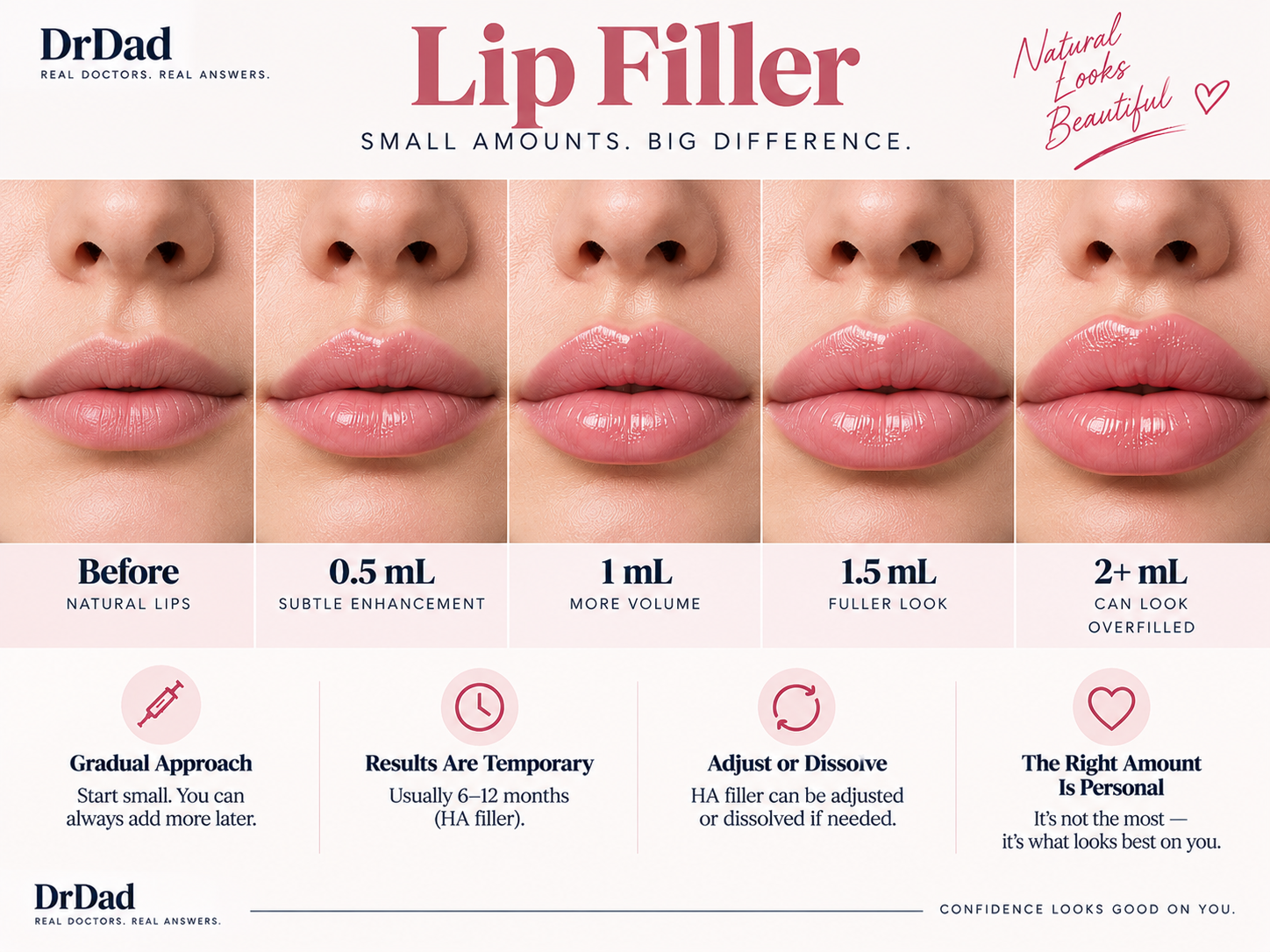
The difference between natural-looking lip filler and an overfilled appearance often does not happen in one dramatic step. It happens gradually.
The first treatment looks good. The patient becomes accustomed to it. Then slightly larger lips begin to look normal to her. So she wants a little more.
After the next treatment, she becomes accustomed to that appearance too. Then she wants a little more again.
I understand why this happens. When you see your own face every day, your visual reference point changes.
Something that initially looked dramatically different may look completely ordinary a month later. That does not necessarily mean the filler disappeared.
Sometimes your eyes simply got used to your new face.
This is one reason I am cautious about continuously adding filler simply because a patient says, “I don’t see it anymore.”
Before adding more, I think we should ask another question: Did the filler actually disappear—or did you become accustomed to the result?
Those are very different situations.
Sometimes We Add More. Then We Dissolve It.
This is another part of lip filler that patients may not hear enough about before treatment.
You may change your mind.
I’ve had patients who wanted fuller lips, gradually went larger, and then eventually decided they preferred a more subtle look.
That is not necessarily a failure. Aesthetic preferences change. Hairstyles change. Fashion changes. The way people see their own face changes.
A patient may love a fuller look today and decide a year from now that she wants something much more conservative.
That is one reason I personally like hyaluronic acid, or HA, fillers for the lips.
Why I Prefer HA Filler for Lips
Hyaluronic acid fillers are commonly used for lip augmentation.
For me, one of their biggest advantages in the lips is flexibility.
If a patient likes the result, great. If she wants a little more, we can reassess. If she later decides she wants less, HA filler can often be reduced or dissolved using an enzyme called hyaluronidase when clinically appropriate.
That flexibility matters to me because the lips are such an emotionally sensitive area. A tiny difference can feel enormous to the person looking in the mirror.
And preferences can change. Someone may tell me today: “I want them thick.” Months later, that same patient may say: “I want them thinner and more natural.”
I would rather work with a material that gives us options.
Of course, dissolving filler is still a medical procedure. It is not something I would treat casually, and hyaluronidase has its own risks and considerations.
But the ability to modify HA filler is an important advantage when we’re working in an area where small aesthetic changes can make a large visual difference.
Natural Lip Filler Is About Proportion, Not Just Volume
When patients ask me what makes lip filler look natural, they often expect me to give them a number: 0.5 mL, 0.7 mL, 1 mL.
But I don’t think natural-looking lip filler can be reduced to a number.
Natural is a relationship between the lips and the rest of the face.
The upper lip matters. The lower lip matters. But so do the nose, chin, teeth, smile, facial width, and profile. Even the way the lips move when a patient speaks and smiles matters.
A technically beautiful lip viewed in isolation may not necessarily look natural on the entire face.
That is why I think one of the biggest mistakes in aesthetic treatment is treating a body part instead of treating the person.
Instagram can show you thousands of lips. But you do not walk around as a pair of lips. People see your entire face.
Bigger Is Not Automatically Better—and Smaller Is Not Automatically More Natural
I don’t want “natural” to become a polite way of telling everyone they should have small lips.
Some faces can carry more volume beautifully. Some patients genuinely prefer a glamorous, fuller appearance.
The question isn’t whether big lips are good or bad. The question is whether the volume, shape, projection, and proportions work together.
There is a point where additional filler may stop improving the result. And that point can be difficult for patients—and sometimes injectors—to recognize.
My own philosophy is fairly simple:
The right amount of lip filler is not the largest amount you can tolerate. It’s the amount at which adding more stops making you look better.
Unfortunately, there is no measuring cup that tells us exactly where that point is. Sometimes we have to find it gradually.
Why I Prefer a Gradual Approach
If someone is getting lip filler for the first time, I generally like the idea of being conservative.
You can always reassess. Adding volume later is usually a very different decision from wishing you had added less.
And immediately after injection is not necessarily the best time to judge the final result.
Lips can swell. There can be asymmetry during the early healing period. Bruising can occur. The tissue needs time to settle.
That is why I don’t think patients should panic—or celebrate too quickly—based entirely on what they see immediately after the injection.
Give the lips time to become lips again before deciding what they need next.
Then look at them. Talk. Smile. Take photographs. Look from the front and the side. And decide whether anything actually needs to be changed.
Why Follow-Up Care Matters More Than Patients Think
This is something I have developed from treating my own patients.
I don’t necessarily think lip filler should always be viewed as: Injection → payment → goodbye.
Finding the patient’s preferred lip size can be a process.
In my own practice, I like to follow patients and, when appropriate, offer subsequent touch-ups over the next few visits at a reduced price.
That is my own practice philosophy, not a universal standard for every clinic.
But I like this approach because it changes the conversation. Instead of feeling that we must create the “perfect” lip in one appointment, we can be more conservative.
We can see how the patient responds. We can see what the filler looks like after swelling resolves. We can decide whether a little more would actually improve the result.
And sometimes the answer is: No. Stop right here.
That can be a very valuable answer.
The Cheapest Lip Filler May Not Be the Cheapest Treatment
Suppose one clinic charges less for the initial treatment but every adjustment is another full-price visit.
Another clinic charges somewhat more initially but has a structured follow-up program and discounted touch-ups.
Which one is cheaper? You cannot answer that question from the first advertised price alone.
That’s why, when comparing lip filler cost, I would ask: What happens after the injection?
Patients should know the clinic’s policies before treatment.
Ask what follow-up is included. Ask what a touch-up costs. Ask what happens if you want more. Ask what happens if you want less. Ask what happens if there is asymmetry after everything settles. And ask what happens if you simply don’t like the result.
Those answers tell you a lot about a practice.
What About Lip Filler Migration?
Patients searching for lip filler today frequently encounter the term “filler migration.”
The term is often used online to describe filler appearing outside the intended lip border or creating an unwanted fullness around the mouth.
There can be multiple factors involved, and an online photograph alone cannot reliably tell you exactly what happened.
But one practical lesson is straightforward: More filler is not always the solution to an unsatisfactory result.
If there is already significant product present, repeatedly adding more without carefully evaluating the existing filler may make the aesthetic problem harder rather than easier.
Sometimes the smartest treatment is another injection. Sometimes it is waiting. Sometimes it is doing nothing. And in selected cases involving HA filler, discussing dissolution and reassessment may make more sense than continuing to add volume.
That decision should be made after an in-person clinical evaluation.
Don’t Judge Your Lips During the Swelling Phase
This deserves its own section because patients can become very anxious after lip injections.
Immediately after treatment, lips may look much larger than expected. That does not automatically mean you received too much filler. Swelling can temporarily exaggerate the result.
On the other hand, patients should also understand that not every post-treatment problem should simply be dismissed as “normal swelling.”
Increasing or severe pain, unusual color changes, blanching, dusky or mottled skin, worsening symptoms, or other concerning changes warrant prompt contact with the treating medical professional.
Dermal filler injections are medical procedures. Rare but serious vascular complications can occur.
This is another reason I think choosing an injector should involve more than scrolling through before-and-after pictures.
You are not only choosing someone to make your lips look good. You are choosing someone to recognize and manage a problem if something goes wrong.
Before-and-After Photos Can Be Misleading
Before-and-after photos are useful. I take photographs too. But patients need to understand what they’re comparing.
Was the “after” photograph taken immediately after injection when the lips were still swollen? Was it taken two weeks later? Is the lighting identical? Is the angle identical? Is the patient wearing lipstick or lip liner? Is she smiling differently?
Small differences can dramatically change how lips appear in photographs.
If you are researching an injector, I would rather see consistent, standardized results than twenty spectacular pictures taken under twenty completely different conditions.
And when evaluating your own lips, compare photographs taken under similar conditions.
Memory is surprisingly unreliable. Sometimes a patient tells me her filler has completely disappeared. Then we compare her current photograph with her original photograph. It hasn’t. She simply became used to it.
How Often Should You Get Lip Filler?
There is no schedule that every patient needs to follow.
This is another area where I think aesthetic medicine can become too automatic.
You do not necessarily need more filler because a certain number of months has passed.
If you still like your lips, why are we injecting them again?
HA fillers are temporary, but how long the visible effect lasts varies among patients and products, and the appearance can change gradually rather than disappearing overnight.
I prefer to evaluate what is actually there rather than treating the calendar.
Treat the patient, not the appointment reminder.
What Should You Ask Before Getting Lip Filler?
Before choosing a clinic, I would want answers to a few practical questions:
- Who will actually perform the injection?
- What product are you recommending, and why?
- Is it an HA filler?
- How much product are you recommending for me?
- Why that amount?
- What result should I realistically expect?
- When should I come back for follow-up?
- Is follow-up included?
- What does a touch-up cost?
- What happens if I decide I want less filler?
- Does the practice have hyaluronidase available when appropriate?
- How does the practice handle complications?
Notice that only one of those questions is: “How much does it cost?”
Price matters. But it should not be the only question.
So, How Much Lip Filler Is Too Much?
Here’s the frustrating answer: There is no universal number.
For one patient, a relatively small amount can produce a noticeable change. Another patient may need a different amount to achieve her goal. And the same patient may want different amounts at different stages of her life.
I don’t believe 0.5 mL is automatically natural. I don’t believe 1 mL is automatically too much. And I don’t believe a syringe should be emptied simply because you paid for it.
The treatment should follow the face—not the package size.
The most important thing may be having an injector who is willing to say both: “We can add a little more.” and “I don’t think adding more will make this better.”
Patients deserve both answers.
DrDad Tips
After treating lip filler patients myself, my biggest advice is simple: Don’t make your first appointment a race to your final lip size.
Start with a clear goal, but give yourself permission to discover what you actually like.
Let the swelling settle before judging the result. Compare standardized photographs rather than relying only on memory. If you want more, discuss why you want more before automatically adding another syringe.
For lips, I personally prefer the flexibility of hyaluronic acid fillers because aesthetic preferences can change and HA filler can often be adjusted or dissolved when clinically appropriate.
And when comparing clinics, don’t compare only the first injection price.
Ask about the entire relationship: Initial treatment. Follow-up. Touch-ups. Adjustments. Dissolving. Complication management.
In my own practice, I prefer to follow patients and, when appropriate, provide a few subsequent touch-up opportunities at a reduced price. I find that this allows us to approach the result gradually instead of feeling pressured to find the perfect volume in one appointment.
Your favorite lip size may not be the size you imagined before your first injection. Sometimes you have to find it. And sometimes finding it means knowing when to stop.
Disclaimer
This article reflects my professional experience and personal approach as a practicing doctor and is provided for general educational and informational purposes only. It is not individualized medical advice and does not establish a doctor-patient relationship.
Dermal filler treatment, including lip filler and filler dissolution, has potential risks and complications. Product choice, injection amount, treatment technique, follow-up, and whether dissolution is appropriate depend on the individual patient and clinical circumstances. Anyone considering treatment should be evaluated by an appropriately licensed and qualified healthcare professional. Urgent or unusual symptoms following filler injection should be evaluated promptly.