
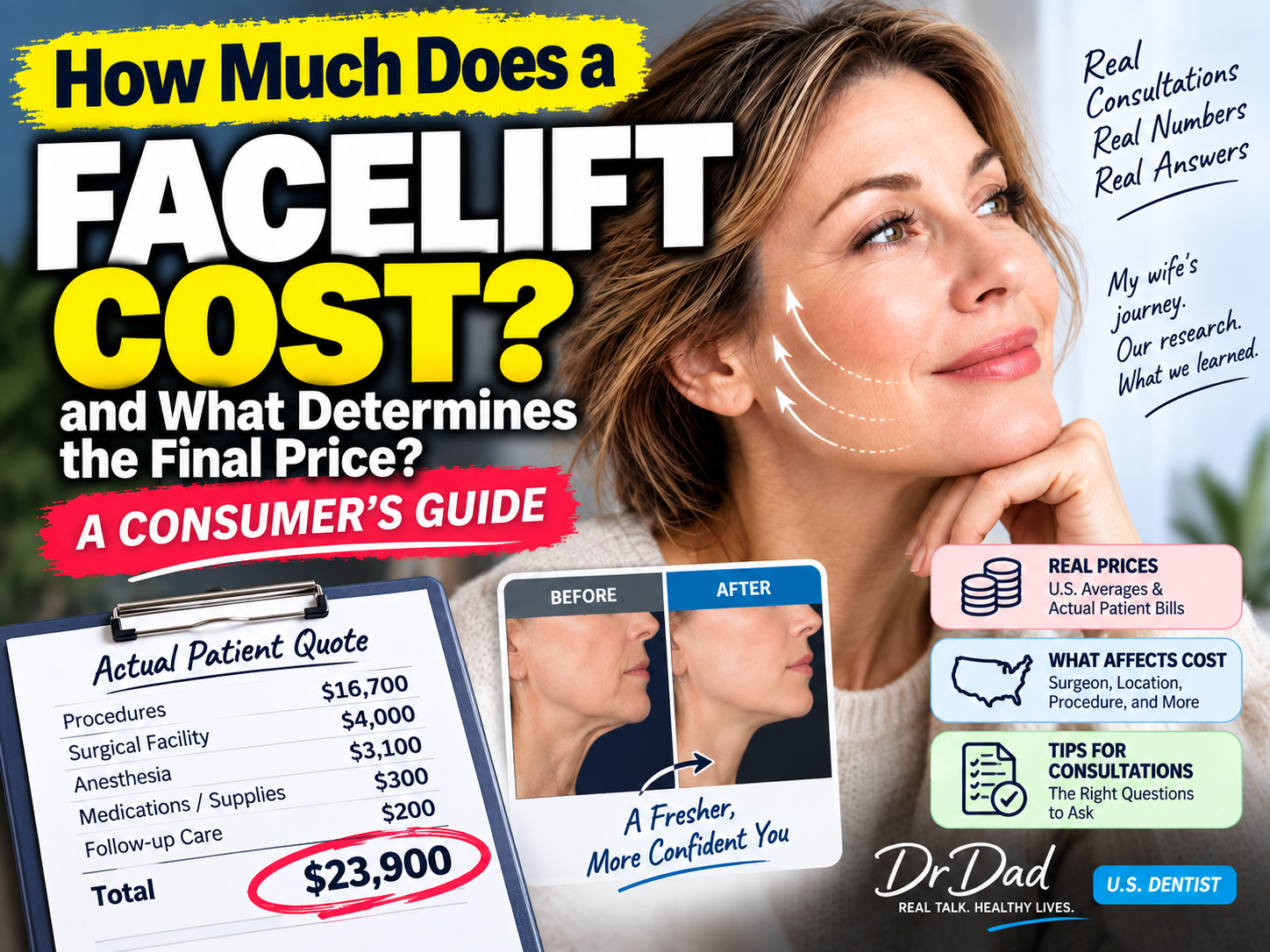
I didn’t start researching facelifts because I planned to write an article about them.
I started because my wife wanted one.
Once she became serious about having a facelift, I went with her to consultations. At first, I thought the process would be fairly straightforward: meet a few surgeons, hear what they recommend, compare their work, compare the prices, and make a decision.
It turned out to be much more complicated than that.
We heard different surgical plans, different terminology, different ideas about what needed to be done—and very different prices. Terms like SMAS facelift, deep-plane facelift, neck lift, fat grafting, blepharoplasty, anesthesia fee, and facility fee started entering our conversations.
And I began to realize something: we weren’t necessarily comparing the same operation.
So after the consultations, I went home and started reading. I looked at medical information, professional-society guidance, patient-reported pricing, and actual surgical quotes people had posted publicly.
This article is not written from the perspective of a facelift surgeon. I’m not one. It is written from the perspective of a consumer who went to the consultations, listened, looked at the prices—and then went home and dug through the available evidence.
And one of the first things I learned was this:
Before you compare facelift prices, make sure you’re comparing the same operation.
So, How Much Does a Facelift Cost in the United States?
The American Society of Plastic Surgeons (ASPS) currently lists the average cost of a facelift at $11,395.[1] But ASPS makes an important qualification: that average is only part of the total price and does not include anesthesia, operating-room facilities, or other related expenses.[1]
Then I looked for something different: what are patients actually reporting that they paid?
RealSelf reports an average facelift cost of $20,130, with a reported range of $5,600 to $52,000, based on 345 patient reviews.[2] This is patient-reported platform data, not a randomized national survey, but it is useful for seeing how wide the real-world price range can be.
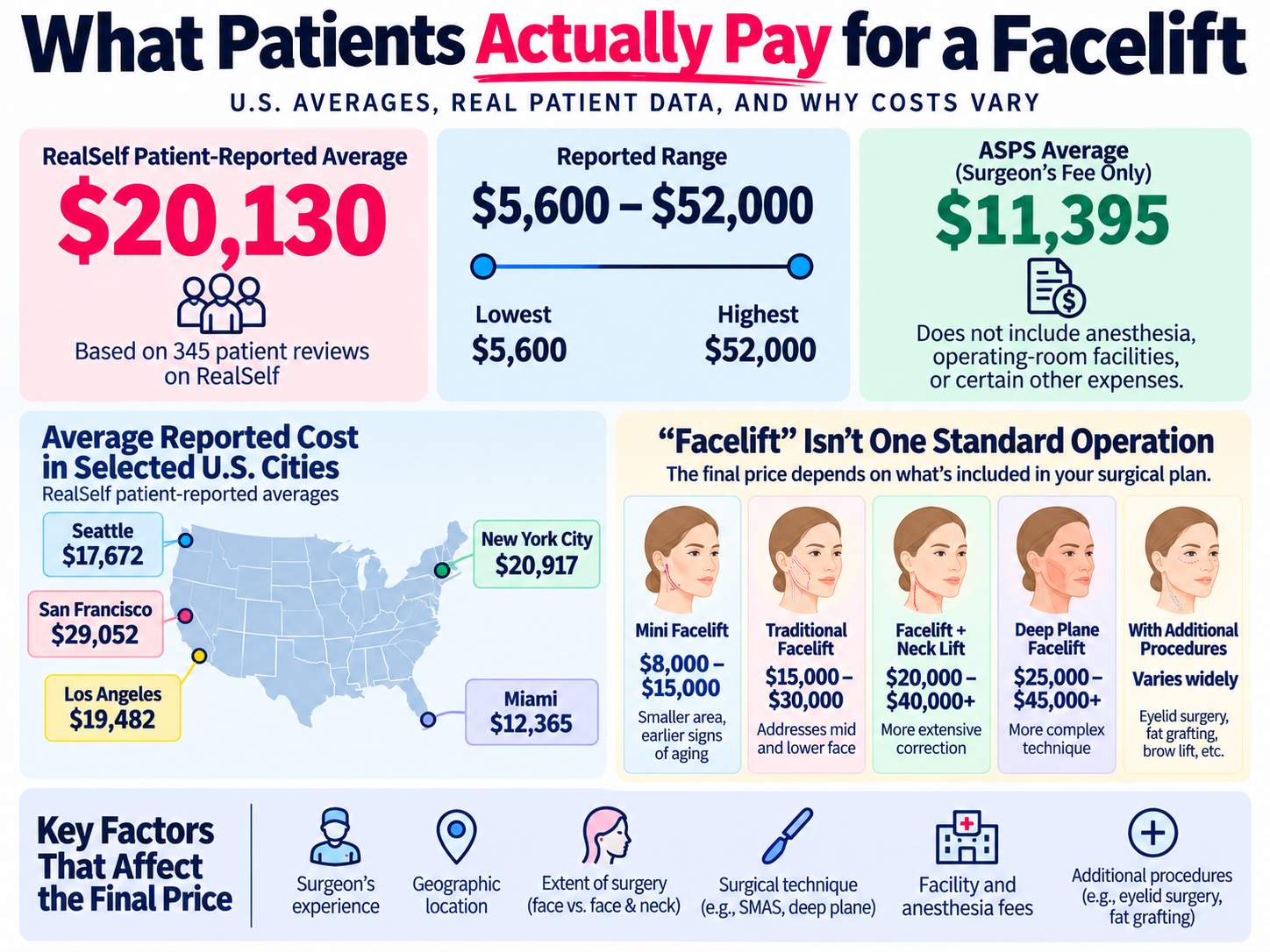
That enormous spread immediately raises a better question: why can two people both say they’re getting a facelift and pay dramatically different amounts?
“Facelift” Isn’t One Standardized Package
One quote may focus mainly on the lower face. Another may include extensive neck work. Another may use a different surgical approach. Someone else may also be having eyelid surgery, fat grafting, brow work, or liposuction.
So before comparing two numbers, I learned to ask: What exactly am I buying for each number?
I Found an Actual $23,900 Surgical Quote Online
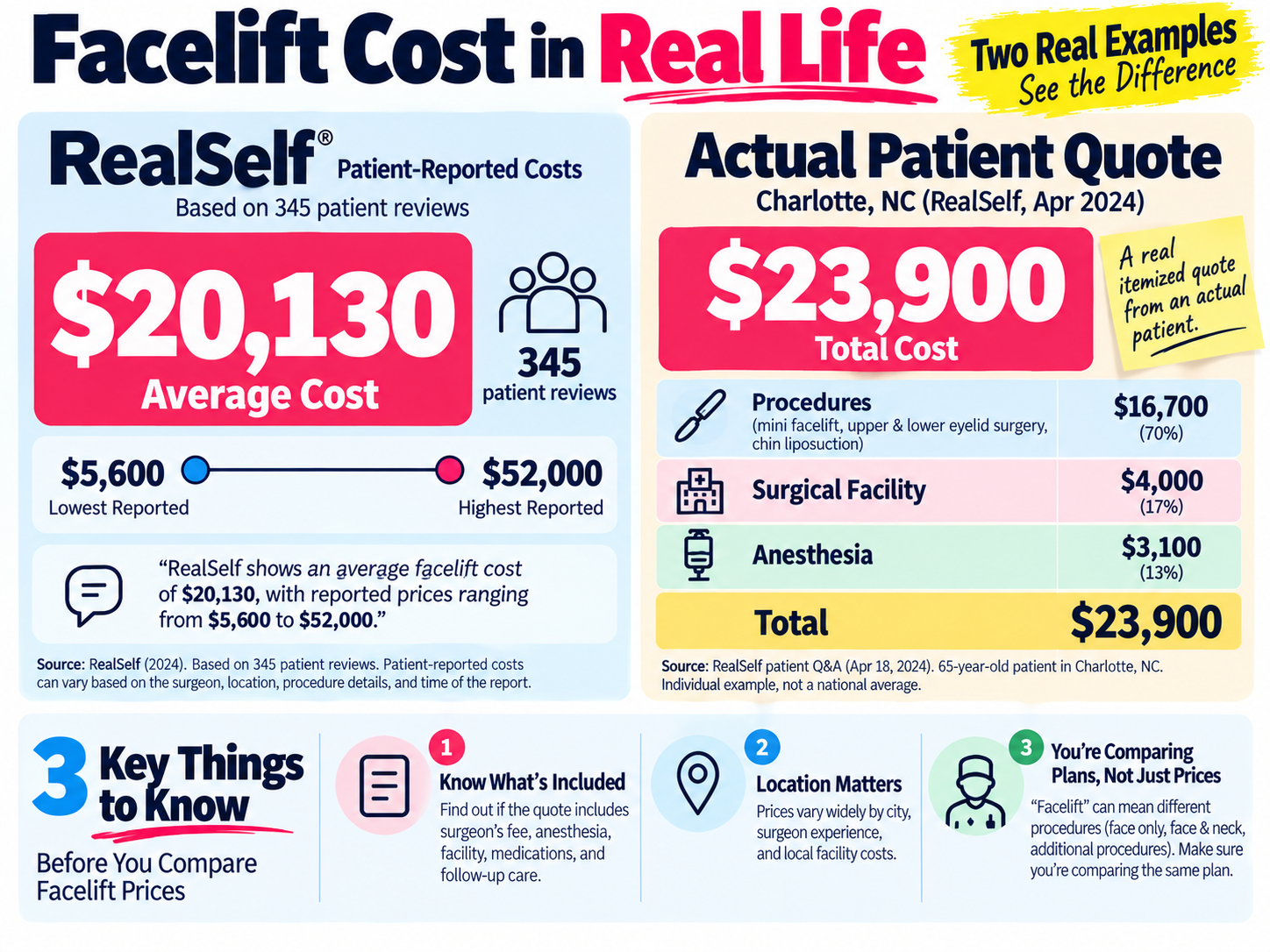
One of the most useful examples I found was a publicly posted RealSelf question from a 65-year-old patient in Charlotte, North Carolina. She shared a quote for a proposed vertical deep-plane mini facelift, upper and lower eyelid surgery, and chin liposuction.[3]
This is important: it was not a facelift-only quote, and it should not be treated as a national average. It was one patient’s individual example.
Her reported breakdown was:
- Procedures: $16,700
- Surgical facility: $4,000
- Anesthesia: $3,100
- Total: $23,900
In that example, facility and anesthesia charges added $7,100 beyond the procedure charges.[3]
That was when I stopped being satisfied with asking, “How much is your facelift?” A much better question is: “Is that the all-in price?”
What Can Be Added to a Facelift Bill?
ASPS lists potential components including the surgeon’s fee, hospital or surgical facility costs, anesthesia fees, medications, post-surgery garments, and medical testing.[1] RealSelf also advises consumers to ask whether a written quote includes consultation, surgeon, facility, anesthesia, and follow-up costs, and whether medications, pre-op tests, recovery supplies, or revision costs may be additional.[2]
Some practices bundle many of these items into one price. Others separate them. That means a $15,000 quote and an $18,000 quote are not necessarily $3,000 apart until you know what each number includes.
The Neck Can Change the Conversation
This was another thing I hadn’t fully appreciated before going through the consultation process. Consumers may think of the face and neck as separate areas, but when the concerns include the jawline, jowls, and loose lower-face or neck tissue, the proposed surgical plan can extend beyond what a patient initially imagined as “just a facelift.”
That changes both the operation and the price comparison.
And Then Come the Additional Procedures
A consultation that starts with a facelift can lead to discussion of upper or lower eyelid surgery, fat grafting, brow procedures, neck procedures, or liposuction. Those recommendations may or may not make sense for a particular patient, but financially something important has happened:
You’re no longer comparing facelift to facelift. You’re comparing surgical plans.
Then I Started Hearing a Lot About the “Deep Plane”
If you research facelifts online, you will quickly encounter terms such as SMAS and deep plane. We did too.
As a consumer, I found it easy to get pulled toward technique names. But the more I read, the more my question changed from “Which name sounds most advanced?” to something more practical:
Why is this surgeon recommending this technique for this particular patient?
RealSelf describes both SMAS and deep-plane approaches as techniques that address deeper facial tissues rather than simply tightening skin, while emphasizing that procedure choice and cost depend on anatomy, goals, surgeon experience, and the specifics of the operation.[2][4][5]
I came away less interested in choosing surgery by a marketing label and more interested in understanding the actual plan.
Surgeon Experience and Geography Affect the Price Too
ASPS states that a surgeon’s facelift fee can vary according to experience, the type of procedure used, and geographic office location.[1] RealSelf’s patient-reported data also shows substantial geographic variation.[2]
That makes intuitive sense: practice overhead, local market conditions, surgical complexity, operating time, and demand can all affect a quote.
But I would not treat price itself as proof of surgical quality. Price is information. It isn’t an outcome.
Will Insurance Pay for a Facelift?
For an elective cosmetic facelift, generally no. ASPS states that most health insurance plans do not cover facelift surgery or its complications.[1] RealSelf likewise describes elective cosmetic facelift surgery as not covered by health insurance.[2]
That means this is usually a substantial out-of-pocket decision, which makes understanding the complete written quote even more important.
The First Thing I Would Ask for Now: an Itemized Quote
If I were starting the consultation process again, I would not write down just one number. I would want to know whether the quote includes:
- Surgeon’s fee
- Anesthesia
- Operating room or surgical facility
- Pre-op testing or medical clearance
- Medications
- Post-op garments or supplies
- Follow-up visits
- Any additional procedures
- How potential revision costs are handled
Not every practice bills these separately. That isn’t the point. The point is to understand what the number you’re comparing actually includes.
What I Would Ask During a Facelift Consultation Now
After sitting through consultations and then going home to research, my questions changed. I would ask what exactly is being planned, why that operation is being recommended for this patient, what parts of the face and neck it will and will not address, why that particular technique is being used, who provides the anesthesia, where the operation is performed, what recovery realistically looks like, how often the surgeon performs the operation, what complications they most commonly see, and how revisions are handled.
And financially, I would ask one very simple question:
“Is this the total, all-in price?”
Then I would ask for the quote in writing.
The Most Useful Thing I Learned About Facelift Cost
When my wife and I started this process, price seemed like one of the easiest things to compare. Ironically, it turned out to be one of the hardest.
ASPS gives a useful professional benchmark of $11,395, but explicitly says that number is only part of the total price.[1] RealSelf’s patient-reported data shows an average of $20,130 and a very wide reported range of $5,600–$52,000.[2] And the publicly posted $23,900 example shows how facility and anesthesia costs can materially change the final number.[3]
Those numbers do not have to contradict each other. They are measuring different things.
DrDad Tips
I started researching this subject as a husband helping his wife make a major cosmetic-surgery decision. I ended up approaching it like a very persistent consumer.
We went to consultations. We listened. We compared prices. Then I went home and read.
The biggest lesson I took away wasn’t which facelift technique is “best.” It was learning how to ask better questions.
What exactly are you going to do? Why are you recommending it for this patient? What is included in this price? What isn’t included? And what evidence supports what you’re telling me?
Most importantly: don’t compare facelift prices until you know you’re comparing the same operation.
The cheapest quote may not be the cheapest final bill. The most expensive quote does not automatically mean the best surgery. And the fanciest-sounding technique is not automatically the right technique.
Understand the operation first. Then compare the price.
Disclaimer
This article reflects my personal experience accompanying my wife to cosmetic-surgery consultations and my subsequent review of publicly available professional-society information, patient-reported pricing data, and educational medical information. I am a practicing dentist, but I am not a plastic surgeon or facial plastic surgeon, and this article should not be interpreted as specialist advice regarding facelift technique, surgical candidacy, anesthesia, or surgical planning.
This content is for general educational and informational purposes only. It is not individualized medical advice and does not establish a doctor-patient or dentist-patient relationship. Facelift recommendations, risks, results, recovery, and costs vary substantially by patient, surgeon, procedure, location, facility, anesthesia, and additional procedures. Pricing figures here are reference data and examples, not treatment quotes. Anyone considering facial cosmetic surgery should consult an appropriately qualified surgeon for individualized evaluation, risks, alternatives, and a complete written cost estimate.
References
[1] American Society of Plastic Surgeons (ASPS). “Facelift Cost.” Used for the current $11,395 average-cost benchmark, its exclusion of anesthesia/operating-room and other related expenses, cost components, insurance information, and factors affecting surgeon fees. ASPS Facelift Cost.
[2] RealSelf. Jolene Edgar. “How Much Does a Facelift Cost, and Is It Worth It?” Updated July 23, 2024. Used for the $20,130 patient-reported average, $5,600–$52,000 range based on 345 patient reviews, quote-comparison guidance, and geographic cost data. RealSelf Facelift Cost.
[3] RealSelf patient Q&A. Charlotte, North Carolina, April 18, 2024. Publicly posted individual quote for a proposed vertical deep-plane mini facelift, upper and lower eyelid surgery, and chin liposuction: $16,700 procedures, $4,000 facility, $3,100 anesthesia, $23,900 total. This is an individual example, not a national average. RealSelf Patient Quote.
[4] RealSelf. “SMAS Facelift Procedure, Cost & How Long It Lasts.” Used for general consumer-level description of the SMAS facelift approach. RealSelf SMAS Facelift.
[5] RealSelf. “Deep Plane Facelift Procedure, Cost, Recovery.” Used for general consumer-level description of the deep-plane facelift approach. RealSelf Deep Plane Facelift.