
Patients ask me this all the time:
“Are dental implants worth it?”
My answer as a dentist is simple.
Yes. If I lost a tooth and I were a good candidate for a dental implant, I would get one.
I don’t say that just because I place implants. I say it because I’ve spent years seeing what happens after a tooth is lost—and what happens when a well-planned dental implant is still functioning many years later.
I’ve even placed dental implants for my own parents. About 10 years later, they are still using them today.
That probably tells you more about how I feel about implants than anything else.
A Missing Tooth Is More Than an Empty Space
Patients sometimes lose a back tooth and think, “Nobody can see it. Why replace it?”
But your teeth don’t work independently. They work together as a chewing system.
Missing teeth can reduce chewing efficiency. And once a tooth is gone, the teeth around the space may begin to change.
A neighboring tooth can gradually tilt or drift toward the empty space. As its position changes, the forces on that tooth can change too.
Something can also happen to the opposing tooth.
Normally, a tooth has another tooth to bite against. When that opposing tooth is gone, the remaining tooth may gradually move farther out of its normal position. We call this supraeruption.
So what started as one missing tooth can eventually affect neighboring teeth, opposing teeth, your bite, and future treatment.
That’s why I don’t look at a missing tooth as simply a hole that needs to be filled.
I look at the whole system.
So, Are Dental Implants Worth It?
For the right patient, I believe they absolutely can be.
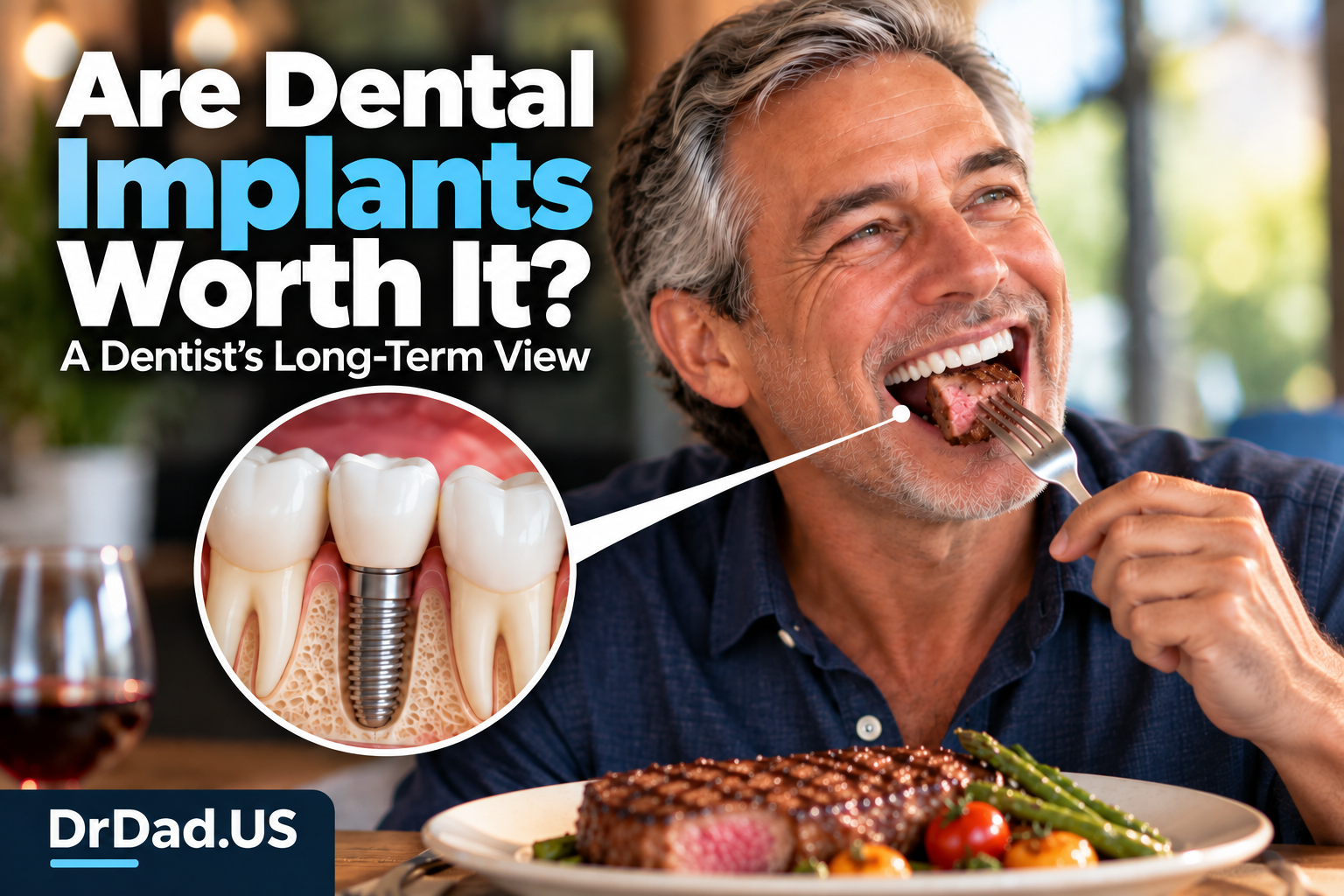
A dental implant replaces a missing tooth from the foundation upward. The implant fixture is placed in the jawbone, an abutment connects to it, and a crown restores the part you see and chew with.
One of the biggest reasons I value implants is their potential lifespan.
Patients often ask me, “How long do dental implants last?”
I never tell them an implant will last forever. Nothing in dentistry comes with that guarantee.
But the long-term research is impressive.
A 2019 systematic review and meta-analysis of contemporary implant systems estimated a 10-year implant survival rate of 96.4%. In a more conservative sensitivity analysis accounting for patients lost to follow-up, the estimate was 93.2%.
And we now have data extending much further.
A 2026 systematic review and meta-analysis of prospective studies following implants for at least 20 years estimated a 20-year implant survival rate of 93.0%.
Those numbers are not a guarantee for an individual patient. Dental implant lifespan depends on treatment planning, bone condition, implant position, oral hygiene, smoking, periodontal health, systemic health, bite forces, and long-term maintenance.
But they show why I consider a properly planned and maintained implant a serious long-term treatment.
The Crown May Age Before the Implant
There is something else patients should understand.
The implant and the implant crown are not the same thing.
The fixture is in the bone. Above it are restorative components, including the crown you chew with.
A systematic review of single implants followed for at least 10 years reported implant survival of approximately 95%, while survival of the original implant crowns was about 89.5%.
In other words, an implant may still be healthy even if the crown eventually needs to be replaced.
I sometimes compare this to a car.
If the tires wear out, you don’t necessarily replace the whole car. You replace the tires.
It’s not a perfect biological comparison, but patients immediately understand the idea.
If the implant fixture is healthy and well integrated with the bone, a worn, damaged, or problematic crown does not automatically mean the implant itself has failed.
Sometimes we simply need to deal with the part on top.
Dental Implant Maintenance Matters
Dental implants don’t get cavities the way natural teeth do, but that doesn’t mean they are maintenance-free.
The gum and bone around the implant still matter.
Inflammation can develop. Bone can be lost. Components can loosen or fracture. Dental implant failure can happen.
That’s why good dental implant maintenance matters.
Brush well. Clean around the implant. Keep regular dental examinations and professional cleanings. If you notice bleeding, swelling, discomfort, mobility, or a change in your bite, have it evaluated.
An implant is not something we put in and forget.
The goal is not simply to place an implant successfully.
The goal is to see it still functioning years later.
Is the Dental Implant Cost Worth It?
There is no question that dental implant cost can be significant.
But I don’t think the right way to evaluate an implant is only by asking what it costs today.
I think about what we are trying to accomplish over the long term.
We are replacing a missing part of the chewing system. We are trying to restore function and stability and create something that may serve the patient for many years.
So instead of asking only:
“How much does a dental implant cost?”
I would ask:
“What is the best long-term solution for my missing tooth?”
For an appropriate patient, longevity is one of the major reasons an implant can be worth the investment.
I Placed Dental Implants for My Own Parents
This is where the subject becomes personal.
About 10 years ago, I placed dental implants for my own parents.
They’re still using them today.
Earlier in my career, one of the things that made me happiest was seeing an implant I had placed years before.
The patient would come back. I would examine it.
Still there. Still healthy. Still functioning.
Another year passed. Still there.
Several more years passed. Still doing its job.
Seeing that used to make me genuinely happy.
But after doing implant dentistry for long enough, something interesting happened.
I started taking that success for granted.
Not because I care less.
Because it became normal.
Of course the implant is still there. It was there last year. It was there the year before. The patient is eating and chewing with it. Everything is functioning as it should.
And I think that may be one of the best things I can say about a successful dental implant.
A good implant eventually becomes boring.
You don’t wake up every morning thinking, “My implant is still there!”
You eat breakfast. You go to work. You have dinner. You chew your food.
You live your life.
And the implant simply does its job.
That’s what has happened with my parents.
About 10 years later, their implants aren’t something we celebrate anymore.
They’re simply teeth they use.
As the dentist who placed them—and as their son—I think that’s a pretty good definition of success.
Would I Get a Dental Implant Myself?
Absolutely.
If I lost a tooth tomorrow, had the proper examination and imaging, and determined that I was a good candidate, I would get a dental implant.
Not because implants are perfect. They’re not.
Not because they last forever. Nobody can promise that.
I would do it because I’ve seen what happens when teeth are missing. I’ve seen neighboring teeth move. I’ve seen changes in the bite. I’ve seen implants function for many years.
I’ve read the long-term research.
I’ve placed implants in my patients.
I’ve placed them in my own parents.
And I’ve watched successful implants become so normal that eventually nobody thinks about them anymore.
So, are dental implants worth it?
For the right patient, I believe they absolutely can be.
A properly planned, placed, restored, and maintained dental implant can function for many years—and eventually become something you don’t have to think about at all.
Sometimes, that’s the best sign that the treatment worked.
References
Howe MS, Keys W, Richards D. Long-term (10-year) dental implant survival: A systematic review and sensitivity meta-analysis. Journal of Dentistry. 2019;84:9–21. PMID: 30904559.
Hjalmarsson L, Gheisarifar M, Jemt T. A systematic review of survival of single implants as presented in longitudinal studies with a follow-up of at least 10 years. European Journal of Oral Implantology. 2016;9(Suppl 1):S155–S162. PMID: 27314122.
Lupi SM, Agolli J, Isola G, Scribante A. Dental implant survival and marginal bone loss after a minimum of 20 years: systematic review and meta-analysis of prospective studies. International Journal of Oral and Maxillofacial Surgery. 2026. PMID: 42173763.
This article is for general educational purposes only and is not a substitute for an examination, diagnosis, or individualized treatment plan from your dentist or another qualified healthcare professional.