
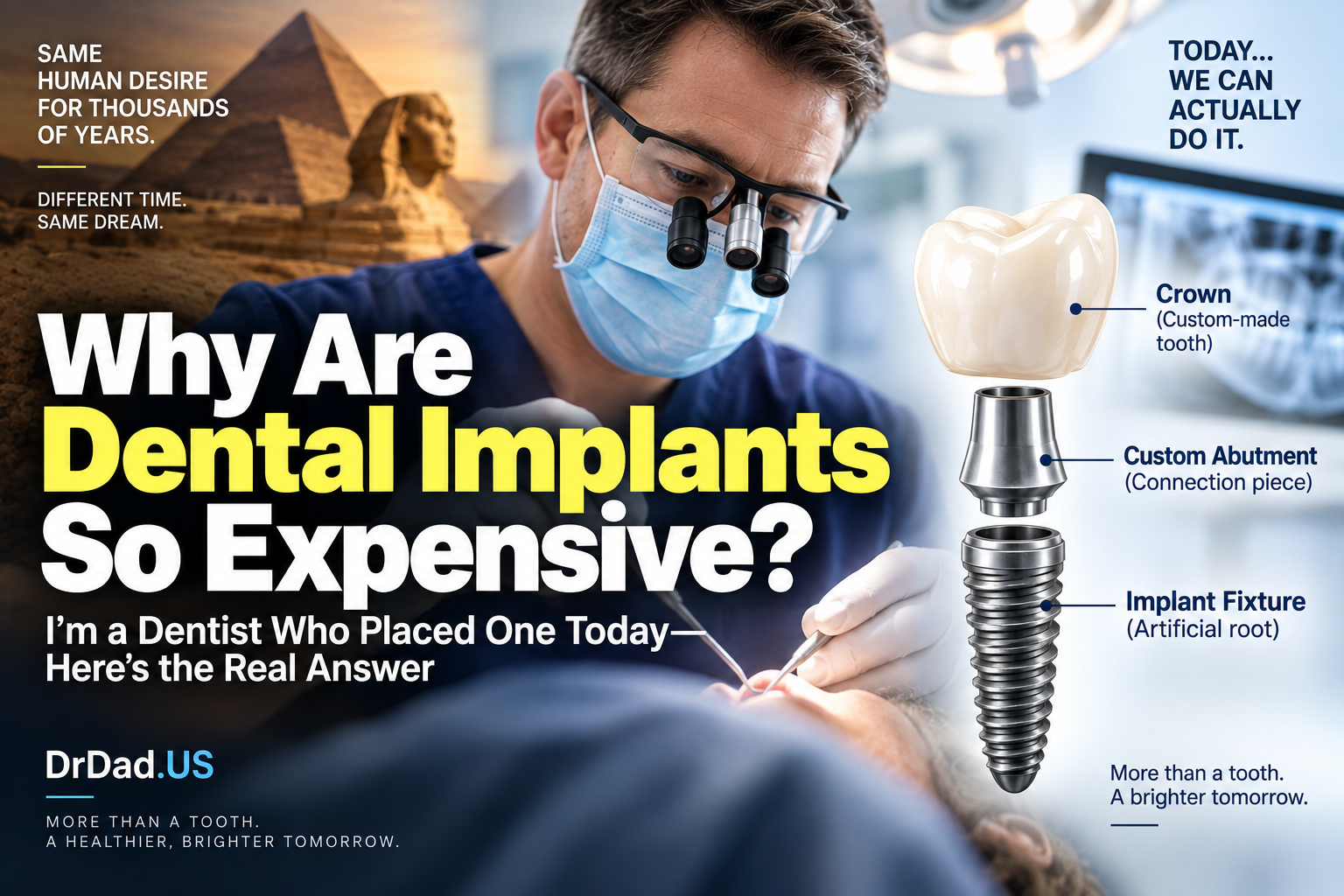
I placed a dental implant today.
But before I explain why dental implants can cost thousands of dollars, I want to go back thousands of years.
Humans Have Wanted to Replace Missing Teeth for Thousands of Years
The desire to replace missing teeth is not new.
Archaeological discoveries have shown that ancient people experimented with different materials to replace lost teeth. There are even ancient examples involving pieces of shell placed into the jaw where teeth were missing.
Think about that for a moment.
Thousands of years before modern dentistry, X-rays, anesthesia, titanium, or dental implants existed, human beings were already trying to find a way to replace a missing tooth.
Apparently, losing a tooth bothered people thousands of years ago just as much as it bothers us today.
They wanted to chew. They wanted to speak. They wanted to smile.
Most importantly, they wanted their tooth back.
For thousands of years, however, we simply didn’t have the science or technology to truly replace a missing tooth root inside the human jaw and build a functional tooth on top of it.
Today, we do.
As a dentist, I find that incredibly exciting.
I placed an implant today, and sometimes when I stop and think about what we are actually doing, it is remarkable.
We can place an artificial root into human bone, allow the bone to integrate with it, connect a precision-made component to that root, and then build a tooth on top that can look, feel, and function much like a natural tooth.
We are accomplishing something humans have wanted to do for thousands of years.
When I think about dental implants from that perspective, the price almost seems secondary.
Almost.
Then you receive an estimate for several thousand dollars to replace one tooth, and the obvious question comes back:
Why are dental implants so expensive?
That’s a fair question.
So let me explain what you’re actually paying for.
A Dental Implant Is Not Just an Implant
One of the biggest misunderstandings about dental implant cost is that patients often think they’re buying one artificial tooth.
They’re actually getting a system.
For a typical single-tooth replacement, there are three major components:
1. Implant Fixture — The Artificial Root
The implant fixture is placed surgically into the jawbone. It takes the place of the missing tooth root and is designed to integrate with the surrounding bone.
2. Custom Abutment — The Connection
The custom abutment is the precision connection between the implant fixture in the bone and the new tooth above it.
It may look like a small piece, but it plays an important role in how the final tooth is positioned and supported.
3. Implant Crown — The Tooth
Finally, there is the implant crown.
This is the part you actually see. It has to be designed to fit your mouth, work with your bite, and look appropriate next to the surrounding teeth.
So when you hear the words “dental implant,” remember that replacing one missing tooth can involve:
Implant fixture + custom abutment + implant crown.
Three highly engineered components working together to replace one natural tooth.
That’s already a lot of technology.
But we’re not finished.
Before I Place the Implant, I Need to Know What’s Under the Gums
This is where another major piece of modern implant dentistry comes in: the dental CT scan, commonly called a CBCT scan.
When I’m planning a dental implant, I don’t want to guess what’s underneath the gums.
I want to understand the height, width, and depth of the available bone.
I want to see the three-dimensional anatomy of the area.
I want to know where important anatomical structures are located.
I want to determine the appropriate position, angle, and length of the implant.
And I want to identify potential problems before surgery whenever possible.
A traditional dental X-ray gives us extremely valuable information, but it is still a two-dimensional image.
A CBCT gives us a three-dimensional view.
That can completely change the way an implant case is evaluated and planned.
The CT Scanner Is Expensive. But Owning One Isn’t Enough.
Dental CBCT machines are sophisticated and expensive pieces of equipment.
An office has to purchase the machine, maintain it, keep the software and systems working, and train people to use it properly.
But here’s something even more important:
Buying an expensive CT scanner doesn’t make someone a good implant dentist.
Someone has to interpret those images.
Someone has to understand what he or she is looking at.
Someone has to take all of that information and develop a treatment plan.
And then someone has to actually perform the surgery.
That’s where the dentist’s education, training, clinical judgment, experience, treatment planning, and surgical skill become part of the equation.
Technology can give me extraordinary information.
But I still have to interpret it.
I still have to plan the case.
And ultimately, I have to place the implant into the patient’s jaw.
The technology matters. The dentist using that technology matters just as much.
“But My Dentist Doesn’t Charge for the CT Scan.”
That’s possible.
Many dental offices don’t charge a separate fee for a CT scan when they’re doing implant treatment.
But that doesn’t mean the CT scan costs nothing.
The equipment still costs money. The software costs money. Maintenance costs money. And the professional time and expertise required to interpret the scan and incorporate it into the surgical plan also have value.
Some dental offices charge separately for those services.
Other offices incorporate some or all of those costs into the overall dental implant price.
Neither approach automatically makes one office better than another.
But it does make comparing implant prices more complicated than looking at a single number.
Don’t Ask Only, “How Much Is an Implant?”
This is probably the most practical advice I can give you.
If you’re calling dental offices and comparing dental implant prices, don’t ask only:
“How much is one implant?”
That number may not tell you what you think it tells you.
An advertised implant price may refer primarily to the implant fixture itself. The custom abutment and crown may be additional. Depending on your situation, there may also be costs associated with an extraction, bone grafting, imaging, or other necessary treatment.
So instead, ask a better question:
“What is the total cost to replace my missing tooth from beginning to end?”
That’s the number I would want to know if I were the patient.
Ask what is included.
Does the estimate include the CBCT scan?
Does it include the implant fixture?
The custom abutment?
The implant crown?
Does your particular case require a tooth extraction or bone graft?
Are there other procedures that could change the final cost?
Now you’re comparing the cost of replacing a missing tooth, not just an advertised implant price.
And that’s a much more meaningful comparison.
The cheapest advertised dental implant may not be the cheapest way to replace your tooth.
So, Why Are Dental Implants So Expensive?
Because you’re not simply buying a titanium screw.
You’re paying for an entire process designed to replace something nature originally made for you.
There is the implant fixture.
The custom abutment.
The implant crown.
There is 3D imaging and surgical planning.
There is the technology required to see the anatomy that isn’t visible from the outside.
And behind all that technology is a dentist who has to interpret the CT scan, plan the treatment, make clinical decisions, and actually perform the surgery.
I placed a dental implant today.
And after doing this work, I still occasionally stop and think about how extraordinary the idea really is.
Thousands of years ago, humans were already experimenting with ways to replace missing teeth.
Today, we can place an artificial root into the jawbone and build a new tooth on top of it.
That’s pretty amazing.
So yes, dental implants can be expensive.
But before deciding whether an implant is “too expensive,” make sure you know what you’re actually comparing.
Don’t just ask how much the implant costs.
Ask how much it will cost to replace your missing tooth—from beginning to end.
That’s the question that really matters.
This article is for general educational purposes only and is not a substitute for an examination, diagnosis, or individualized treatment recommendation from your dentist.