
A root canal in the United States commonly costs roughly $1,200–$1,500 out of network overall, although the actual fee varies by tooth, complexity, location, provider, and insurance coverage. [3] And the root canal itself may not be the entire cost. Depending on the tooth and how much structure remains, a filling or crown may be needed afterward.
That price can make patients wonder whether it would be easier to simply remove the tooth. But cost should be considered together with prognosis. A 2022 systematic review reported pooled primary root canal treatment success of 92.6% using looser outcome criteria and 82.0% using strict radiographic criteria. [1] Those numbers are not a guarantee for an individual tooth, but they show why root canal treatment remains an established way to preserve restorable teeth.
The better question is often: If this tooth can predictably be saved, what does it cost to save it—and what will it cost me if I lose it instead?
How Much Does a Root Canal Cost in the United States?
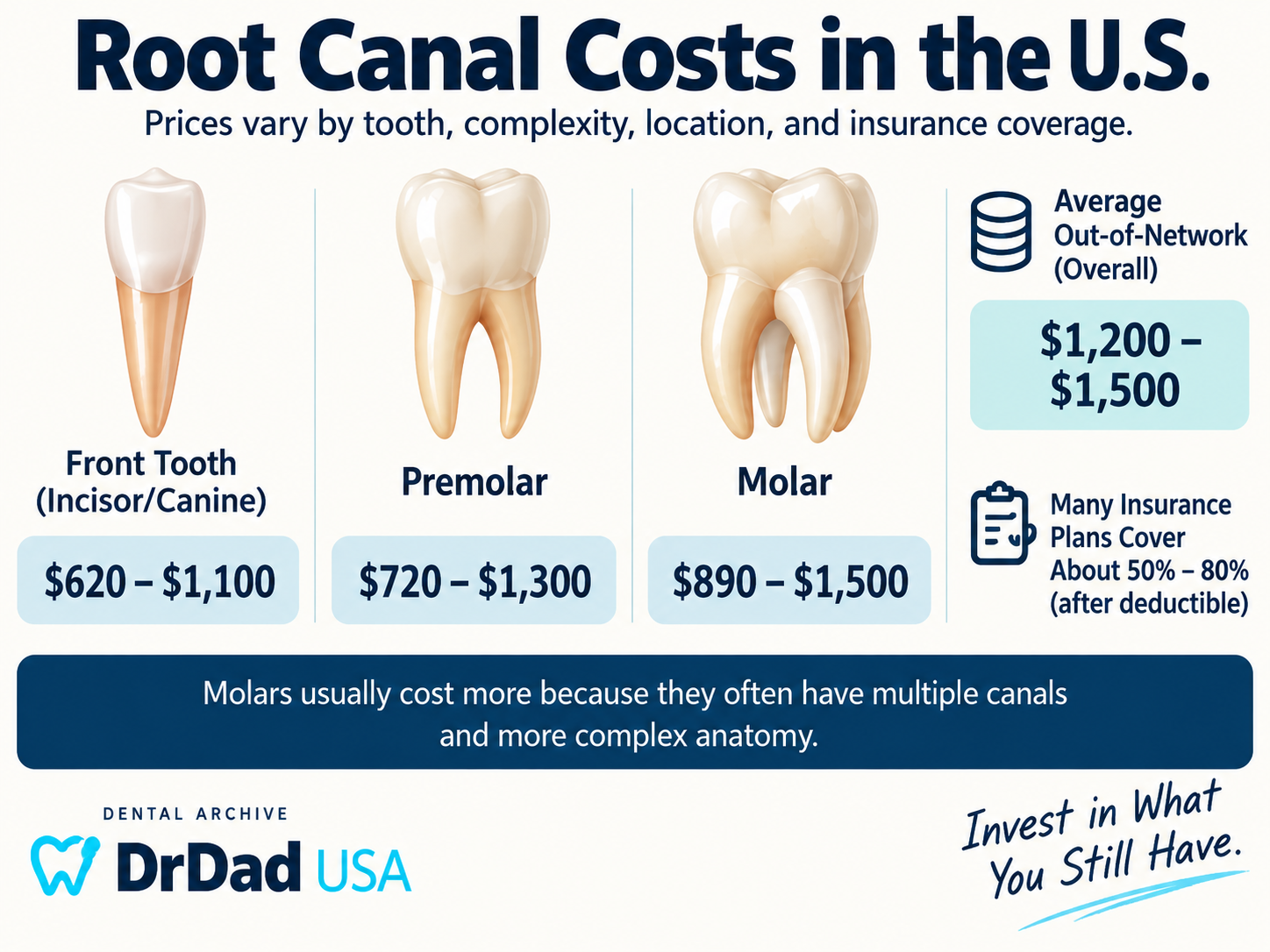
Consumer pricing references show that fees vary substantially by tooth. Front teeth are generally less expensive, while molars tend to cost more because their internal anatomy is often more complex. [3][4]
| Tooth Type | Broad U.S. Reference Range |
|---|---|
| Front tooth | $620–$1,100 |
| Premolar | $720–$1,300 |
| Molar | $890–$1,500 |
Why Is a Front-Tooth Root Canal Usually Cheaper?
The reason is not that a front tooth is less important. It is usually about anatomy and treatment complexity. Front teeth commonly have simpler canal systems, while premolars and especially molars may have multiple canals, curves, branches, and anatomical variations that take more time to locate, clean, shape, disinfect, and seal. [4][5]
That does not mean every molar has the same number of canals or that complexity increases in a perfectly predictable pattern as you move toward the back of the mouth. Dental anatomy varies from person to person and tooth to tooth.
Why Does a Root Canal Take So Long?
The part patients don’t see is often the part that takes the most time.
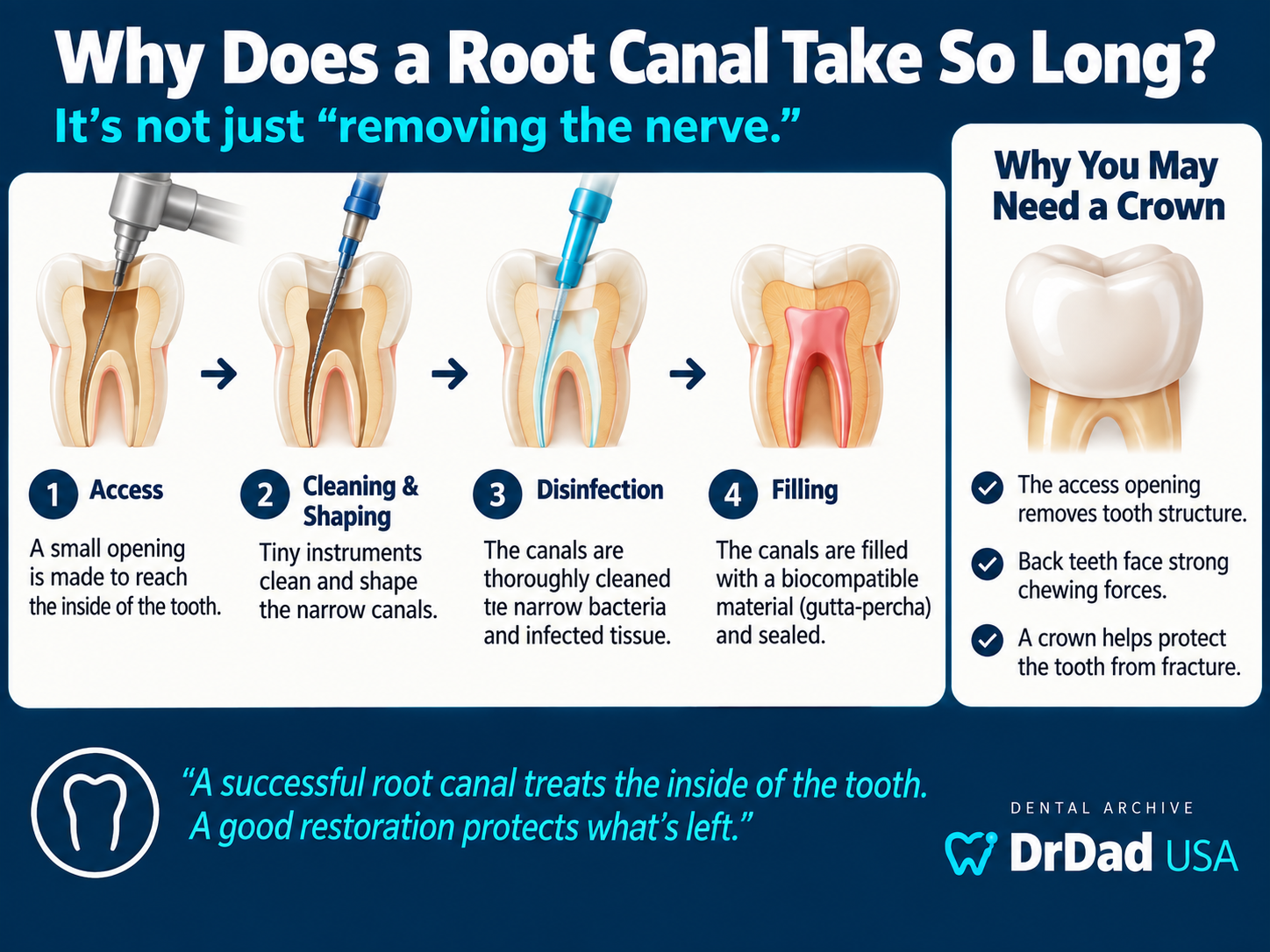
A dentist or endodontist must first create access to the inside of the tooth. Then tiny instruments are used to clean and shape the narrow root canals. The canal system is disinfected, prepared, filled with a biocompatible material, and sealed. [5]
In my clinical language, much of this time-consuming internal preparation can be thought of as root canal shaping. We are working inside spaces that are extremely small and cannot simply be scrubbed like the outside of a tooth.
What Are We Actually Putting Inside the Tooth?
After the canals have been cleaned, shaped, and disinfected, they are commonly filled with a biocompatible material called gutta-percha and sealed. [5] The goal is not simply to “remove the nerve.” The goal is to treat the infected or irreversibly damaged pulp space and seal the prepared canal system.
Does Root Canal Treatment Really Work?
Yes—but “success” has to be defined carefully. The 2022 systematic review of primary root canal therapy found pooled success of 92.6% under loose criteria and 82.0% under strict radiographic criteria. [1] A separate 2024 systematic review and meta-analysis of root-filled posterior teeth reported pooled tooth survival of about 91% at 4–7 years and 87% at 8–20 years. [2]
Success rate and tooth survival are not exactly the same measurement, and neither number predicts the outcome of one particular tooth. Prognosis depends on the diagnosis, remaining tooth structure, fractures, periodontal support, infection, anatomy, quality of treatment, restoration, bite forces, and other factors.
Then Why Do Some Root Canals Fail?
Teeth are biological structures with complicated anatomy. Persistent infection, previously untreated anatomy, leakage, new decay, fractures, periodontal disease, or problems with the final restoration can all affect the long-term result. A tooth that is technically treatable from an endodontic standpoint may still have a poor overall prognosis if there is not enough healthy structure left to restore it predictably.
Why You May Need a Crown After a Root Canal
Finishing the root canal and protecting the tooth are two different jobs.
To perform a root canal, we need an access opening through the tooth. The tooth may also have already lost structure from decay, an old restoration, or fracture. Posterior teeth then have to withstand substantial chewing forces. For these reasons, a crown or another appropriate cuspal-coverage restoration is often recommended for structurally compromised back teeth after root canal treatment. [5]
This does not mean every root-canal-treated tooth automatically requires a crown. The correct restoration depends on the tooth, location, remaining structure, bite, and clinical situation.
How Much Does the Crown Add?
A permanent crown can add roughly $1,100–$2,000 as a broad out-of-network consumer reference. [6] Using the broad ranges above, a molar root canal plus crown can therefore reach roughly $1,990–$3,500 before considering other procedures or insurance benefits. That is an illustration, not a treatment quote.
“Why Don’t I Just Pull It?”
Extraction may have a lower initial fee. But once the tooth is gone, the financial discussion changes. If you want to replace it, you may be considering an implant and crown, a bridge, or another prosthetic option—each with its own treatment requirements, time, risks, and costs.
Extraction may look cheaper today. Replacing the tooth tomorrow may be a very different financial calculation.
Root Canal vs. Implant: They Are Not Really Competing Treatments
An implant can be an excellent treatment when a tooth cannot reasonably be saved. Root canal treatment is intended to preserve a natural tooth that is still worth saving. So I do not view the decision as “root canal or implant—which technology is better?” The first question is whether the natural tooth has a reasonable restorative prognosis.
What About Dental Insurance?
Many dental plans provide partial coverage for root canal treatment, but benefits vary significantly. Consumer guidance commonly describes coverage in the neighborhood of 50%–80% after the deductible for some plans, but your actual benefit can be very different. [3] Network status, deductible, annual maximum, waiting periods, plan exclusions, and whether the final restoration is billed separately can all change your out-of-pocket cost.
Before treatment, ask for an estimate showing the root canal and the anticipated final restoration separately. Then compare that estimate with your specific insurance benefits rather than assuming a percentage.
When Would I Not Recommend Saving the Tooth?
Not every tooth should be saved at any cost. A severe non-restorable fracture, inadequate remaining tooth structure, extensive decay that cannot predictably be restored, advanced periodontal problems, or another poor-prognosis finding can make extraction the more reasonable treatment.
The key word is restorable. Root canal treatment can address the inside of a tooth; it cannot make a hopelessly fractured or non-restorable tooth structurally sound.
“But Doctor, It Doesn’t Hurt Anymore.”
Pain alone does not determine whether the pulp is healthy. Symptoms can change as pulpal disease progresses, and some infected teeth may have surprisingly little discomfort. Diagnosis should be based on the history, clinical examination, appropriate testing, radiographs, and the dentist’s findings—not simply on whether the tooth hurts at that moment.
So, Is Saving the Tooth Worth It?
If a tooth is restorable and has a reasonable prognosis, preserving the natural tooth can make excellent clinical and financial sense. If the tooth is hopeless, spending more money on it simply because it is “natural” may not make sense either.
If your dentist has made a proper diagnosis, can show you why the pulp is irreversibly damaged or infected, believes the tooth is restorable, and recommends root canal treatment with a reasonable prognosis, I would take that recommendation very seriously.
DrDad Tips
Root canal treatment is a long-established procedure, and modern evidence supports good outcomes in appropriately selected teeth. But I would not make the decision from a success-rate headline or a price tag alone.
Ask your dentist to show you why the tooth needs treatment. Look at the X-ray together. Ask about the diagnosis, whether the tooth is restorable, its individual prognosis, whether a crown is likely to be needed, and what happens if you choose extraction instead.
Do not remove a reasonably saveable tooth solely because extraction looks cheaper today. At the same time, do not spend heavily trying to save a tooth with a hopeless prognosis.
Save the tooth when the tooth is worth saving.
Disclaimer
This article reflects my professional experience and perspective as a practicing dentist and is provided for general educational and informational purposes only. It is not individualized dental or medical advice and does not establish a dentist-patient or doctor-patient relationship.
Root canal success, tooth survival, treatment cost, insurance coverage, the need for a crown, and whether a tooth can or should be saved depend on individual clinical circumstances. Factors may include the diagnosis, remaining tooth structure, fractures, decay, periodontal condition, infection, canal anatomy, previous treatment, bite, restorative options, medical and dental history, and other findings that cannot be assessed through a general article.
The cost figures in this article are broad U.S. reference ranges and are not treatment quotes. Actual fees and insurance benefits vary by provider, geographic area, treatment complexity, network status, deductible, annual maximum, and individual insurance plan.
Please consult your treating dentist or an appropriately qualified endodontist for an examination, diagnosis, prognosis, treatment options, and individualized cost estimate.
References
- Burns LE, Kim J, Wu Y, Alzwaideh R, McGowan R, Sigurdsson A. “Outcomes of primary root canal therapy: An updated systematic review of longitudinal clinical studies published between 2003 and 2020.” International Endodontic Journal. 2022;55(7):714–731. DOI: 10.1111/iej.13736. Used for pooled primary root canal treatment success estimates.
- “The tooth survival of non-surgical root-filled posterior teeth and the associated prognostic tooth-related factors: A systematic review and meta-analysis.” International Endodontic Journal. 2024. DOI: 10.1111/iej.14116. Used for pooled long-term survival estimates of root-filled posterior teeth.
- Delta Dental. “Root Canal Treatment Cost.” Used for broad U.S. consumer cost ranges and general insurance-cost context.
- American Association of Endodontists. “Root Canal Cost.” Used for the relationship between tooth location, treatment difficulty, and cost.
- American Association of Endodontists. “What Is a Root Canal?” and “Root Canal Explained.” Used for treatment steps, cleaning and shaping, gutta-percha, sealing, and post-treatment restoration guidance.
- Delta Dental. “Dental Crown Treatment Cost.” Used for broad consumer reference pricing for permanent crowns.