
Something has changed in my dental office over the years.
More and more of my male patients are asking about Botox.
And they don’t always ask in a shy, roundabout way.
Sometimes a patient just sits down in the chair and says:
“Doc, can you give me some Botox?”
I hear it often enough now that it no longer surprises me.
Years ago, cosmetic injectables were often talked about as if they were mainly for women. That is not what I see anymore. Men ask about Botox. Women ask about Botox. Patients of different ages ask about it.
Botox has become much more mainstream.
But then comes the question that creates all the confusion:
“Doctor, should I get Botox or filler?”
My answer?
What are we trying to fix?
Because Botox and filler are not competitors.
They are different tools for different jobs.
If you remember only one thing from this article, remember this:
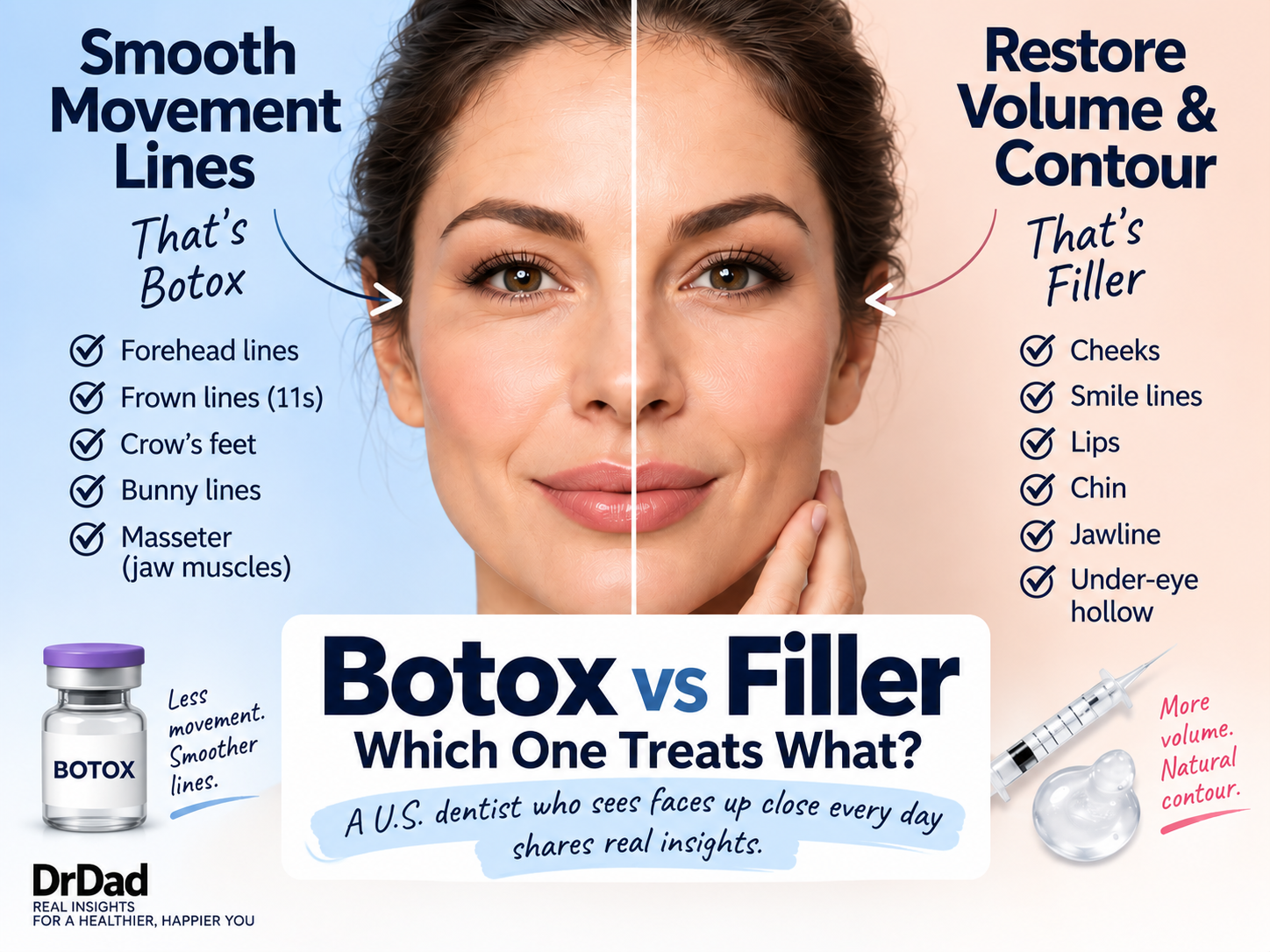
Botox relaxes movement. Filler restores volume.
That one sentence will clear up a lot of confusion.
Botox and Filler Are Not the Same Thing
Imagine you have two tools in your garage.
One is a screwdriver.
One is a hammer.
Which one is better?
That is the wrong question.
It depends on whether you have a screw or a nail.
Botox and dermal fillers work the same way conceptually. They can both improve facial appearance, but they solve different problems.
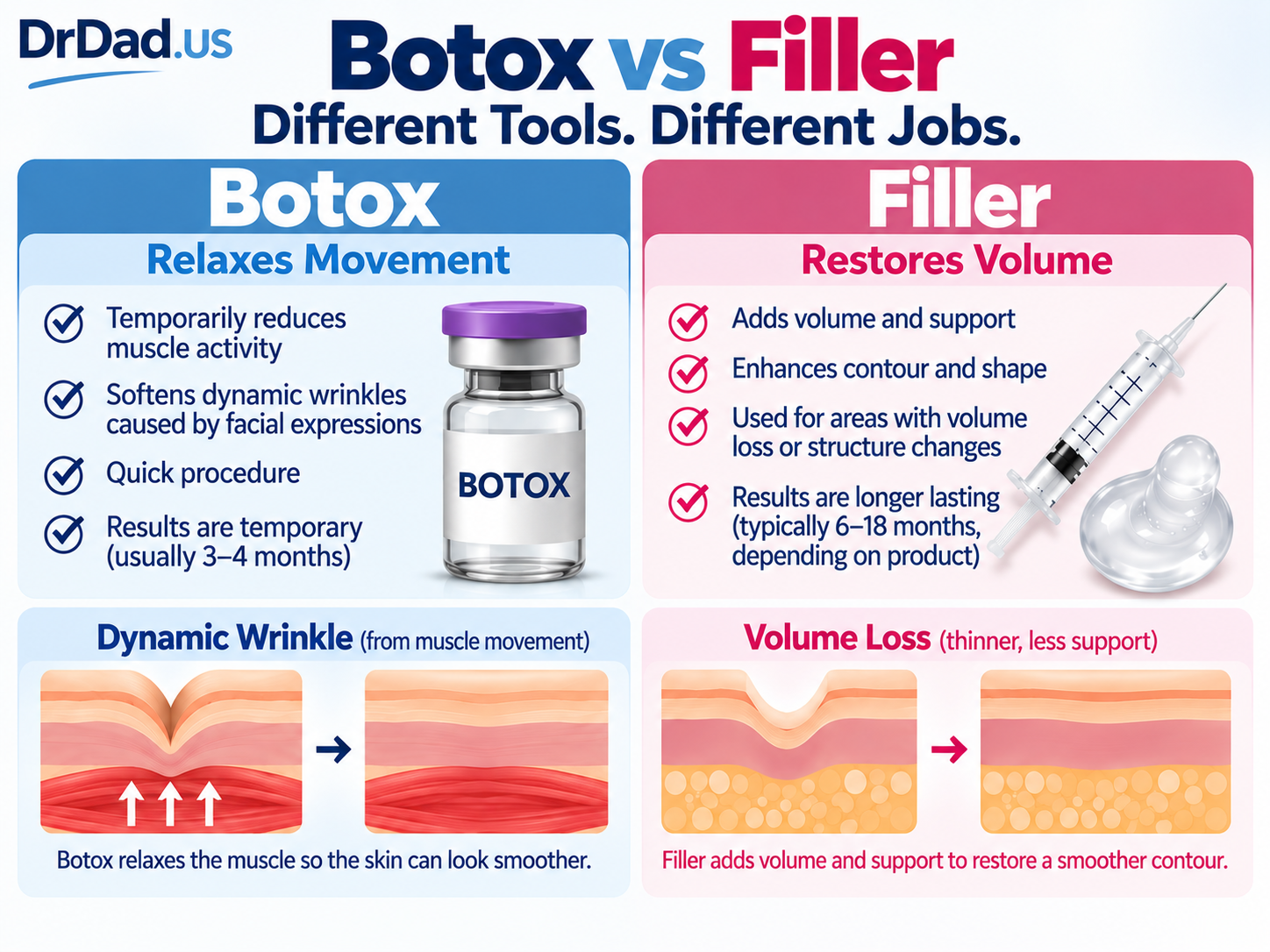
Botox temporarily reduces the activity of selected muscles.
Dermal filler adds volume, supports tissue, or changes contour.
So instead of asking:
“Which is better, Botox or filler?”
Ask:
“What is causing the thing I want to improve?”
Now we can make a sensible decision.
Botox: Think Movement
Make an angry face.
Raise your eyebrows.
Smile hard.
Squint.
Notice what happens?
Your facial muscles move the skin over and over again. Over many years, those repeated movements can contribute to lines becoming more noticeable.
That is where Botox can be extremely useful.
Botox does not “fill” a wrinkle.
It reduces selected muscle activity.
Movement problem → think Botox.
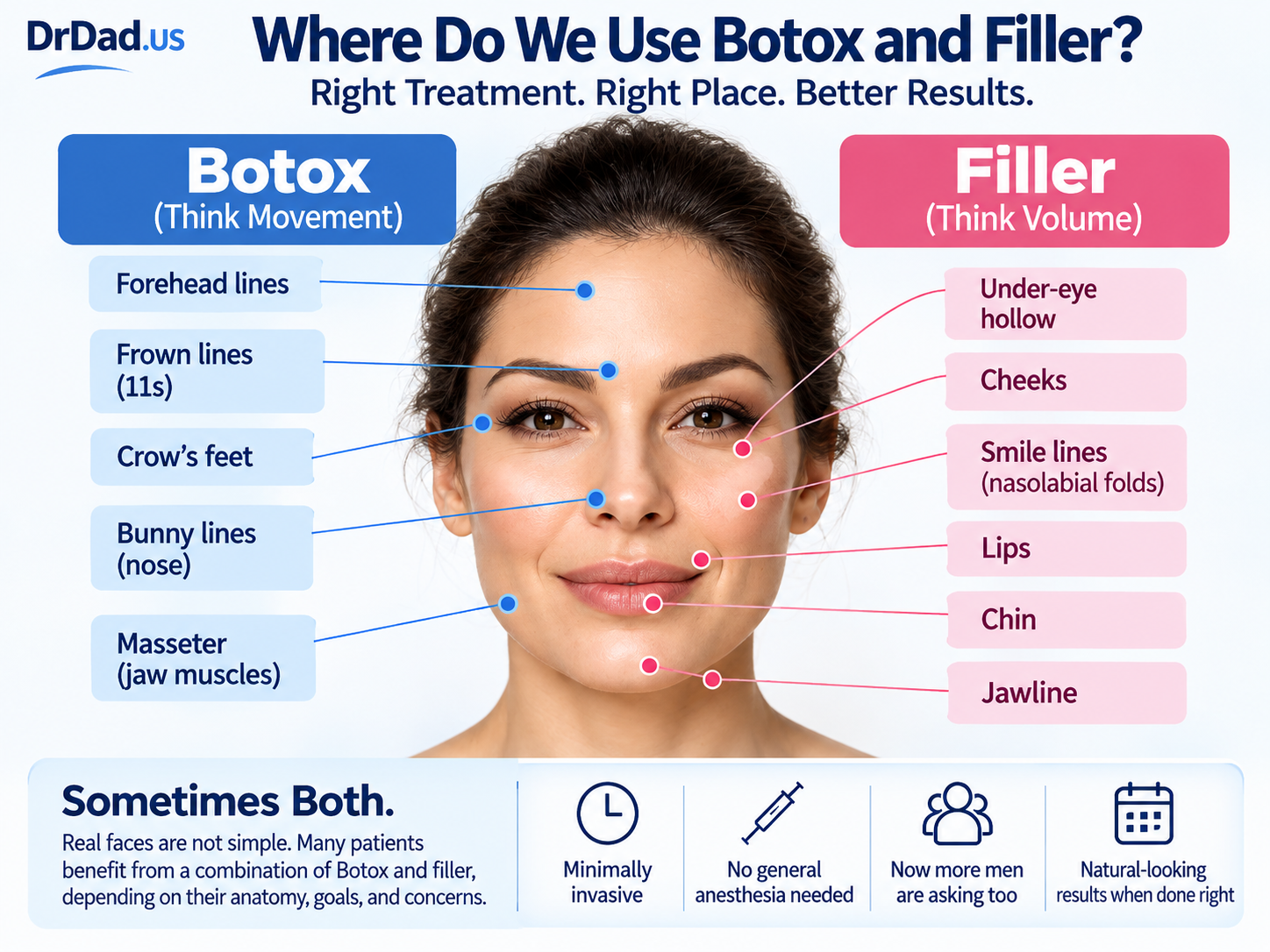
Forehead Lines
Raise your eyebrows and look in the mirror.
Those horizontal lines across your forehead are strongly influenced by movement of the frontalis muscle.
This is one of the classic areas where Botox is used.
The goal is generally not to create a forehead that looks like it has been laminated.
Good treatment should soften unwanted lines while maintaining an appearance that fits the patient.
Frown Lines — The “11s”
Now frown.
Those vertical lines between your eyebrows are commonly called the 11 lines.
They are another classic Botox area because the muscles between the eyebrows repeatedly pull the area inward and downward.
Some patients tell me:
“I look angry even when I’m not angry.”
That is exactly the kind of complaint where understanding muscle movement matters.
Crow’s Feet
Smile.
The little lines that fan outward from the corners of the eyes are called crow’s feet.
Again: Muscle movement.
So Botox may be used to soften them.
Bunny Lines
Some people develop small wrinkles along the sides of the nose when they smile or scrunch their nose.
These are sometimes called bunny lines.
They are also related to muscle movement and can be treated with botulinum toxin in appropriate patients.
Masseter Muscles
Botox is also used in selected patients in the masseter muscles—the large chewing muscles near the back of the jaw.
Depending on the patient’s anatomy and treatment goal, reducing masseter activity can change the appearance of a prominent lower face.
This is a little different from treating forehead wrinkles, but the principle is still the same:
We are changing muscle activity, not adding volume.
So Where Does Filler Come In?
Now forget movement for a moment.
Think about volume.
As faces age, they do not simply develop wrinkles.
Facial volume, fat distribution, skin, bone support, and tissue position all change.
Sometimes what a patient calls a “wrinkle” is actually related partly to loss of underlying support.
Botox cannot replace missing volume.
You cannot relax a hollow area back into being full.
That is where filler becomes useful.
Remember our second rule:
Volume problem → think filler.
Lips
This is probably the easiest example.
If someone wants additional lip volume or a change in lip contour, relaxing a muscle is not going to create that volume.
Filler can.
The important word here is appropriate.
More filler does not automatically mean a better result.
The goal should fit the patient’s anatomy, proportions, and expectations.
Cheeks
Cheek volume can change with age.
In appropriately selected patients, filler can be used to restore or enhance volume and contour.
Again, we are not treating excessive muscle movement.
We are addressing structure and volume.
Chin
Filler can also be used to alter the contour or projection of the chin in selected patients.
This is one of the reasons I don’t like describing filler simply as a “wrinkle treatment.”
Filler is often about shape and structure, not just wrinkles.
Jawline
Filler may also be used to enhance or support jawline contour.
And here is an interesting example of why Botox and filler should not be viewed as competitors.
For one patient, a lower-face concern may involve prominent masseter muscles.
For another, it may involve insufficient structural definition.
Those are different problems.
Different problems require different tools.
Smile Lines
Nasolabial folds—the lines extending from around the nose toward the corners of the mouth—are another area patients commonly ask about.
These are not simply a matter of “one wrinkle, one injection.”
Facial structure, cheek support, tissue position, skin quality, and anatomy can all contribute.
Filler may be considered in appropriate cases, but good treatment requires looking at the face as a whole rather than simply chasing a line with a syringe.
Under the Eyes
Under-eye hollows are another area where filler may be considered in carefully selected patients.
But this is an anatomically sensitive area, and not every under-eye concern is a filler problem.
Puffiness, skin changes, pigmentation, anatomy, and volume loss can look similar to patients but may require very different approaches.
This is a good example of why an experienced injector matters.
The Easy Way to Remember All of This
Here’s the DrDad memory trick:
Forehead moving too much? Botox.
Frown muscles making 11s? Botox.
Crow’s feet from smiling? Botox.
Lost cheek volume? Filler.
Want more lip volume? Filler.
Need chin or jawline contour? Filler may be an option.
And sometimes?
Both.
Because a real human face does not come divided into a Botox side and a filler side.
Muscle activity, volume, skin, bone structure, and aging all interact.
Why I Like Botox
Botox is one of those treatments that sounds much more dramatic before you’ve actually seen it performed.
For many patients, the procedure itself is relatively quick.
Yes, there are needles.
I am a dentist. I am not going to pretend a needle suddenly becomes a feather because we call the procedure “aesthetic.”
But today’s very fine needles—including extremely small-gauge needles—can make injections considerably more tolerable.
For many patients, the discomfort is brief.
And unlike many surgical cosmetic procedures, routine cosmetic Botox generally does not require general anesthesia or IV sedation.
That’s a meaningful advantage.
Botulinum toxin also has decades of clinical use behind it. We know far more about these products today than when they first entered aesthetic medicine.
Its effects are temporary, which can also be reassuring to patients.
However, temporary does not mean risk-free.
Bruising, swelling, headache, unwanted weakness or asymmetry, and eyelid or eyebrow drooping can occur. More serious adverse effects are uncommon but possible.
That is why something being common does not mean it should be treated casually.
And I Like Filler Too — With an Important Asterisk
Filler can produce beautiful results when the right product is placed in the right location for the right patient.
But filler deserves respect.
One category I particularly like discussing with patients is hyaluronic acid, or HA, filler.
Why?
Because HA fillers have an important practical advantage: they can be dissolved with an enzyme called hyaluronidase when clinically necessary.
That does not make them magically risk-free.
One of the most serious complications of dermal filler is accidental injection into or compression of a blood vessel, potentially causing a vascular occlusion.
Although serious vascular complications are uncommon, the consequences can be significant. Depending on the location and circumstances, tissue injury can occur, and rare cases involving vision loss or other serious complications have been reported.
This is exactly why I would not choose an injector based on who has the prettiest social-media page.
I care about something much less glamorous:
Do they know anatomy?
Do they have substantial injection experience?
Do they recognize complications quickly?
And do they know what to do if something goes wrong?
Those questions matter.
“But My Friend Got It and Looks Great”
Good.
Your friend also has your friend’s face.
You have yours.
This is one of the biggest mistakes people make with aesthetic treatment.
They bring in a photograph and say:
“I want this.”
But aesthetic treatment is not ordering a haircut from a menu.
Different people have different muscle strength, facial proportions, bone structure, fat distribution, skin quality, asymmetry, and aging patterns.
The treatment should follow the anatomy.
The anatomy should not be forced to follow Instagram.
Botox vs Filler: At a Glance
| If the concern is… | Usually think… |
|---|---|
| Forehead movement lines | Botox |
| Frown / 11 lines | Botox |
| Crow’s feet | Botox |
| Bunny lines | Botox |
| Prominent masseter muscles | Botox in selected patients |
| Lip volume or contour | Filler |
| Cheek volume | Filler |
| Chin projection or contour | Filler |
| Jawline contour | Filler |
| Smile lines / folds | Filler or another approach depending on cause |
| Under-eye hollow | Filler in carefully selected patients |
| Multiple causes | Sometimes a combination |
That table is useful.
But your face still needs to be examined by someone who knows what they are looking at.
Why Are So Many Men Asking About Botox Now?
This is one of the more interesting changes I’ve noticed in practice.
Male patients increasingly ask me about Botox without acting as though they are asking for some secret Hollywood procedure.
Sometimes it’s simply:
“Doc, can you give me some Botox?”
And I think that tells us something.
Aesthetic injectables have become mainstream enough that many men are now comfortable asking about them directly.
Often, they are not asking to look like a different person.
They may simply say they look tired.
Or angry.
Or older than they feel.
That is a much more useful conversation.
The question shouldn’t be:
“How much Botox can we put in?”
The question should be:
“What bothers you, what is causing it, and what is the smallest sensible treatment that addresses it?”
That philosophy applies to filler too.
Don’t Buy Syringes. Buy Judgment.
This may be the most important part of this article.
Patients naturally compare prices:
“How much per unit?”
“How much per syringe?”
“There’s a special this month.”
I understand.
Cost matters.
But with anything being injected into your face, I would put clinical judgment and experience considerably higher on the shopping list.
A syringe is a product.
Knowing whether you need it, where it belongs, how much to use, where not to put it, and what to do if something unexpected happens—that is professional judgment.
There is a big difference.
DrDad Tips
I like both Botox and filler when they are used appropriately.
Botox is especially useful when unwanted facial lines are being driven by repetitive muscle movement. Filler is useful when the problem involves volume, support, or contour.
Don’t choose between them because one is fashionable.
Choose the treatment that matches the problem.
For filler, I personally appreciate the additional practical advantage of hyaluronic acid fillers because they can be dissolved with hyaluronidase when necessary. That does not eliminate the possibility of serious complications, including vascular occlusion, so injector experience and anatomical knowledge remain extremely important.
And don’t be embarrassed to ask questions—even if you’re a guy who never imagined yourself asking about Botox.
Trust me.
I’ve heard it before.
“Doc, can you give me some Botox?”
My answer should never start with the syringe.
It should start with:
“Show me what bothers you.”
Because the best aesthetic treatment is not Botox.
It is not filler.
It is the right treatment, in the right place, for the right patient.
Disclaimer
This article is based on the author’s professional experience as a practicing dentist in the United States and is provided for general educational and informational purposes only. It is not a diagnosis, treatment plan, or personalized medical or dental advice. Botox and dermal fillers are medical treatments with potential risks, contraindications, and complications. Individual anatomy, medical history, medications, treatment goals, and applicable scope-of-practice rules can affect whether a procedure is appropriate. Consult a properly qualified healthcare professional with appropriate training and experience in aesthetic injectables for an individual evaluation and treatment recommendations.