

One of the reasons I became interested in Botox had nothing to do with an advertisement, a conference, or social media.
It started with one of my patients.
For years, I had assumed that she was in her 50s. Her skin simply looked remarkably good for what I thought was her age.
Then one day, I discovered that she was actually in her mid-70s.
I was genuinely surprised.
So I asked her:
“How do you keep your skin looking like this?”
She leaned toward me and quietly whispered:
“I get Botox.”
I never forgot that conversation.
Of course, one patient who looks unusually young is not scientific proof that Botox prevents aging. Genetics, sun exposure, smoking, skincare, facial anatomy, and many other factors influence how our faces age.
But that patient changed the way I thought about Botox.
Eventually, I began providing Botox treatment myself.
And after treating patients, I came to appreciate why botulinum toxin has become such a popular aesthetic procedure. When used appropriately, a relatively small treatment can produce a noticeable change without surgery.
But almost every new patient eventually asks the same question:
How much is Botox going to cost me?
The answer depends largely on where you want treatment, how strong your facial muscles are, and how many units you actually need.
Botox Cost Depends on How Much of Your Face You Treat
If you’re treating one area, your total cost will generally be lower than if you’re treating several areas of the face.
That sounds obvious, but it’s one of the reasons advertisements for Botox can be confusing.
Someone treating only a small area is not receiving the same treatment as someone treating the forehead, frown lines, crow’s feet, and other areas.
And someone treating the masseter muscles for a square jaw may require considerably more units than someone treating a few facial lines.
So when someone asks me:
“How much does Botox cost?”
My first thought is:
How much Botox are we actually talking about?
How Much Does Botox Cost Per Unit in the United States?
Many U.S. practices charge for BOTOX Cosmetic by the unit.
Pricing varies considerably by city, provider, practice, and promotions. As a practical benchmark, patients may encounter prices roughly in the $10–$25 per unit range, although some practices charge outside that range.
That means the price per unit is only half of the equation.
If a practice charges $15 per unit, for example:
20 units = about $300
40 units = about $600
60 units = about $900
The number advertised per unit doesn’t tell you what your final bill will be. The number of units you actually receive does.
What Does Botox Cost by Treatment Area?
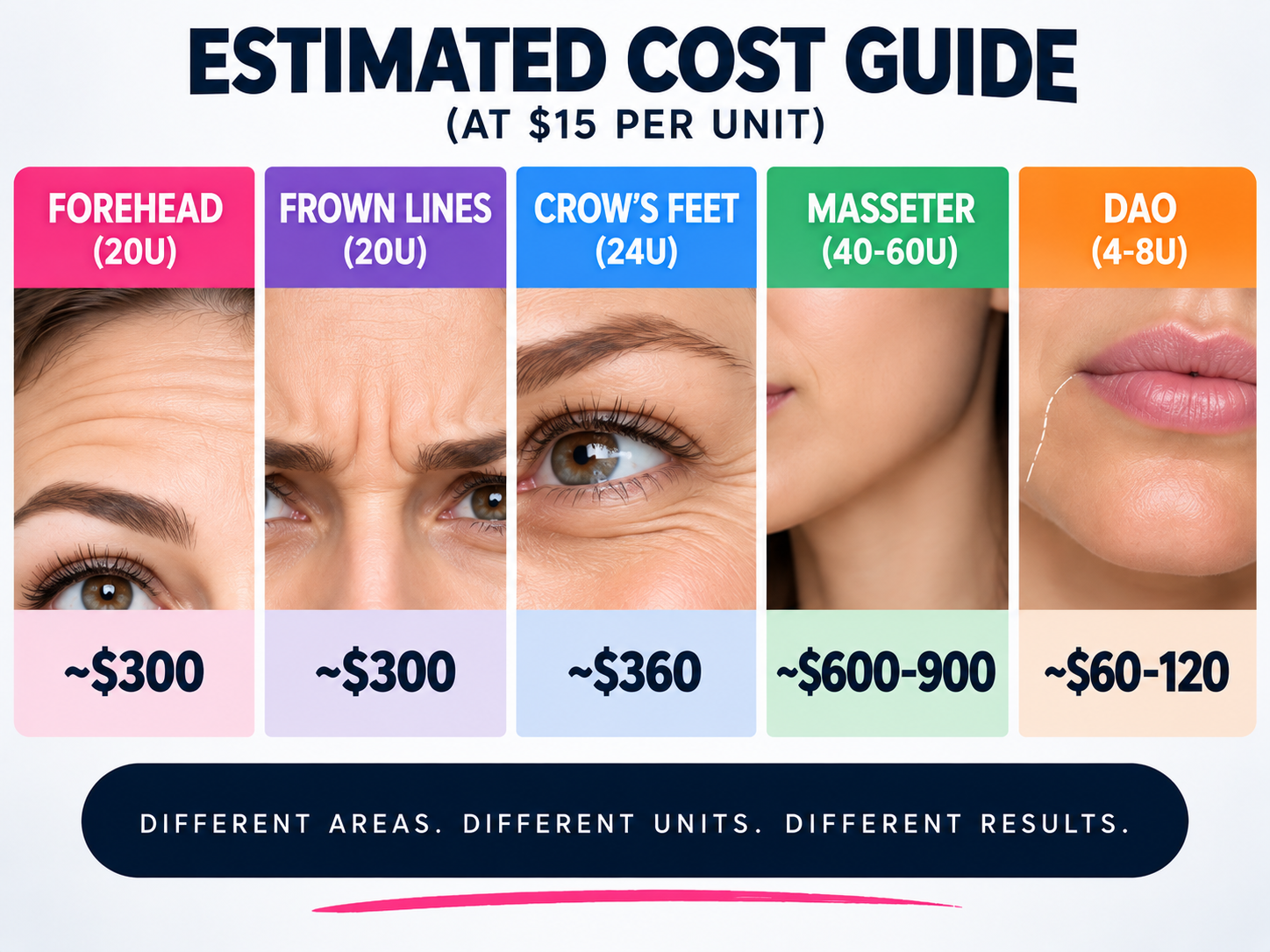
Here’s a practical way to understand it. Using $15 per BOTOX Cosmetic unit simply as an example:
| Treatment area | Approximate BOTOX units | Example cost at $15/unit |
|---|---|---|
| Forehead lines | 20 units* | ~$300 |
| Frown lines / “11s” | 20 units | ~$300 |
| Crow’s feet | 24 units total | ~$360 |
| Forehead + frown lines + crow’s feet | 64 units | ~$960 |
| DAO / downturned mouth corners | ~4–8 units total** | ~$60–$120 |
| Masseter / square jaw slimming | ~40–60 units total (20–30/side)*** | ~$600–$900 |
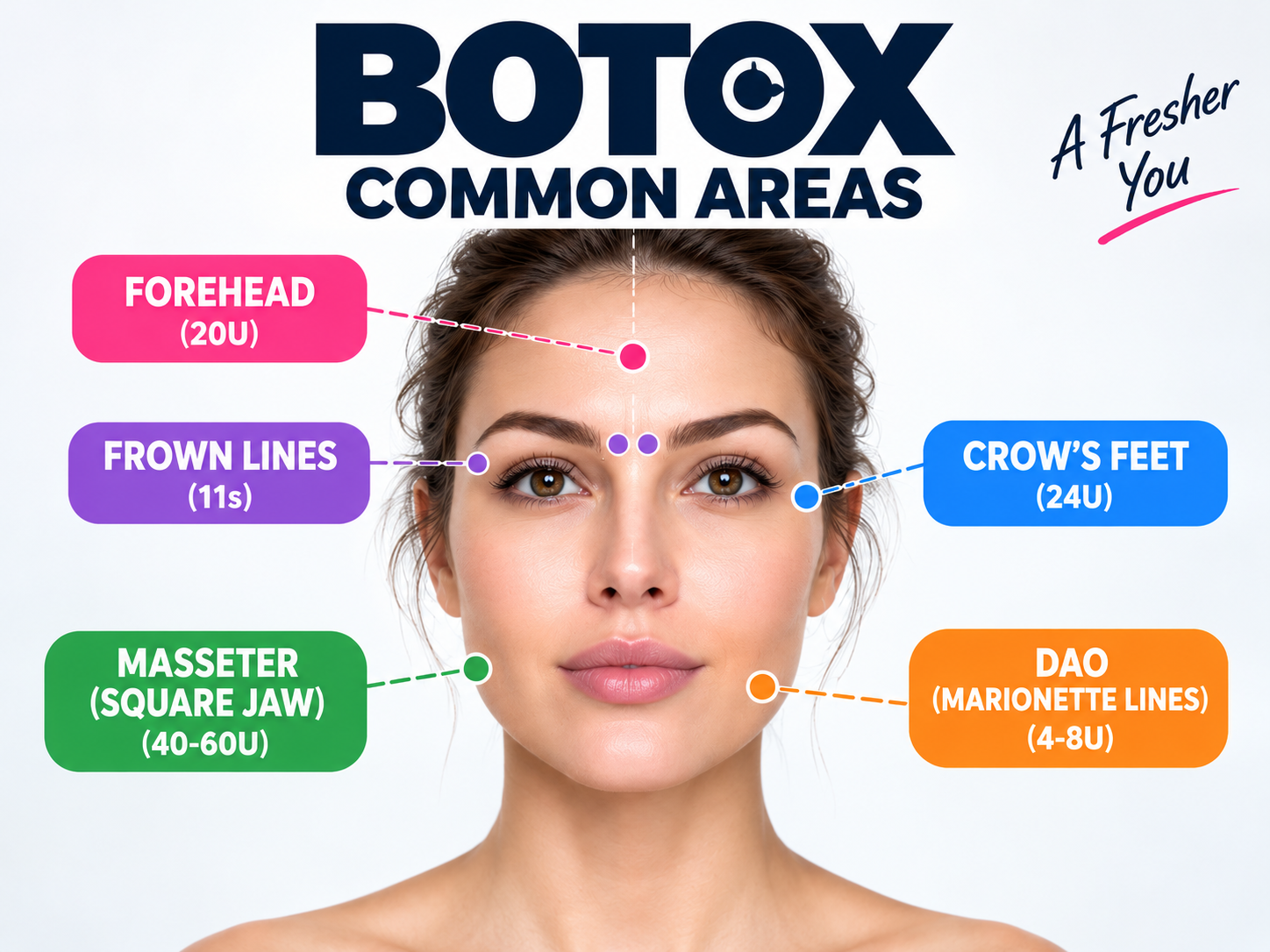
For BOTOX Cosmetic, FDA-labeled dosing is 20 Units for glabellar lines and 24 Units for lateral canthal lines, or crow’s feet. The labeled forehead regimen uses 20 Units in the frontalis together with 20 Units in the glabellar region, for a total of 40 Units. Treating all three approved upper-face areas totals 64 Units.
These numbers are useful reference points, but they are not a prescription for every face.
Actual dosing should be individualized according to anatomy, muscle activity, treatment goals, and clinical judgment.
* The FDA-labeled forehead-line regimen includes simultaneous treatment of the glabellar area.
** DAO treatment and cosmetic masseter treatment for jaw slimming are off-label uses in the United States.
One Important Point About “Forehead Botox”
Patients often say: “I just want Botox in my forehead.”
But the forehead isn’t an isolated piece of anatomy.
The frontalis helps elevate the eyebrows, while muscles in the glabellar complex contribute to pulling them downward and inward. That balance matters.
For BOTOX Cosmetic, the FDA-approved forehead-line regimen therefore includes treatment of the glabellar region as well. The labeled total is 40 Units—20 Units for the forehead lines plus 20 Units for the glabellar lines.
This is one reason I don’t think patients should choose treatment simply by saying: “Give me the cheapest 20 units you can.”
Where those units go matters enormously.
What About the Marionette Lines?
People sometimes ask about putting Botox into their marionette lines, the lines that travel downward from the corners of the mouth.
But Botox does not fill a deep crease or replace lost facial volume.
In selected patients, botulinum toxin can instead be used in the depressor anguli oris, or DAO, a muscle that helps pull the corners of the mouth downward.
Relaxing that downward pull can sometimes improve a downturned appearance around the mouth.
Published clinical recommendations generally involve only a few units per side, but this is an off-label cosmetic use, and dosing needs to be conservative because the muscles around the mouth have important functions.
More importantly, if the marionette appearance is primarily caused by volume loss, skin laxity, or structural aging, simply injecting more Botox isn’t necessarily the answer.
Botox relaxes muscle. It doesn’t replace volume.
What About Botox for a Square Jaw?
Botox isn’t only used for wrinkles.
Another common aesthetic application is the masseter muscle.
The masseter is one of the major muscles involved in chewing. In some people, these muscles are naturally large or become quite prominent. That can contribute to a wider, more square appearance of the lower face.
By reducing masseter muscle activity with botulinum toxin, the muscle can gradually decrease in prominence, creating a slimmer lower-face appearance in appropriately selected patients.
And because the masseter is a much larger and stronger muscle than many of the small muscles we treat for facial wrinkles, masseter Botox often requires considerably more units.
A commonly reported cosmetic range for BOTOX is approximately 20–30 units per side, or roughly 40–60 units total, although actual dosing varies substantially depending on muscle size, strength, anatomy, and treatment goals.
At our hypothetical price of $15 per unit, that would put a typical 40–60-unit treatment at approximately $600–$900.
But there is an important anatomical point here: not every square jaw is caused by a large masseter.
If someone’s lower-face width comes primarily from the underlying mandible rather than muscular hypertrophy, Botox cannot make the bone narrower.
Cosmetic masseter reduction is also an off-label use of BOTOX in the United States.
How Many Botox Units Do You Really Need?
Two people of exactly the same age can need very different treatment plans.
One patient may have relatively mild facial muscle activity and want only subtle softening. Another patient may have very strong muscles and prominent dynamic wrinkles.
The same is true of masseters. One person’s masseter may be relatively small, while another person’s can be remarkably strong and prominent.
I don’t think the goal should automatically be: “Give me as many units as possible.”
But I don’t think it should be: “Give me the absolute minimum because I want the cheapest treatment.”
The goal is to use an appropriate amount for your anatomy, muscle strength, and desired result.
Too little may not give you the result you wanted. Too much—or injections placed in the wrong location—can create unwanted effects.
Botox is extremely effective. But it is still a medical procedure.
Why Are People Getting Botox in Their 20s?
Botox is no longer something people think about only in their 40s or 50s. Some adults now start in their 20s.
You’ve probably heard the term: “Preventive Botox.”
Many facial wrinkles begin as dynamic wrinkles.
Raise your eyebrows. Frown. Squint. Smile.
Your skin repeatedly folds along similar lines. When you’re young, those lines may disappear almost completely when your face relaxes. Over time, some can become increasingly visible even when you’re no longer making the expression.
Once a deeply established static line develops, simply reducing muscle movement does not necessarily make that crease disappear completely.
That’s one reason some younger adults choose to reduce excessive repetitive muscle movement before those lines become deeply established.
There is scientific interest in this concept, but I would be careful not to oversell it. Long-term evidence showing that everyone should begin Botox in their early 20s to prevent future wrinkles is limited.
Botox can reduce the muscle activity that contributes to dynamic wrinkles. It does not stop aging.
Should Everyone Start Botox at 20?
No.
I wouldn’t choose Botox based on a birthday. I would look at the face.
Some people in their 20s have extremely strong facial muscle activity and already develop noticeable lines when they make expressions. Other people at the same age have very little.
If you’re 22, have almost no visible lines, and you’re happy with your appearance, there isn’t some rule saying you need Botox because everyone on social media seems to be getting it.
But if you have strong repetitive movement in a particular area and those lines bother you, discussing conservative treatment with an experienced provider can be reasonable.
The treatment should fit the patient. Not the trend.
If You Really Don’t Want the Wrinkles to Return, Consistency Matters
Here’s something patients sometimes forget: Botox is temporary.
Muscle activity gradually returns. Eventually, the facial movement responsible for those dynamic wrinkles returns as well.
So Botox isn’t something you do once at 25 and expect to last until you’re 65.
If maintaining the effect matters to you, treatment generally needs to be repeated.
Don’t just ask: “How much is my Botox appointment?”
Ask: “How much do I need, how frequently will I want treatment, and what will this cost me over time?”
For example, a hypothetical $600 treatment repeated several times a year is a very different financial commitment from a small $150 treatment performed occasionally.
That’s the real cost of Botox.
What About Botox Resistance?
This becomes particularly interesting if someone starts relatively young and expects to receive botulinum toxin treatment for many years.
Patients sometimes call it “Botox resistance.”
Neutralizing antibodies to botulinum toxin can occur, and in some circumstances they can contribute to reduced treatment effectiveness.
But if your Botox doesn’t seem to work as well one time, that does not automatically mean you’ve developed resistance.
Dose matters. Placement matters. Technique matters. The muscle being treated matters. Treatment intervals matter. And the specific product matters.
Modern botulinum toxin type A products also differ in formulation and manufacturing characteristics.
I would therefore be cautious about any claim that a particular product has “zero resistance.”
For someone planning repeated treatment over many years, it is reasonable to discuss product selection, dosing, and treatment intervals with the treating professional.
Don’t Compare Botox, Dysport, Xeomin, and Other Products Unit-for-Unit
If one office advertises Botox at one price per unit and another advertises a different botulinum toxin product at a lower price per unit, you cannot necessarily conclude that the second treatment is cheaper.
The units of different botulinum toxin products are not directly interchangeable.
Understand which product is being used, how much is being recommended, and what the total treatment will cost.
Botox Is Excellent—But Injector Skill Matters
I like Botox. A lot.
For the appropriate patient, it is one of my favorite types of aesthetic treatment.
A few carefully placed injections can make a meaningful difference without surgery and with relatively little interruption to everyday life.
But its apparent simplicity can be deceptive.
You aren’t simply injecting a wrinkle. You are altering the activity and balance of facial muscles.
The forehead, eyebrows, glabella, eyelids, muscles around the mouth, and masseters all have anatomical relationships and functions that need to be respected.
That’s why I don’t believe the cheapest price per unit should determine who injects your face.
If one office charges $10 per unit and another charges $15 or $20, don’t look at that number alone.
Ask: Who is injecting me? How many units are being recommended? Why are they recommending that amount? Where will those units be placed? What result are we trying to achieve?
Those questions matter much more than saving a few dollars per unit.
So, Is Botox Worth the Money?
For someone who is bothered by dynamic facial wrinkles, understands the limitations of the treatment, and accepts that the results are temporary, Botox can be an excellent aesthetic procedure.
But I would think about the cost differently than many people do.
Don’t just ask: “How much is one unit?”
Ask: How many areas am I treating? How many units are appropriate for my anatomy? How often do I want to maintain the result? What will my real annual cost be? And who is actually doing the injections?
Those questions tell you much more about the value of the treatment than an advertised unit price.
Botox can be a remarkably effective treatment when it is used for the right patient, in the right muscles, at the right dose. The goal isn’t simply to use more Botox. The goal is to use the right amount in the right place.
This article is for general educational purposes only. Botox dosing, treatment areas, suitability, risks, and costs vary by patient and provider. Some uses discussed above are off-label. An individualized evaluation by an appropriately qualified healthcare professional is necessary before treatment.