
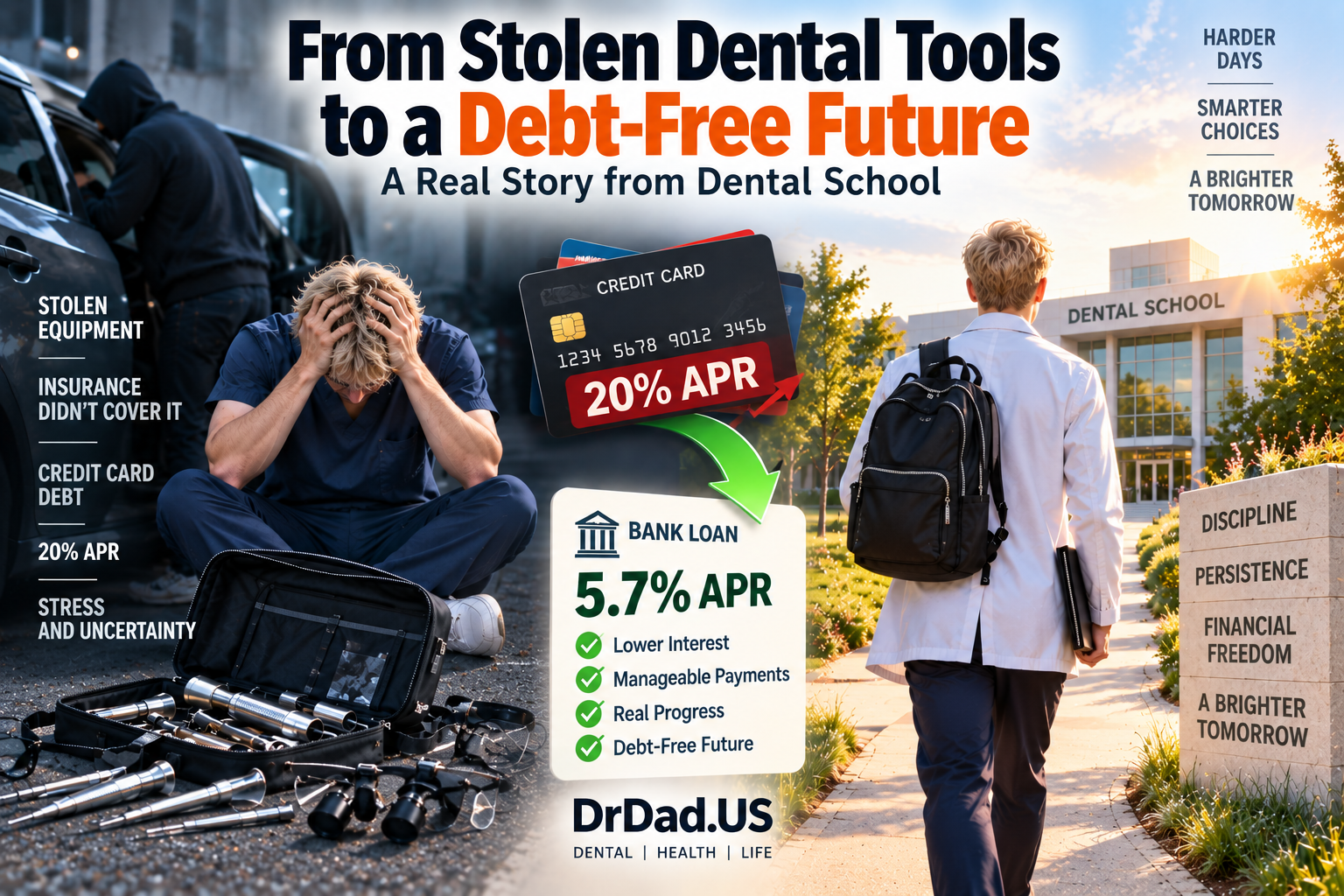
There was a time when a credit card statement could ruin my entire day.
It was during dental school.
Money was already tight. School consumed most of the day, part-time work filled some of the remaining hours, and there wasn’t much left for anything else.
Then one careless mistake made everything worse.
I forgot to lock my car.
The Day Everything Disappeared
Dental students carry around equipment most people never think about.
Handpieces. Hand instruments. Loupes. Other tools needed for clinic and lab.
We moved between different clinical and laboratory settings, and much of that equipment had to travel with us. These weren’t optional gadgets sitting in the trunk.
They were the tools needed to treat patients and get through dental school.
One day, someone opened my unlocked car and stole them.
Imagine being a student with very little money and walking up to your car expecting another ordinary school day.
Then you realize your equipment is gone.
First comes disbelief.
You look again.
Maybe it’s somewhere else.
Then you realize what happened.
And immediately another thought arrives:
How am I going to replace all of this?
There was no option to simply stop going to clinic.
The equipment had to be replaced.
An insurance claim seemed like the obvious solution. But as I remember it, the auto insurance didn’t cover the stolen dental equipment because those items weren’t considered part of the vehicle, or something along those lines.
This happened many years ago, so I don’t remember the exact insurance language.
I remember the feeling.
The equipment was gone, the insurance wasn’t paying, and a dental student somehow had to find the money to replace it.
The Credit Card Solved One Problem—and Created Another
The quickest solution was a credit card.
The necessary equipment was purchased again, and school continued.
Problem solved.
Except it wasn’t.
Now there was credit card debt, and the interest rate was around 20% APR.
That’s when the stress really began.
A credit card can be incredibly useful during an emergency. You can solve a several-thousand-dollar problem in minutes.
But afterward, the bill arrives.
And then another.
When money is already tight, a high-interest balance can feel like you’re walking uphill while someone keeps making the hill steeper.
Payments were going out, but interest kept appearing.
Working more helped.
Spending less helped.
There wasn’t much money going toward dates, vacations, or entertainment anyway. Dental school and part-time work didn’t leave much time or money for those things.
But something about that credit card balance bothered me.
Why was so much money going toward interest instead of making the debt disappear?
That question changed everything.
Then I Started Looking at the APR
The breakthrough wasn’t earning a huge amount of money.
It wasn’t discovering some secret investment.
It was much simpler.
APR shopping.
If the credit card was charging roughly 20% APR, did the debt really have to stay there?
The answer was no.
After looking around, a bank loan became available at approximately 5.7% APR.
That was the moment the problem began to look different.
The debt itself hadn’t changed.
But the cost of carrying the debt could.
So the high-interest credit card debt was moved into the much lower-interest bank loan.
Approximately:
20% APR → 5.7% APR
That didn’t erase a single dollar of principal.
But suddenly the fight felt fairer.
Sometimes You Don’t Need to Eliminate the Debt Overnight. You Need to Change the Math.
Consider $10,000 in credit card debt.
Twenty percent of $10,000 is $2,000. At 5.7%, the comparable simple annual figure is $570.
That’s a difference of $1,430.
Actual interest savings won’t work exactly like that because balances decline as payments are made, and loans can have different fees, terms, and compounding methods.
But the example shows why credit card APR matters.
When you’re paying a very high interest rate, reducing that rate can allow more of your money to work toward eliminating the debt rather than servicing expensive interest.
That’s why someone carrying high-interest credit card debt today should at least investigate whether a lower-interest personal loan, debt consolidation loan, or balance transfer could reduce the cost.
Not everyone will qualify.
And a lower advertised payment doesn’t automatically mean a better loan.
But the APR is worth shopping.
The Debt Still Had to Be Paid
Lowering the interest rate created breathing room.
It didn’t create money.
The next part was boring.
Work.
School.
Payments.
Repeat.
Expenses stayed low. Part-time work continued. Going out wasn’t much of a priority.
Every payment pushed the balance a little lower.
As I remember it, the whole process took roughly two years.
Two years can feel like forever when you’re a student staring at debt.
But something interesting happens with time.
It passes whether you want it to or not.
Eventually, the balance that once seemed overwhelming became smaller.
Then smaller again.
And finally:
Zero.
The dental equipment theft that once felt like a financial disaster became an old story.
How I’d Attack $10,000 in Credit Card Debt Today
If someone handed me a statement today showing $10,000 in credit card debt at 20% APR, the first question wouldn’t be:
“How can I pay this 20% debt faster?”
It would be:
“Why am I still paying 20%?”
I’d investigate whether my credit and income allowed me to move the balance to something substantially cheaper.
That could mean a personal loan to pay off credit card debt, a debt consolidation loan, or possibly a 0% APR balance transfer credit card.
But every option needs careful comparison.
For a personal loan, look at the APR, origination fees, loan term, monthly payment, and total repayment.
For a balance transfer, look at the transfer fee, how long the promotional rate lasts, and what the APR becomes afterward.
The objective isn’t simply to move debt from one account to another.
The objective is to make the debt cheaper while destroying it.
There’s One Big Trap
Suppose you owe $10,000 on credit cards.
A lower-interest loan pays those cards off.
Now the cards show:
$0 balance.
That can feel fantastic.
But you’re not debt-free.
The $10,000 still exists. It simply moved to a cheaper place.
If those credit cards get used again and another $10,000 accumulates, the situation becomes much worse.
Now there could be a $10,000 loan plus $10,000 in new credit card debt.
So refinancing high-interest credit card debt only works if the old balance isn’t recreated.
That was the discipline required after moving my own debt from roughly 20% to 5.7%.
The lower APR created an opportunity.
Living carefully and continuing to make payments finished the job.
Two Years Later, the Problem Was Gone
Looking back, the most memorable part isn’t actually the stolen dental equipment.
It’s how enormous the problem felt at the time.
A student doesn’t see the next 20 or 30 years.
He sees the next credit card bill.
The next tuition payment.
The next clinic session.
The next shift at a part-time job.
When you’re standing inside a financial problem, it can look permanent.
But it isn’t necessarily permanent.
That frightened dental student eventually finished school.
The loan eventually reached zero.
The stolen instruments were replaced.
Life continued.
And the experience left behind a lesson that still makes sense today.
If you’re carrying $10,000 in high-interest credit card debt, don’t only stare at the balance.
Look at the APR.
See whether you can responsibly lower the interest rate.
Stop adding new debt.
Keep working.
Keep paying.
Give the process time.
The smartest thing I did wasn’t paying a 20% credit card faster.
It was realizing that I didn’t have to keep paying 20%.
The debt moved from roughly 20% APR to 5.7% APR.
Then, little by little, the balance moved toward zero.
At the time, two years seemed painfully long.
Today, two years seems like a very small chapter of a much longer life.
Debt can feel permanent when you’re inside it. Sometimes the first glimpse of hope is simply realizing that the numbers can be changed.
This article is for general educational purposes and reflects personal experience, not individualized financial advice. Interest rates, loan eligibility, fees, balance-transfer terms, and appropriate debt strategies vary. Compare the full cost and terms carefully before refinancing or consolidating debt.