
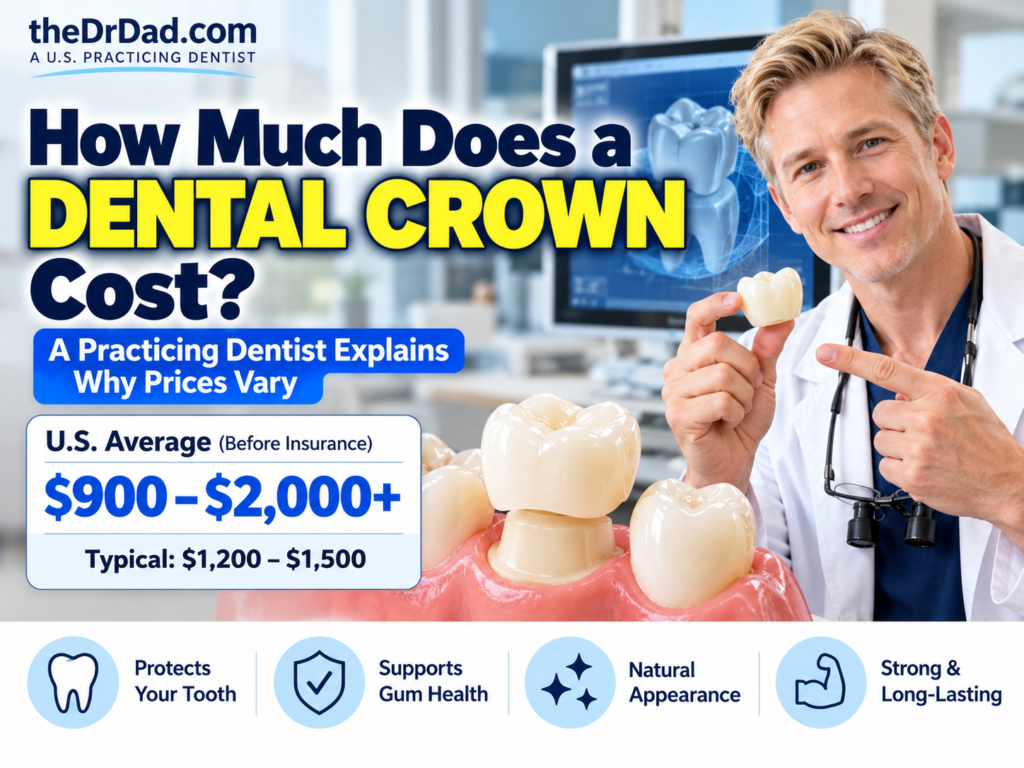
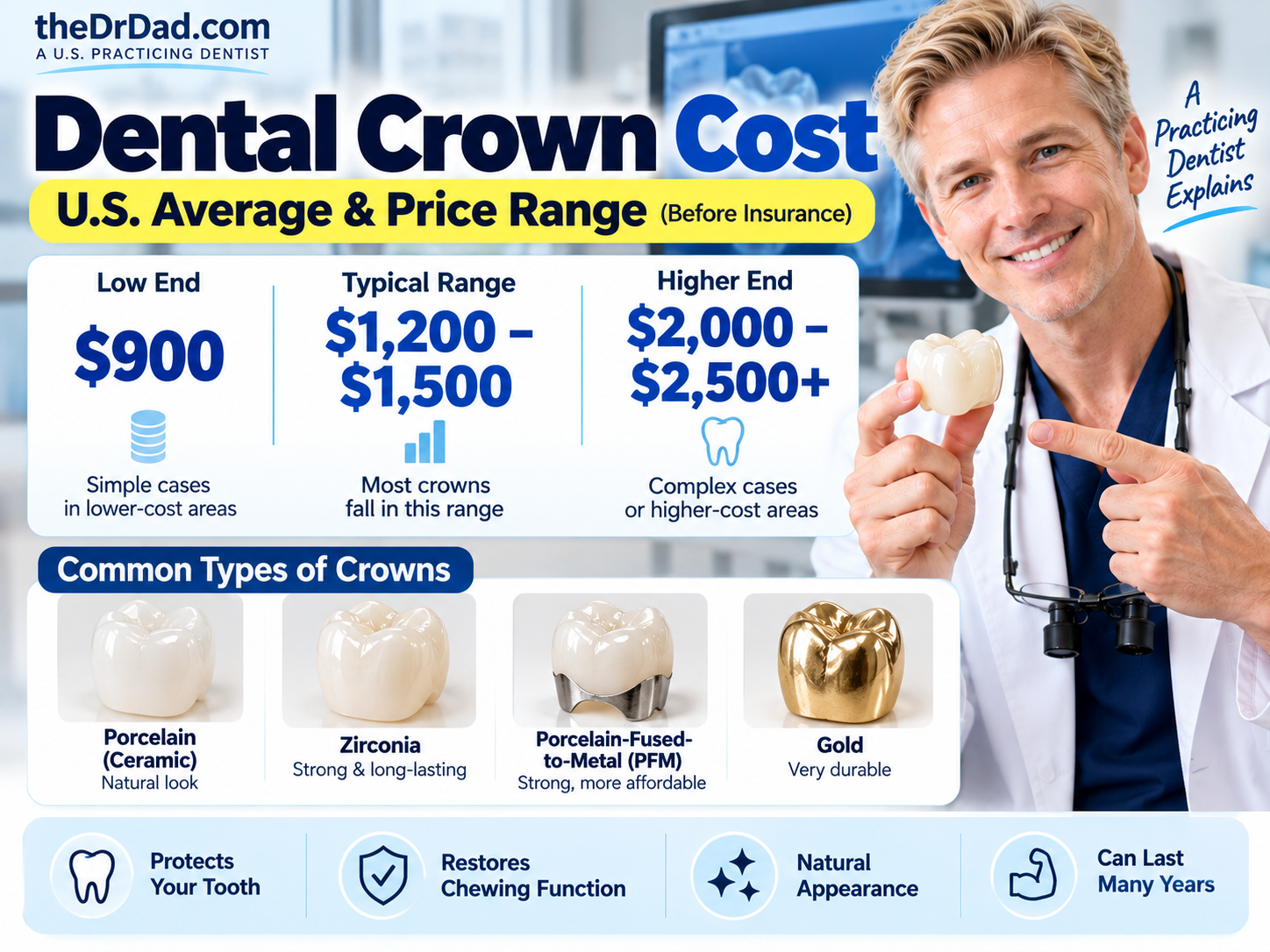
Quick Answer: In the U.S., a dental crown commonly costs $900–$2,000+ per tooth before insurance; many fall near $1,200–$1,500. The fee varies by location, complexity, laboratory, material, and insurance arrangements.
What Are You Paying For?
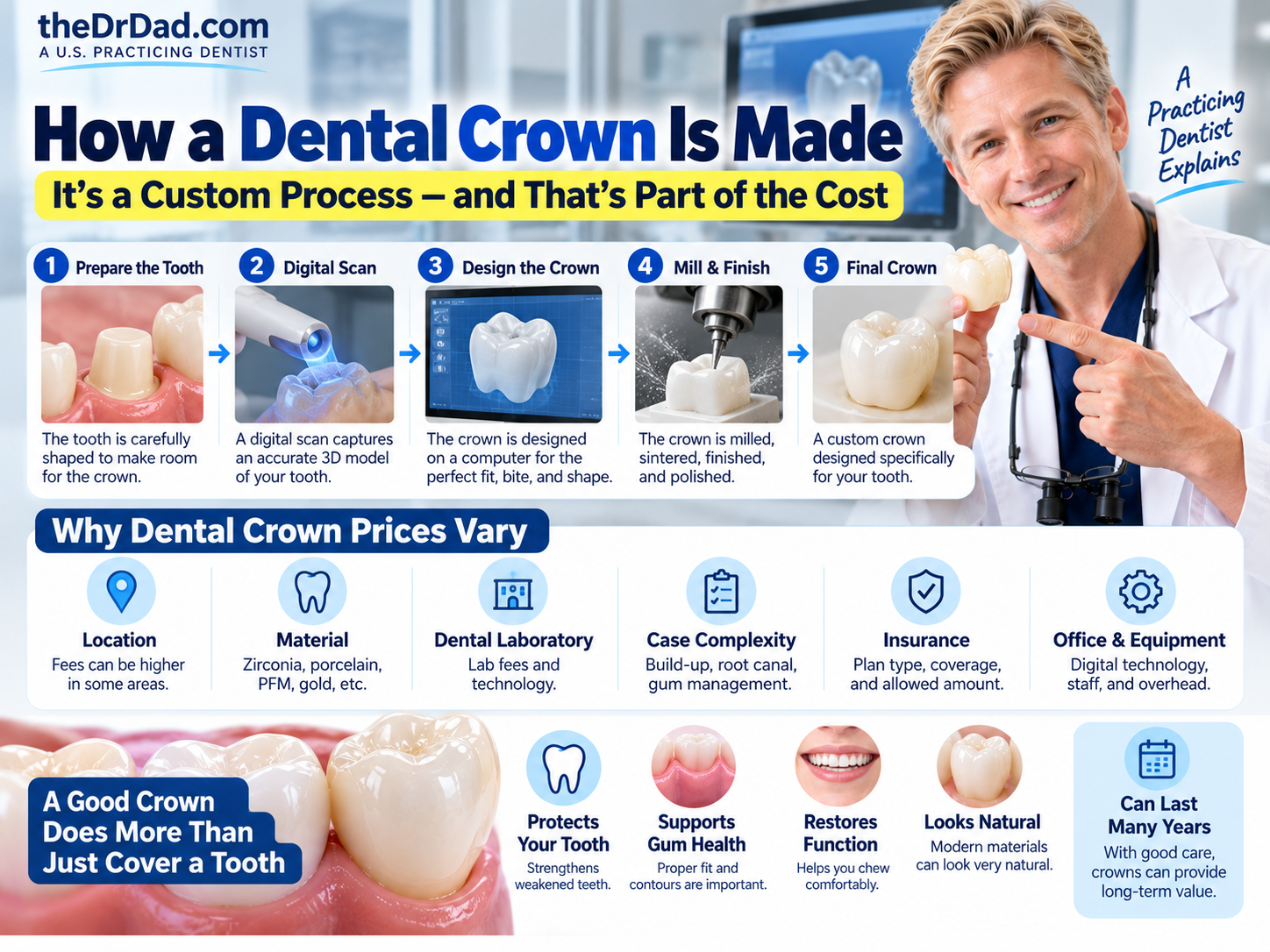
A crown is a custom restoration, not simply a piece of zirconia. The fee covers diagnosis, tooth preparation, scanning or impressions, design, fabrication, fitting, bite adjustments, and cementation. I use zirconia frequently because it combines strength with increasingly natural esthetics, but good fit, margins, bite, and contour matter more than the material alone.
Why Do Crown Prices and Timelines Vary?
Some offices make crowns the same day; others use an outside dental laboratory. Both can produce excellent results. Digital design, milling, finishing, and sometimes shipping take time. A higher fee does not automatically mean a better crown. Ask whether core buildup or root canal treatment is needed, because those may be billed separately.
What About Insurance?
Many plans cover part of a medically necessary crown, but deductibles, annual maximums, waiting periods, network fees, and plan rules change your share. Request an itemized estimate showing the crown, any additional treatment, expected insurance payment, and your portion.
Is a Crown Worth It?
When a tooth can be predictably restored, a well-made crown can protect weakened tooth structure and restore chewing and appearance. It does not prevent future decay: clean around the crown and keep regular dental visits. Not every damaged tooth is restorable, so ask your dentist to explain the diagnosis and alternatives before comparing prices.
DrDad Tips
A reasonable starting point is roughly $900–$2,000+, with many straightforward crowns around $1,200–$1,500. But if I were the patient, price would not be the only thing I would evaluate.
I would first want to know whether the tooth truly needs a crown and whether it can predictably be saved. Then I would care about the preparation, margin, fit, contact, bite, contour, material, and final appearance.
A good crown should not just cover a tooth. It should protect the tooth, respect the gums, restore function, and look like it belongs there.
When all of those things are done properly, I consider a crown one of the most valuable treatments we have for preserving a natural tooth.
References
- Aspen Dental. How Much Do Dental Crowns Cost? 2026 pricing data.
- Synchrony / CareCredit. Average Dental Care Costs. Synchrony Average Procedural Cost Study.
- Turkyilmaz I, Wilkins GN, Varvara G. Tooth preparation, digital design and milling process considerations for CAD/CAM crowns: Understanding the transition from analog to digital workflow. Journal of Dental Sciences. 2021;16(4):1312–1314.
- Kosyfaki P, Martín MDP, Strub JR. Relationship between crowns and the periodontium: a literature update. Quintessence International. 2010;41(2):109–126.
- Paniz G, Nart J, Gobbato L, Mazzocco F, Stellini E, De Simone G. The impact of the margin of restorations on periodontal health—a review.
- Clinical outcomes of zirconia dental restorations: A systematic review and meta-analysis.
- Larsson C, Wennerberg A. The clinical success of zirconia-based crowns: a systematic review. International Journal of Prosthodontics.
- The Complete Digital Workflow in Fixed Prosthodontics Updated: A Systematic Review.
- Influence of CAD-CAM milling strategies on the outcome of indirect restorations: A scoping review. Journal of Prosthetic Dentistry.
Medical & Dental Disclaimer
This article is for general educational and informational purposes only and does not provide individualized dental or medical advice, diagnosis, or treatment.
DrDad is run by a U.S.-licensed general dentist, but reading this article does not establish a dentist-patient relationship.
Whether a tooth needs a crown—and whether that tooth can predictably be restored—depends on an individual clinical examination, dental history, remaining tooth structure, periodontal condition, bite, symptoms, and, when appropriate, diagnostic imaging.
Treatment options, fees, materials, insurance benefits, and expected longevity vary by patient, dentist, laboratory, geographic location, and dental insurance plan. Discuss your individual treatment options and costs with your treating dentist before proceeding.