
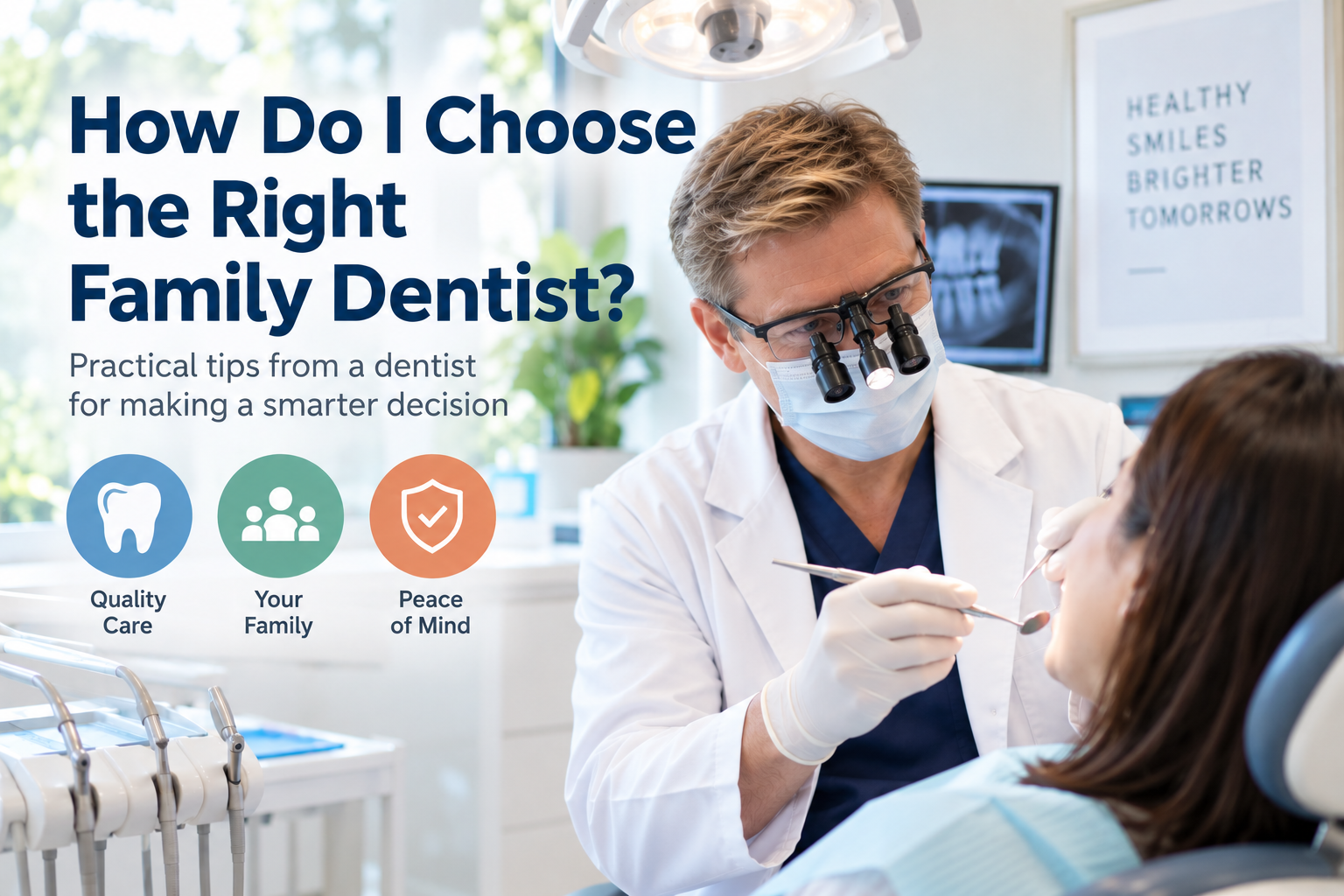
Choosing a family dentist sounds simple, but it may be more important than most people realize.
As a general dentist who owns and operates a dental practice in the United States, I would like to share how I personally would choose a general or family dentist for myself or my family.
My basic philosophy is simple. I want a dentist who provides high-quality care at a reasonable cost.
A dentist may be extremely skilled, but if the fees are far beyond what I can reasonably afford, that can be a problem. On the other hand, choosing a dentist simply because the office offers the lowest price can also be a mistake if the quality of care is not there.
Even as a dentist myself, I do not automatically seek out the most famous professor or specialist for every procedure. Their expertise may be exceptional, but their fees can also be exceptionally high.
For me, the goal is to find the right balance between quality and cost.
How Do Most Americans Choose a Family Dentist?
From what I see in everyday practice, there are three common ways patients in the United States choose a family dentist.
The first—and probably the most common—is Google.
People search for something like “dentist near me,” look at the star ratings and reviews, and choose an office that seems to have a good reputation.
The second method is through dental insurance.
Patients look through the list of dentists who participate in their insurance network and select one from that list.
The third is advertising.
A dental office sends a promotional flyer or postcard to the home, perhaps with a new-patient offer, and the patient decides to make an appointment.
Are these bad ways to choose a dentist?
No.
But in my opinion, they are not necessarily the best ways either.
Google reviews, insurance participation, location, and price can all be useful information. But when I am deciding who will actually work on my teeth, I want to know more.
First, Look at the Dentist’s Education and Training
So what would I do?
Before making an appointment, I would visit the dental office’s website and read the dentist’s biography.
One of the first things I would look for is whether the dentist completed additional residency or postgraduate clinical training after dental school.
Dental school provides the foundation for becoming a dentist. After graduation, some general dentists begin practicing immediately, while others continue with additional clinical training.
Personally, I pay attention to that additional training.
If a dentist has spent additional time developing clinical experience—especially in areas related to the treatment I may need—that is useful information for me when deciding where to receive care.
Does completing a residency automatically mean that one dentist is better than another?
Of course not.
There are many excellent dentists with different educational backgrounds and years of clinical experience.
But when I am choosing between dentists, additional postgraduate training is one factor that matters to me.
And fortunately, you usually do not have to call the office to find out.
Take a few minutes and look at the dentist’s website.
Second, Does the Dentist Use High-Magnification Dental Loupes?
There is another thing I personally look for, and patients may not think about it:
Does the dentist use high-magnification dental loupes while treating patients?
Dental loupes are magnifying devices worn by dentists to help them see the working area more clearly.
Why does that matter to me?
Think about the environment in which a dentist works.
The mouth is a small, confined, and relatively dark space. Teeth themselves are small. Many of the details we work with are even smaller.
During many dental procedures, water is also being sprayed into the mouth. There may be a dental mirror, instruments, the patient’s tongue and cheeks, and other factors competing for a very limited field of view.
In that environment, being able to see clearly matters.
From my perspective as a practicing dentist, this is extremely important.
I do not want to rely on what I think I am seeing when I can use magnification to see the treatment area more clearly.
I would rather see what I am treating than estimate what I am treating.
That distinction is important to me.
High-magnification loupes do not magically make someone a great dentist, and simply owning expensive equipment does not guarantee excellent dentistry.
But if I am choosing a dentist for myself, I want to know whether that dentist has invested in tools that allow him or her to see the treatment area in greater detail.
How Can a Patient Know?
Again, start with the dental office’s website.
Look at the dentist’s biography and photographs.
Read about the dentist’s education and additional training.
Then look at photographs of the dentist actually working.
Does the dentist appear to use magnification?
Does the website mention dental loupes, magnification, or advanced visualization?
Not every dental office will provide this information online, so the absence of a photo or description does not necessarily mean that the dentist does not use loupes.
If you cannot find the information and it matters to you, simply ask the office.
There is nothing wrong with asking:
“Does the dentist use magnification or dental loupes during treatment?”
My Two Simple Tips for Choosing a Family Dentist
If I were looking for a new family dentist today, I would still consider Google reviews, insurance coverage, location, and cost.
But I would not stop there.
I would spend a few minutes on the dentist’s website and look for two additional things:
1. Did the Dentist Complete Additional Residency or Postgraduate Clinical Training?
Additional education does not guarantee that someone is the best dentist, but it tells me more about the dentist’s clinical background and commitment to further training.
2. Does the Dentist Use High-Magnification Dental Loupes?
Dentistry takes place in a very small working environment where visibility can be challenging. Personally, I want my dentist to be able to see the treatment area as clearly as possible.
For me, good dentistry is not about choosing the most famous dentist, the cheapest dentist, or simply the office with the most five-star reviews.
It is about finding a reasonable balance of training, clinical judgment, technology, quality, and cost.
DrDad Tip
Before choosing your family dentist, spend five minutes on the practice website.
Look beyond the star rating.
Check the dentist’s education. Look for additional residency or postgraduate training. And see whether the dentist uses high-magnification loupes in clinical practice.
Those two details will not tell you everything about a dentist.
But if I were choosing a dentist for myself or my family, they are two things I would definitely want to know.