
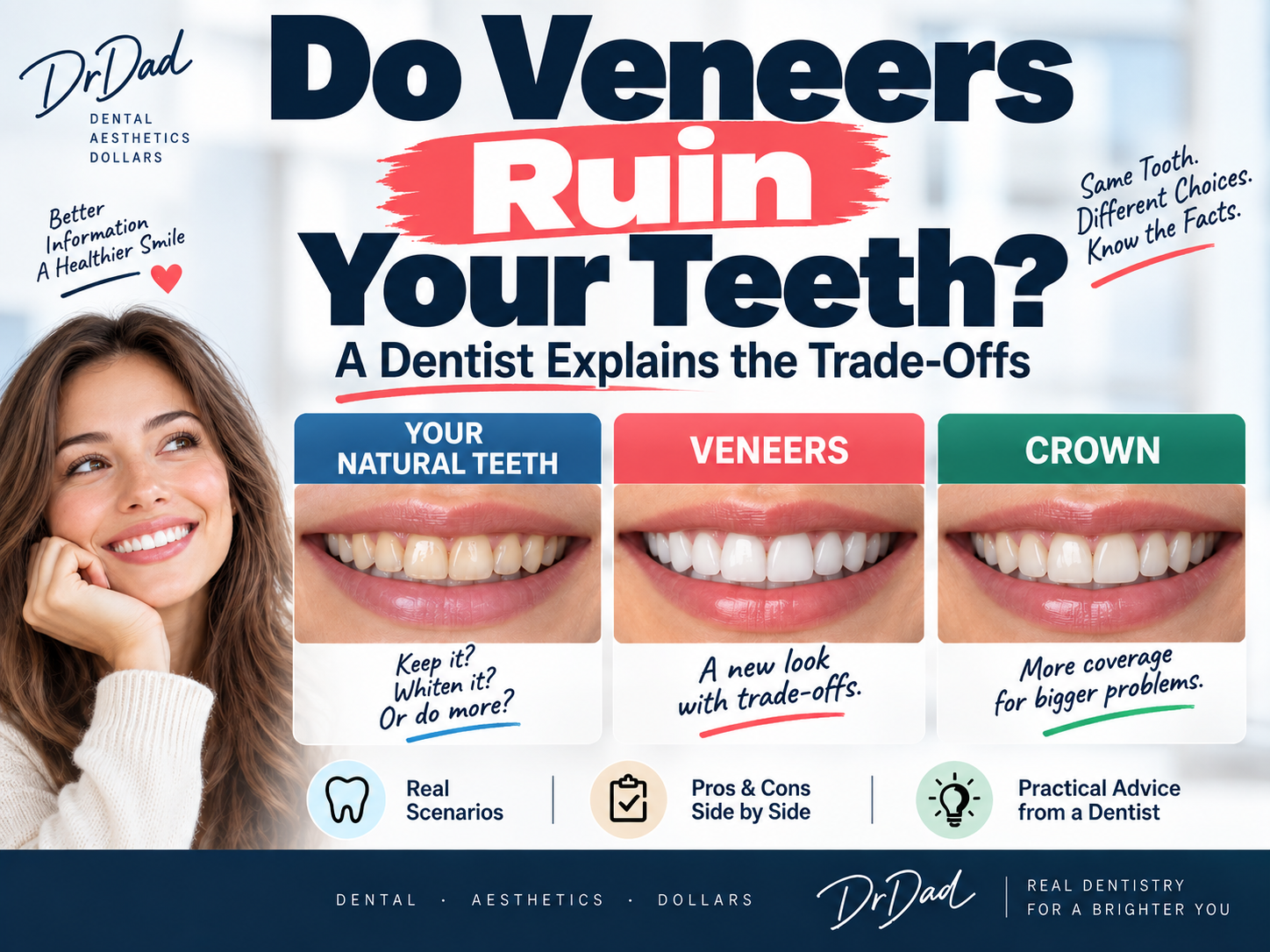
One of the questions I hear most often from female patients is:
“Doctor, what do you think about veneers?”
My answer is usually something like this:
“If you’re a Hollywood celebrity or a YouTuber whose face is constantly on camera, I can understand why you might seriously consider veneers. But if that’s not your situation and there’s nothing significantly wrong with your teeth, I’d probably start with something conservative like whitening.”
I usually say it with a smile, but there is a serious point behind it.
A tiny difference in tooth color or shape that nobody notices across a dinner table can suddenly become obvious in a high-resolution photograph, a close-up video, or under professional lighting.
For someone whose appearance is part of the job, those small differences may matter every single day. For everyone else, the trade-off may be very different.
So when someone asks me, “Do veneers ruin your teeth?” I don’t think a simple yes or no is a very useful answer.
Veneers can be an excellent treatment. In the right situation, they may be the best treatment. But in another situation, they may not be.
The restoration should follow the diagnosis—not the other way around.
First, What Is a Veneer Actually Doing?
A porcelain veneer is a thin ceramic restoration that primarily covers the visible surface of a tooth.
It can change a tooth’s color, shape, length, proportion, symmetry, and overall appearance. And well-planned veneers can produce beautiful results.
But before looking at the before-and-after photographs, patients should understand something important:
A cosmetic improvement can have a biological trade-off.
Depending on the tooth, its position, its existing color, previous dental work, the desired result, and the treatment design, some natural tooth structure may need to be removed.
How much? There is no single number that applies to everyone.
Some cases can be treated very conservatively. Some may be candidates for minimal-preparation approaches. Other cases require more preparation to create the necessary space, shape, or color correction.
That is why I don’t particularly like either of these statements:
“Veneers don’t damage your teeth.”
or
“Veneers ruin your teeth.”
Both are too simplistic.
The better questions are:
What condition is the tooth in now?
What are we trying to accomplish?
What are the alternatives?
And what are we giving up to get the result we want?
Let’s look at three very different patients.
Scenario 0: Your Teeth Look Fine in Real Life—but You Notice Them in Photos
This is probably the most interesting scenario.
Imagine that your teeth are healthy. Maybe one tooth is slightly darker than the others. Maybe the color is not quite as uniform as you would like.
When you’re talking with friends, eating dinner, going to work, or looking casually in the mirror, nobody seems to notice. Then someone takes a photograph. And suddenly you notice it. Every time.
Once you’ve seen that difference, it can become difficult to stop looking at it. Now you are considering a veneer.
Option 1: Keep the Natural Tooth
The biggest advantage is obvious: We don’t remove anything.
You keep your natural enamel and tooth structure. There is no veneer to chip, fracture, debond, maintain, or eventually replace. You also preserve your future treatment options.
The disadvantage is equally obvious: The thing that bothers you is still there.
And cosmetic concerns are personal. Something doesn’t have to be a disease to affect how someone feels about their smile.
But when the concern is very small, I think the size of the treatment should be considered alongside the size of the problem.
If the only time you notice the color difference is when you zoom into a photograph, permanently altering a healthy tooth deserves some thought.
Option 2: Choose a Veneer
A veneer gives us much greater control over color. It can also change shape, length, surface characteristics, and proportion if those changes are desired.
That can be a significant advantage. But the trade-off is that we may be permanently altering an otherwise healthy tooth to correct something that was barely noticeable in normal life.
That doesn’t automatically make veneers the wrong choice. This is where my Hollywood and YouTuber comment comes from.
If your smile is photographed or filmed in high resolution every day and your appearance is an important part of your profession, a subtle difference that seems insignificant to someone else may be very important to you.
Your benefit may justify the trade-off. For someone else, it may not.
Before touching healthy enamel, I would at least want to discuss whether whitening, bonding, orthodontics, or simply doing nothing could provide an acceptable result.
Sometimes the best dental treatment is surprisingly simple. Sometimes it is no treatment at all.
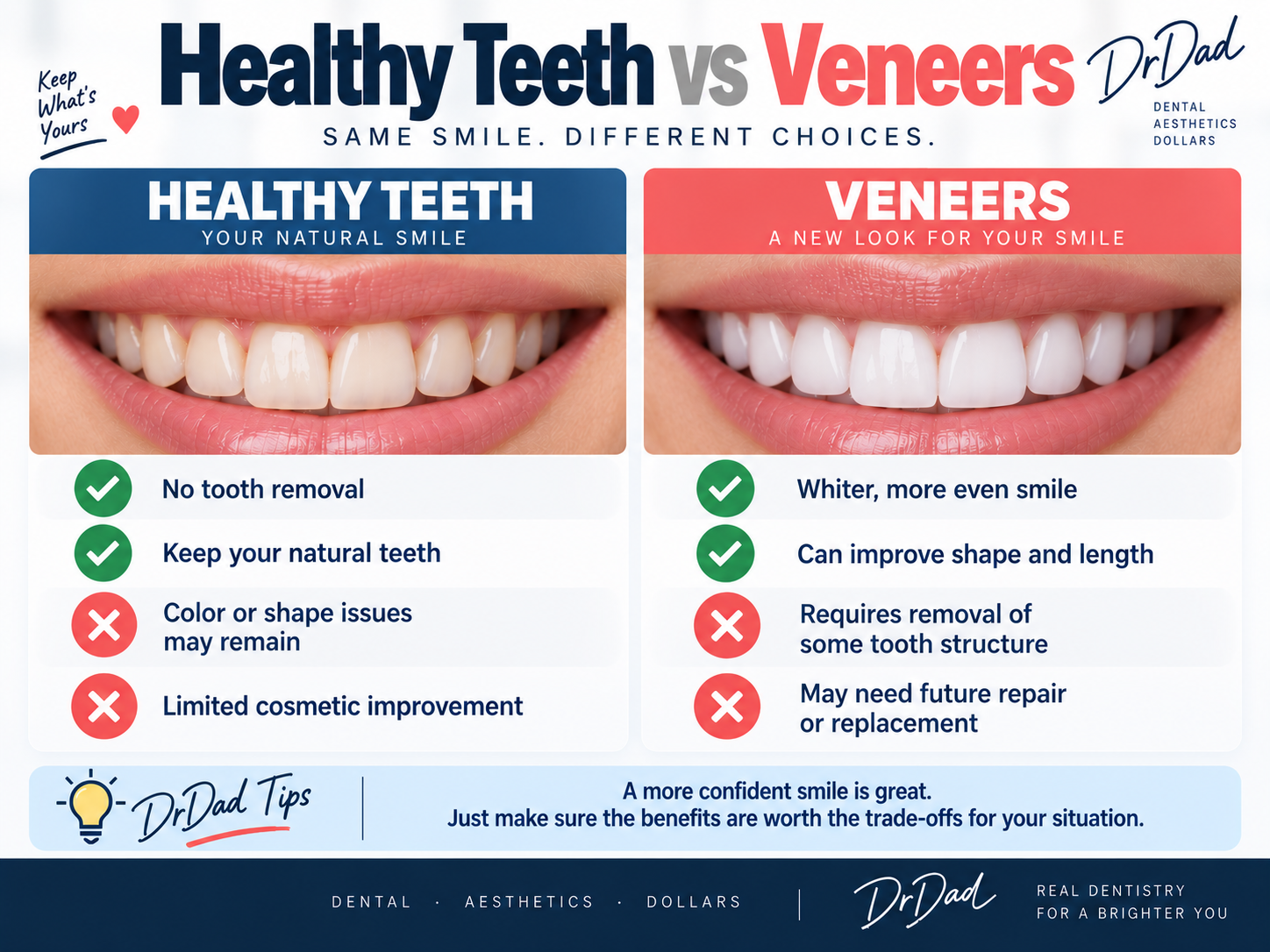
Scenario 1: Your Teeth Are Healthy, but the Color or Shape Really Bothers You
Now let’s change the situation. Your teeth are still healthy.
But this isn’t something you notice only after zooming into a photograph. Maybe the shape has bothered you for years. Perhaps the teeth appear too short, too narrow, uneven, or significantly discolored. Maybe several teeth don’t have the proportions you want.
You see it every time you smile. Now the potential benefit of veneers becomes much greater.
Keeping Your Natural Teeth
The greatest advantage is still preservation. Healthy natural enamel is valuable.
If whitening, bonding, orthodontics, or another conservative treatment can give you a result that makes you happy, those options deserve consideration.
But conservative treatment has limitations. Whitening can improve color, but it cannot redesign the shape of a tooth.
Orthodontics can change tooth position, but it cannot necessarily correct every issue involving tooth shape, proportion, or intrinsic discoloration.
Bonding can be wonderfully conservative, but composite and porcelain have different properties and different long-term maintenance considerations.
Sometimes several cosmetic concerns need to be addressed simultaneously. That is where veneers can become very powerful.
Choosing Veneers
A well-planned veneer case can allow us to control several aesthetic variables at once: Color. Shape. Length. Symmetry. Proportion. Overall smile appearance.
That is a lot of control from a relatively thin restoration. And in the right patient, that can make veneers an excellent treatment.
But the patient still needs to understand the exchange. If healthy tooth structure must be removed, the decision is generally not reversible in the practical sense.
You should not enter veneer treatment assuming that ten years from now someone can simply remove the veneers and restore your teeth exactly to their original condition.
You are making a long-term restorative decision. The veneers may eventually require maintenance, repair, or replacement.
For someone with a very minor cosmetic concern, that trade-off may seem large. For someone who has disliked her smile every day for years, the benefit may feel much greater.
Same treatment. Different situation. Different decision.
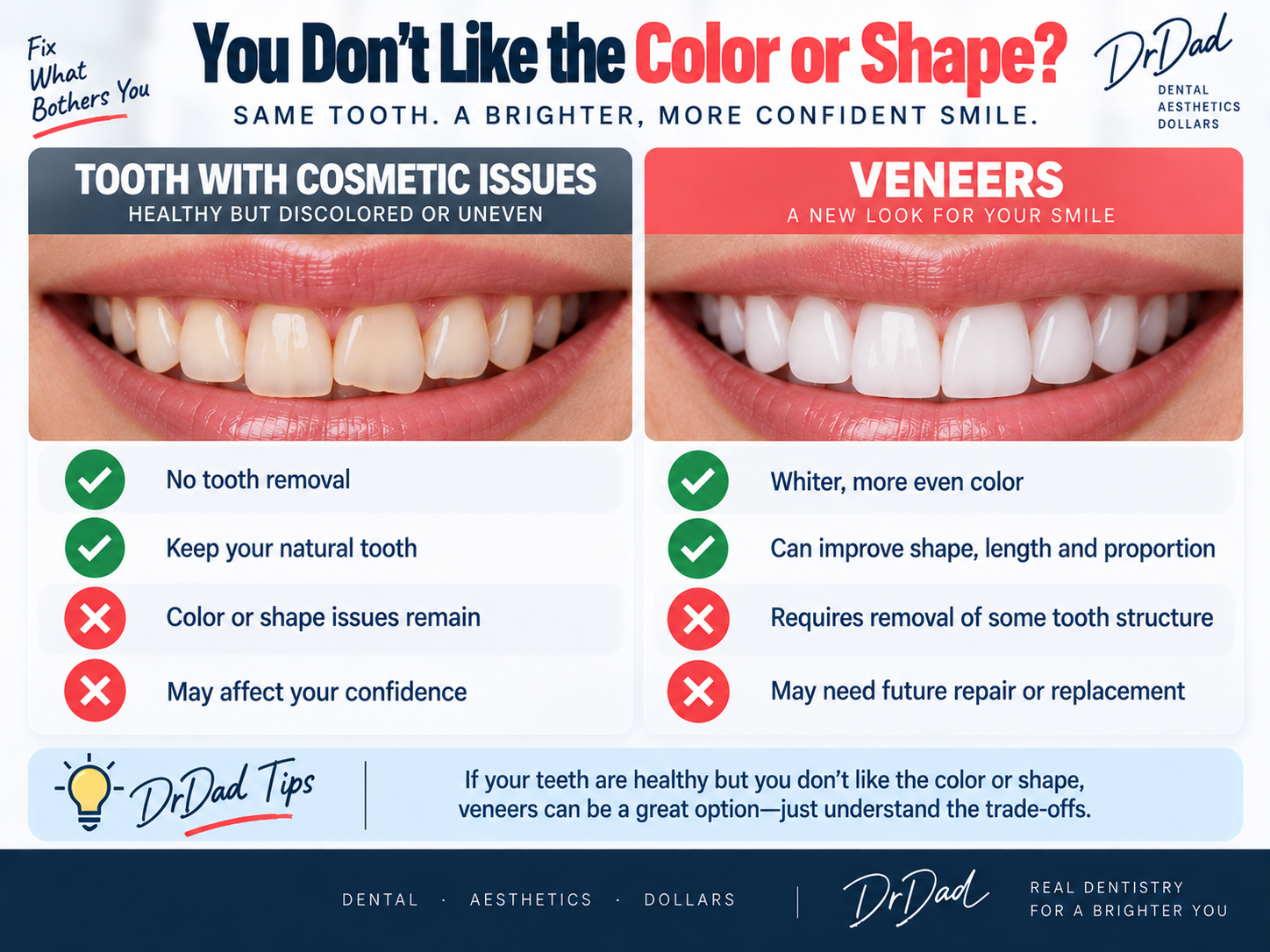
Scenario 2: The Teeth Already Have Significant Problems
Now let’s change the starting point completely.
Imagine several teeth are crooked. Some have old composite restorations. Others have large fillings. Maybe there are fractures, worn areas, decay, significant discoloration, or structural problems.
These are no longer pristine, untouched teeth.
Now asking: “Should I get veneers?” may not even be the correct first question.
We first need a diagnosis. After that, the discussion might involve veneers, crowns, a combination of restorations, orthodontics, or other treatment.
This is where the condition of the teeth matters enormously.
Veneers When Teeth Already Need Treatment
If enough healthy tooth structure remains and a veneer can predictably accomplish both the restorative and aesthetic goals, a veneer may allow us to preserve more natural tooth structure than a crown.
That can be an important advantage. But not every damaged or heavily restored tooth is a good veneer candidate.
Existing restorations, decay, fractures, remaining enamel, tooth position, bite, discoloration, and many other factors can change the treatment plan.
Sometimes a veneer is exactly the right restoration. Sometimes it isn’t.
When a Crown May Make More Sense
A crown generally covers substantially more of the tooth and typically requires more tooth preparation than a veneer.
If we’re starting with a pristine healthy tooth, that difference is extremely important.
But what if the tooth is already heavily restored? What if much of the original tooth structure is compromised? What if there are fractures, large restorations, decay, or structural problems?
Now the biological calculation is different. The additional coverage of a crown may serve an important restorative purpose.
This is why I don’t think patients should automatically view a veneer as “good” because it removes less tooth and a crown as “bad” because it removes more.
The correct amount of tooth reduction is not automatically the smallest possible amount.
The goal is to preserve as much healthy tooth structure as reasonably possible while still providing the treatment the tooth actually needs.
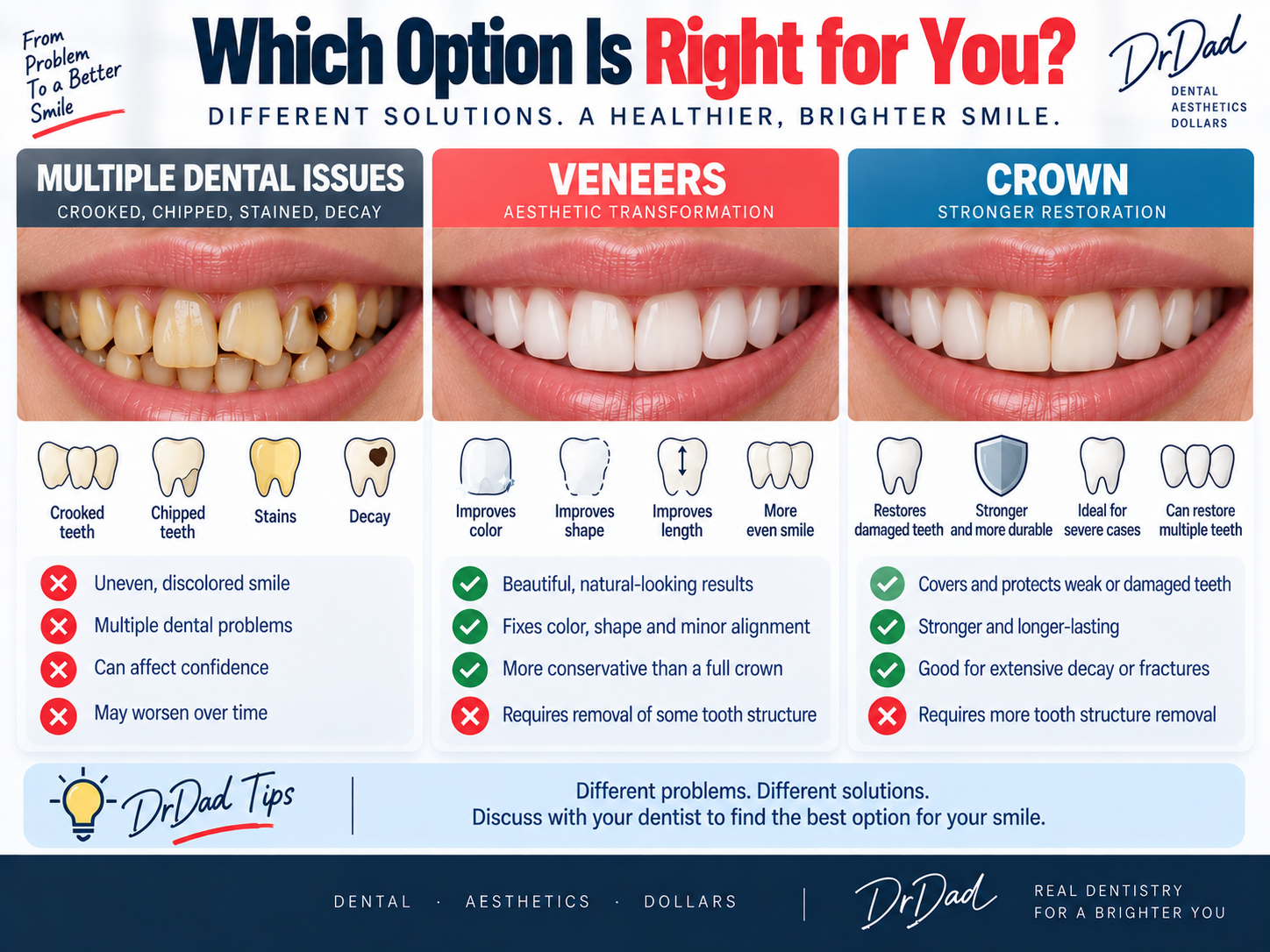
Natural Tooth vs. Veneer vs. Crown
| Natural Tooth | Veneer | Crown | |
|---|---|---|---|
| Tooth preservation | Maximum | Generally more conservative than a crown | Generally requires more reduction |
| Color control | Limited without additional treatment | Excellent | Excellent |
| Shape control | Limited | Excellent | Excellent |
| Future maintenance | Normal dental care | May eventually need repair/replacement | May eventually need repair/replacement |
| Best use | Healthy teeth when treatment isn’t necessary | Appropriate cosmetic/restorative cases | Teeth requiring more extensive restoration |
But there is one very important warning about this table:
These are not three interchangeable cosmetic packages.
You don’t choose among natural tooth, veneer, and crown the way you choose small, medium, or large. The condition of the tooth comes first.
What Happens to the Tooth Under a Veneer?
Another misconception is that once porcelain covers the front of a tooth, the tooth underneath is somehow protected forever. It isn’t.
The tooth underneath is still a tooth.
You still need to brush. You still need to floss. The margins still need to be maintained.
The tooth can still develop dental disease, including decay in susceptible areas. The gums can also change or recede over time, potentially affecting how the margin looks.
That is why regular dental examinations remain important after cosmetic dental treatment.
Beautiful porcelain does not eliminate biology.
Do Veneers Last Forever?
No dental restoration should be approached with the assumption that it will necessarily last forever.
Veneers can perform very well for many years. But they are still restorations.
A veneer can chip. It can fracture. It can debond. The surrounding tooth can change. The gums can change. Your bite can change.
And eventually, a veneer may require repair or replacement.
This becomes particularly important when a young person is considering veneers on otherwise healthy teeth.
Don’t think only about how your smile will look next month. Think about what this decision may mean for the tooth over the next 10, 20, or 30 years.
One Question I Wish More Patients Would Ask
Patients understandably ask me: “How will my veneers look?”
That’s an important question. But I would add another: “How much healthy tooth structure will you need to remove to get that result?”
Then I would ask: “Is there a more conservative way to get most of the result I want?”
Maybe whitening is enough. Maybe bonding is appropriate. Maybe orthodontics makes more sense. Maybe doing nothing is perfectly reasonable. Maybe veneers are clearly the best option.
Or perhaps the teeth already require significant restorative treatment and crowns make more clinical sense.
There is no contradiction in any of those answers. They are different treatments for different conditions.
A Patient Who Had Been Saving for Her Smile for Years
One patient in particular comes to mind when I think about this subject. She was a woman in her 60s.
Her teeth had accumulated many years of dental history. Several were crooked. There were composite restorations, amalgam restorations, worn areas, and damaged tooth structure.
She told me that having a clean, even, beautiful smile had been something she wanted for most of her life.
And then she told me something I still remember: She had been saving money for years to finally have her teeth fixed.
She wanted her smile to look clean and beautiful. She had also heard that veneers were very good. So she asked me if I could give her veneers.
I understood why. Patients see beautiful veneer cases online all the time. The word “veneer” itself has almost become synonymous with a beautiful smile.
But my job wasn’t to sell her a veneer. My job was to examine the teeth in front of me.
When I evaluated her teeth, there were simply too many existing restorations and too many structural and positional problems for veneers to be the appropriate treatment for what she needed.
So we discussed another option. Crowns.
I explained why I believed crowns were more appropriate for her particular teeth and what the treatment would involve. And that is what we ultimately did.
The important part is that choosing crowns did not mean accepting an inferior cosmetic result.
Her goal wasn’t to own veneers. Her goal was to have a clean, even, beautiful smile.
And that is what we were able to give her. She was extremely happy with the result. And even now, years later, she remains happy with her smile.
I think about her whenever someone asks me whether veneers are “better” than crowns. That isn’t really the question.
Veneers can be excellent. Crowns can be excellent. Bonding can be excellent. Orthodontics can be excellent. Whitening can be excellent.
What makes a treatment truly excellent is using it in the right situation.
For one patient, veneers may be the best treatment. For another patient, they may not be.
For my patient, crowns were the appropriate treatment because of the condition of the teeth we were starting with.
Someone else could walk into my office tomorrow with a completely different starting condition, and veneers might be exactly what I recommend.
The restoration should follow the diagnosis—not the other way around.
So, Do Veneers Ruin Your Teeth?
Usually, that isn’t the most useful question.
A properly diagnosed and well-executed veneer can be an excellent restoration.
But veneers can involve irreversible changes to natural tooth structure, and that matters—especially when we are starting with healthy teeth.
So instead of asking only: “Are veneers bad for teeth?”
I would ask:
What condition are my teeth in now?
What problem am I trying to solve?
How much natural tooth structure needs to be removed?
Are there more conservative alternatives?
And which treatment is most appropriate for these particular teeth?
Once those questions are answered, the word written on the treatment plan—whitening, bonding, veneer, crown, orthodontics, or something else—becomes much easier to understand.
DrDad Tips
If you are considering veneers, don’t begin by deciding that you want veneers.
Begin by finding out what your teeth actually need.
If your teeth are healthy and you have a small cosmetic concern, especially something you notice mainly in photographs, ask whether whitening, bonding, orthodontics, or no treatment could accomplish enough.
If your teeth are healthy but you have a significant aesthetic concern, veneers may offer a degree of control over color, shape, and proportion that more conservative treatments cannot always provide.
And if your teeth already have extensive restorations, decay, fractures, wear, or structural problems, the treatment decision may be completely different.
Before committing to treatment, I would ask your dentist:
What is the diagnosis?
Why is this restoration appropriate for my teeth?
How much healthy tooth structure will need to be removed?
What are my alternatives?
And what should I expect over the long term?
Veneers are excellent when veneers are the right treatment.
Crowns are excellent when crowns are the right treatment.
The same is true for bonding, orthodontics, whitening, and many other treatments we use every day.
Good dentistry isn’t about choosing the treatment with the best name.
It’s about making the right diagnosis and using the right treatment in the right situation.
Disclaimer
This article reflects my professional experience and perspective as a practicing dentist and is provided for general educational and informational purposes only. It is not individualized dental or medical advice and does not establish a dentist-patient or doctor-patient relationship.
The appropriate treatment for any tooth depends on many individual factors, including remaining tooth structure, enamel, existing restorations, decay, fractures, periodontal health, bite, tooth position, aesthetic goals, dental history, and other clinical findings that cannot be evaluated through a general article.
Veneers, crowns, whitening, bonding, orthodontic treatment, and other restorative or cosmetic procedures each have indications, limitations, benefits, risks, and alternatives. A treatment recommendation can only be made after an appropriate examination and diagnosis.
Please consult your treating dentist or an appropriately qualified dental professional to determine which treatment options, if any, are appropriate for your individual situation.