

I’m a dentist.
And yes, I’ve had a bad credit score.
People are sometimes surprised when I tell them that.
“How can a doctor have bad credit?”
Pretty easily, actually.
Student loans don’t disappear because there’s “Dr.” in front of your name. A professional degree doesn’t automatically make you good with money. And if your spending grows faster than your income, your credit score doesn’t care what you do for a living.
I learned that lesson the expensive way.
Not once.
Twice.
And both times, the lesson came with interest.
I Bought a Dental Practice With Bad Credit
When I was preparing to buy my dental practice, my credit situation was not where I wanted it to be.
That created a problem.
Buying a dental practice usually means borrowing a substantial amount of money. And when you are asking a lender for that much money, your financial history suddenly becomes very important.
My weaker credit affected the financing available to me.
I ended up buying the practice with an interest rate roughly one percentage point higher than what I might otherwise have qualified for.
One percentage point.
That doesn’t sound terrifying.
But there is something you learn very quickly when you start borrowing serious amounts of money:
A small percentage attached to a big number is no longer a small number.
That extra interest was not some theoretical punishment hiding inside my credit report.
It was money. My money. Leaving my bank account. Every month.
Then I Needed a $100,000 CT Scanner
You would think I learned my lesson. Apparently, I needed another one.
After buying the practice, I needed to bring in a CT scanner. The machine was around $100,000.
I needed the equipment for the practice, so I started looking for financing. There was just one little problem: my credit still wasn’t great.
And lenders were not exactly fighting each other for the privilege of giving me $100,000.
Eventually, I found financing. But the rate was roughly three percentage points higher than what stronger credit might have allowed me to obtain.
Three percentage points.
On a $20 purchase? Who cares?
On a $100,000 piece of equipment? I cared. A lot.
My plan became simple: get the equipment I needed, improve my financial position, and refinance the loan later if I could qualify for a better APR.
That is eventually what I did.
But looking at that original interest rate? I wanted to cry.
That extra interest was the price of my bad credit. Literally.
Your Credit Score Is Not Just a Number
That experience changed the way I think about credit.
A credit score can look like just another number on a screen: 650. 700. 750. 800.
But those numbers can have real dollar values attached to them.
A stronger credit profile may help you qualify for more favorable borrowing terms. A weaker profile may mean higher rates, fewer options, larger required deposits, or even being turned down, depending on the lender and the transaction.
Most Americans will never finance a dental CT scanner. But replace “CT scanner” with a car, a house, a business, or even the process of applying for an apartment. Now the story becomes much more familiar.
So What Is a Good Credit Score?
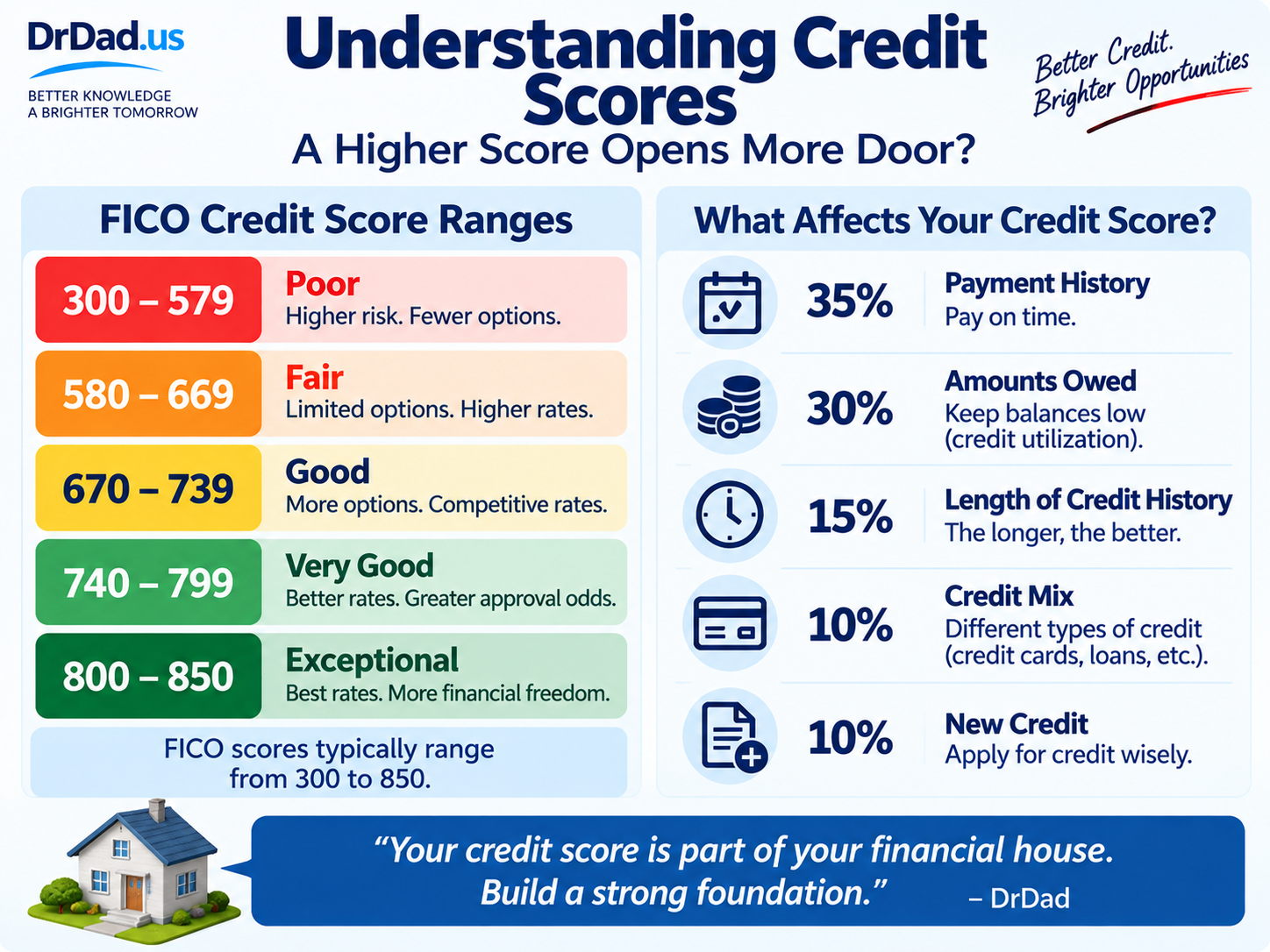
One of the most widely used credit-scoring systems in the United States is the FICO Score, which generally ranges from 300 to 850.
| FICO Score | General Rating |
|---|---|
| 300–579 | Poor |
| 580–669 | Fair |
| 670–739 | Good |
| 740–799 | Very Good |
| 800–850 | Exceptional |
So if someone asks, “What is a good credit score in America?” a FICO score of 670 or above falls within FICO’s “Good” range.
But I would not become obsessed with crossing one magical number. Lenders do not all use exactly the same underwriting standards. They may use different scoring models or versions, and your income, debt, down payment, loan type, collateral, and other financial information can matter too.
Credit score is important. It is not the only number in your financial life.
A Doctor Can Have Bad Credit
There is a financial myth that I would really like to kill.
High income does not automatically equal good credit.
I’m living proof.
Doctors, dentists, lawyers, business owners, engineers—anyone can make financial mistakes.
A nicer car. A bigger house. More expensive vacations. More monthly payments. More credit card spending. Somewhere along the way, your spending can start chasing your income—or passing it.
A large paycheck cannot protect you from poor financial habits forever.
Student Loans Don’t Care That You’re a Doctor
Many healthcare professionals begin their careers carrying substantial educational debt.
Having debt and having bad credit are not the same thing. But debt affects your overall financial picture, and how you manage your obligations matters.
The bigger question is: How are you managing the financial obligations you have?
What Actually Affects Your Credit Score?
Payment History
Do you pay your obligations on time? A history of late or missed payments can hurt.
Pay what you agreed to pay, when you agreed to pay it.
Amounts Owed
How much debt are you carrying? For revolving accounts such as credit cards, how much of your available credit are you using?
Length of Credit History
A longer credit history can be useful because lenders and scoring models have more information about how you have managed credit over time.
Credit Mix
Credit reports can contain different types of accounts, such as revolving credit and installment loans. But don’t borrow money you don’t need just to chase a better “mix.”
New Credit
Applying for a lot of new credit within a short period can also matter. Use credit intentionally.
Know Your Income Before You Build Your Lifestyle
If I could go back and give my younger self one financial instruction, it would be extremely simple:
Know what actually comes in. Know what actually goes out.
You don’t have to stop enjoying your money. But your lifestyle needs some relationship with reality.
Build your spending around the income you actually have—not the lifestyle you think your income should buy.
Your Credit Score Is Part of Your Financial House
I think of credit as part of the foundation of your financial house.
Income is part of the foundation. Savings are part of it. Debt is part of it. Spending habits are part of it. And credit is part of it.
Maintain that foundation carefully, and when you eventually need to make a major financial move, you may approach it from a much stronger position.
That financial house may eventually help you buy your real house.
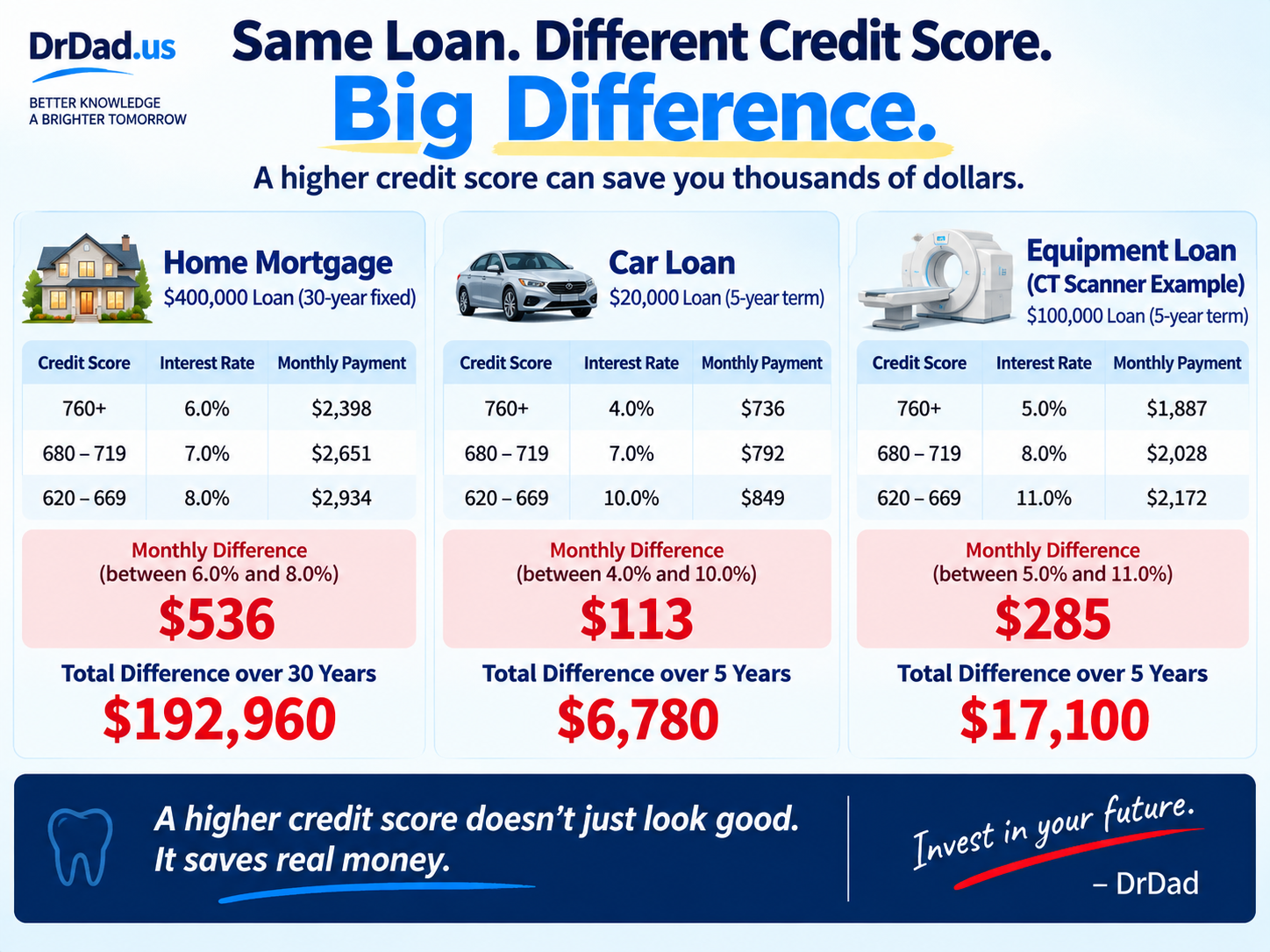
One Percentage Point Can Be Real Money
This is the part people underestimate.
The important question isn’t “Is 1% a big number?” The important questions are: 1% of what? And for how long?
When the loan balance has five, six, or seven digits, those questions matter. A lot.
Three Percentage Points Hurt Even More
My CT scanner experience made the lesson even clearer. Approximately $100,000 of equipment. Financing roughly three percentage points higher than the rate I hoped to obtain.
Suddenly credit was not an abstract financial concept anymore. It was a business expense.
That is one reason I eventually refinanced when I was able to obtain better terms.
Refinancing itself is not automatically the right decision. There can be fees, different loan terms, prepayment considerations, and other costs. You have to do the math.
I would have preferred to qualify for the better financing from the beginning.
Fix Your Credit Before You Need Credit
The worst time to discover that your credit needs work is when you desperately need someone to lend you money.
Your car just died. You found the house you want. You need equipment for your business. You are trying to move into an apartment. Now suddenly you’re checking your credit.
That’s backward.
Think about credit before you need credit.
Don’t Chase 850 Just for Bragging Rights
The purpose of your financial life is not to win a video game called Credit Score.
A high credit score is useful because of what it can help you do.
The real goal is a strong overall financial position: pay on time, control debt, maintain emergency savings, spend within your means, use credit carefully, build assets, and when you borrow money, understand what that money actually costs.
A Good Credit Score Doesn’t Make You Rich
You can have an excellent credit score and very little wealth. You can also have substantial assets and a credit profile that isn’t perfect.
A credit score is not your net worth. It is not your salary. It is not your intelligence. And it certainly isn’t your value as a human being.
It is a tool used to evaluate aspects of credit risk. But in the American financial system, it can be a very expensive number to ignore.
I paid tuition for that lesson. And I’m not talking about dental school.
DrDad Tips
I learned about credit the expensive way.
When I bought my dental practice, my weaker credit contributed to financing that was roughly one percentage point higher than what I might otherwise have obtained.
Then I needed a roughly $100,000 CT scanner. Again, credit became a problem. I eventually obtained financing at a rate roughly three percentage points higher than the better financing I wanted, with the plan to improve my position and refinance later.
I did refinance. But I would much rather have had stronger credit from the beginning.
Know your income. Control your spending. Pay your bills on time. Don’t let your lifestyle grow faster than your finances. Pay attention to your credit before you need to borrow.
Your credit score is part of the foundation of your financial house. Take care of that house. Because someday, it may influence how much it costs to buy the real one.
I learned that lesson by paying for it. Literally.
Disclaimer
This article is based in part on the author’s personal financial experience as a practicing dentist and dental practice owner in the United States and is provided for general educational and informational purposes only. It is not individualized financial, credit, tax, legal, lending, or investment advice. Credit-scoring models, lender requirements, interest rates, loan terms, and individual financial circumstances vary and can change over time. Before making significant borrowing, refinancing, or other financial decisions, review the actual terms and costs and consult an appropriately qualified professional when necessary.