
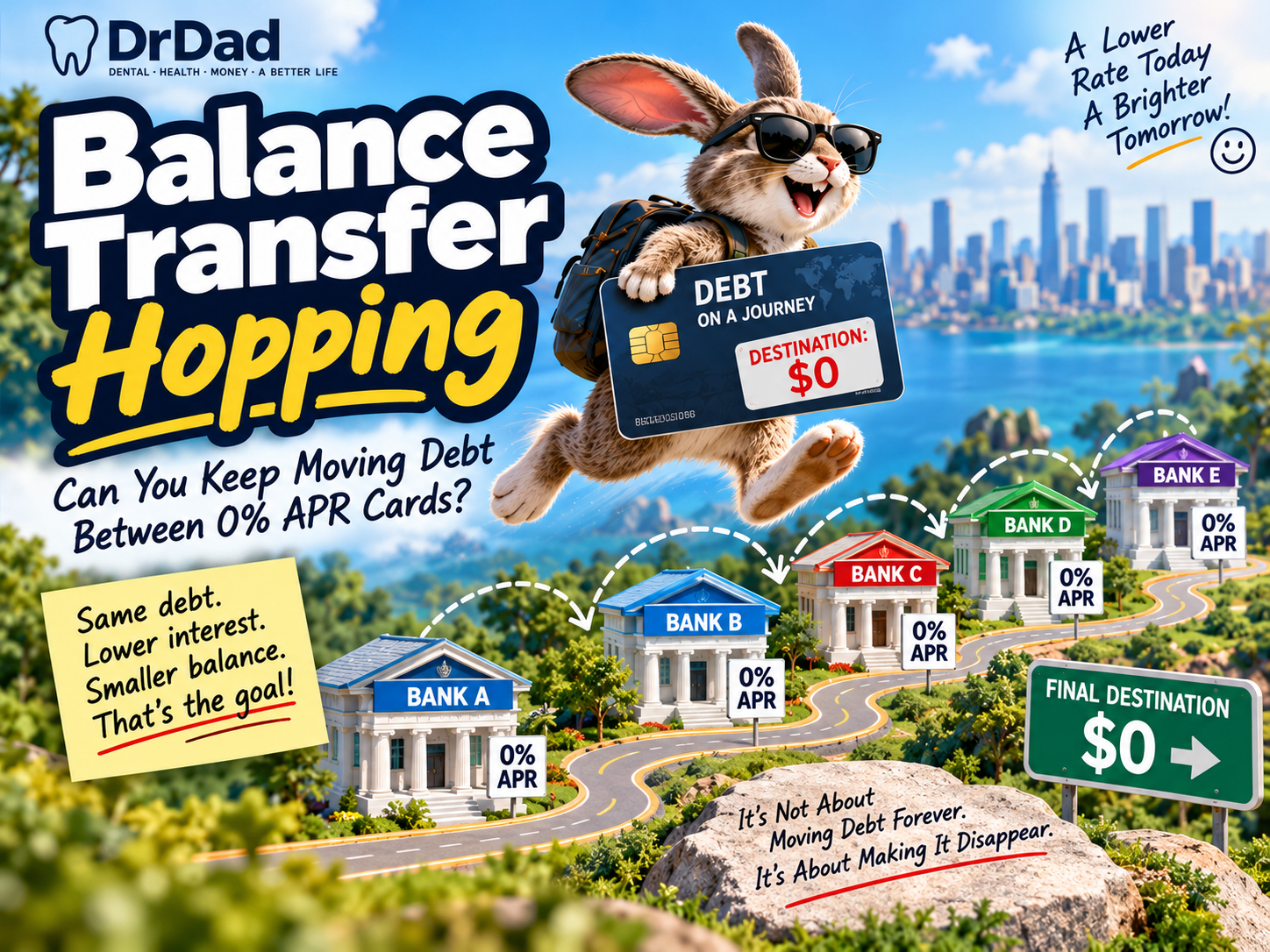
Your debt can hop from bank to bank. The goal is to make sure it gets smaller at every stop.
Let’s say you have $10,000 in credit-card debt at 24% APR.
Then another bank makes you an interesting offer: 0% APR on balance transfers for 18 months.
There’s a 3% balance-transfer fee, so moving $10,000 costs $300. That’s easy math. But here’s the more interesting question: What happens after 18 months?
What if you haven’t paid it all off? Could you move the remaining balance to another bank offering another 0% APR promotion? And then do it again?
Bank A → Bank B → Bank C → Bank D
Could your debt keep hopping around the U.S. banking system looking for 0% APR? Theoretically? Yes.
Welcome to what I like to call Balance Transfer Hopping. And the math gets more interesting than you might think.
How Balance Transfer Hopping Works
Balance-transfer promotions are commonly used by credit-card issuers to attract customers. The basic idea is simple.
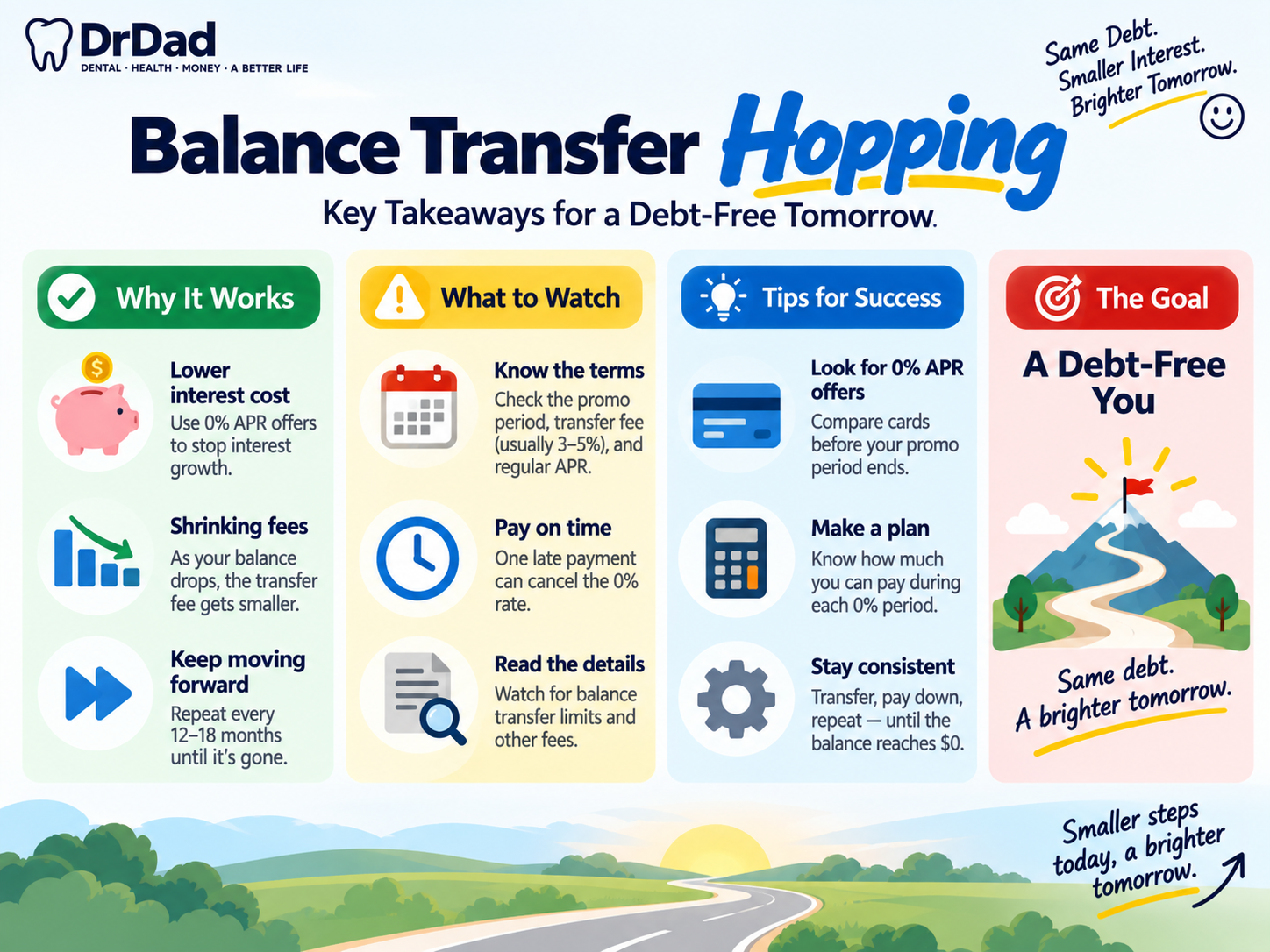
You move high-interest debt from one card issuer to another card offering a promotional 0% APR period. You usually pay a balance-transfer fee, but during the promotional period, qualifying transferred debt doesn’t accrue interest.
Suppose you owe $10,000 at 24% APR. Bank B offers 0% APR for 18 months + a 3% transfer fee.
Moving the balance costs: $10,000 × 3% = $300.
Nobody enjoys paying $300. But the correct comparison isn’t, “Do I want to pay $300?” It’s: “How much high-interest credit-card interest could that $300 help me avoid?” Now we’re asking the right question.
What Happens If the Debt Keeps Hopping?
This is where it gets interesting.
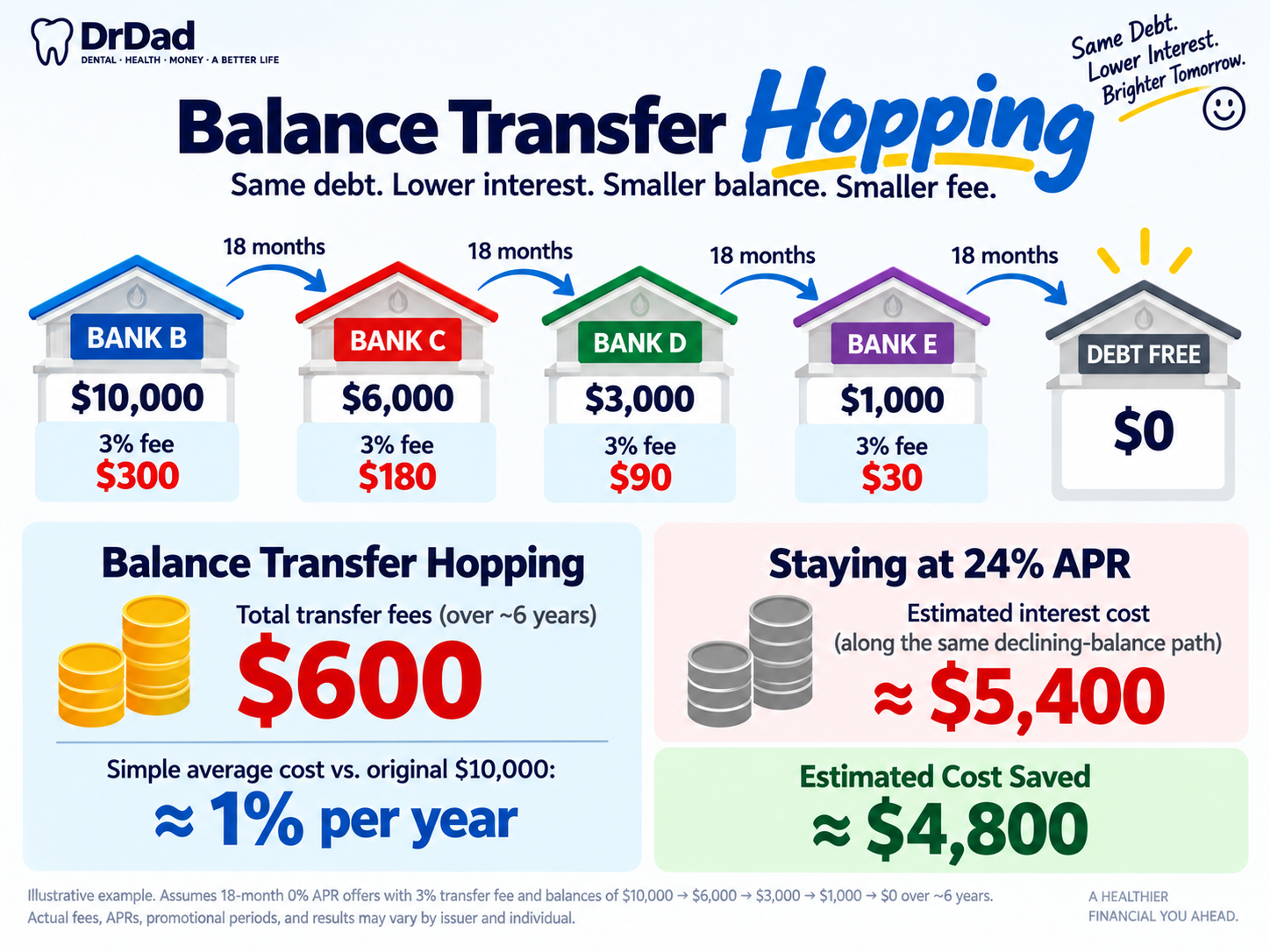
Suppose you transfer the original $10,000 to Bank B. Then you actually use those 18 interest-free months to attack the principal. By the time the promotion expires, you’ve reduced the debt to $6,000.
Bank C has another qualifying 0% balance-transfer offer. You hop again. But now your transfer fee is smaller: $6,000 × 3% = $180.
Another 18 months go by. You’ve reduced the debt to $3,000. Another qualifying offer appears. Hop. $3,000 × 3% = $90.
Later, you’re down to $1,000. One last hop: $1,000 × 3% = $30.
Look at the journey: $10,000 → $6,000 → $3,000 → $1,000 → $0.
In this simplified example, total transfer fees are $600. And because the debt keeps shrinking, the transfer fee keeps shrinking too.
That’s the part of Balance Transfer Hopping that I find interesting. The debt is traveling through 0% APR territory. But ideally, it’s losing weight at every stop.
Your Debt Can Travel. You Don’t Have To.
There’s an important distinction here. Balance Transfer Hopping should not mean: “Great! I figured out how to keep $10,000 of debt forever.” That’s exactly the wrong idea.
The purpose is to use each 0% APR period to make the balance smaller before the next hop.
Think of it as a strange financial road trip. Your debt leaves home weighing $10,000. At the first stop, it’s $6,000. At the next stop, $3,000. Then $1,000.
Eventually, you want it to arrive at the only destination that matters: $0.
The purpose of traveling through 0% APR isn’t to extend the vacation. It’s to make sure the debt never comes home.
So Why Doesn’t Everyone Just Keep Hopping?
Because banks aren’t obligated to keep providing you with lily pads.
You have to qualify for the next card. A new application may involve a hard inquiry and opening new accounts can affect your credit profile. Even if you’re approved, you may not receive a credit limit large enough to transfer the entire balance.
And every offer has rules. There may be a deadline for completing the transfer. Fees vary. Promotional periods vary. The post-promotion APR matters. Some transfers aren’t eligible.
Most importantly, there’s no guarantee the next 0% offer will be waiting when you need it.
On paper: Bank A → B → C → D → E
In real life: Bank A → B → C → Application Declined
Your debt just missed its connecting flight.
That’s why I wouldn’t build a financial plan that requires another bank to approve me 18 months from now.
You May Become a Banking-App Collector
There’s another cost that’s difficult to put into a calculator: annoyance.
Do enough Balance Transfer Hopping and take a look at your phone. Bank A app. Bank B app. Bank C app. Bank D app. Passwords. Autopay settings. Statements. Due dates. Transfer deadlines. Promotional expiration dates.
Eventually, you’re not just managing credit-card debt. You’ve become a banking-app collector.
Some people collect watches. Some collect sneakers. You collect financial institutions.
Unfortunately, nobody has ever stopped someone at a restaurant and said: “Wow. Is that the new Citi app?”
So yes, the interest savings can be real. But so is the administrative headache.
The Biggest Danger Isn’t the Transfer Fee
Here’s what worries me much more than paying 3% to move a balance.
Suppose you transfer $10,000 off your old card. Suddenly that old card shows: Available credit: $10,000.
That can psychologically feel like money. It isn’t.
But suppose you start spending again. A year later you might have $8,000 remaining on the new 0% card plus $4,000 of new debt on the old card.
Your brilliant $10,000 debt strategy has somehow produced $12,000 of debt.
That’s not financial optimization. That’s digging a bigger hole with a lower-interest shovel.
Balance Transfer Hopping only makes sense if the debt gets smaller. If you’re hopping balances while creating new balances behind you, you’re traveling in circles.
My Rule With Debt Is Pretty Simple
I don’t carry credit-card debt, so I’m not going to pretend I’ve personally spent years hopping credit-card balances from bank to bank.
But I understand the principle. My thinking about debt is pretty simple:
If I can legally move the same debt to a meaningfully lower interest rate without creating a bigger problem, I’m going to look at the math.
Why voluntarily pay a much higher financing cost for the same debt if a genuinely cheaper alternative is available?
A 0% balance transfer is simply a dramatic example of that principle. But the words “0% APR” shouldn’t hypnotize you.
Transfer fees matter. Terms matter. Your credit matters. And above everything else: Your behavior matters.
Could Balance Transfer Hopping Really Continue for Years?
Theoretically, yes. Practically, maybe. Reliably? No.
You might qualify for several consecutive offers. You might not. Your credit profile can change. Card issuers can change their offers. The credit limit you’re offered can change. Transfer fees can change.
So I wouldn’t make a five-year plan that depends on five future banks saying yes.
Instead, I’d treat every 0% period as an opportunity. You have temporarily moved expensive debt into a much cheaper interest-rate environment. Use that time.
If you transfer $10,000 and 18 months later still owe $10,000, all you’ve really accomplished is moving the furniture.
But if the next hop is only $6,000, you’re making progress. If the next one is $3,000, even better. If eventually there’s nothing left to transfer? Perfect.
The Goal Isn’t to Become Good at Moving Debt
The goal isn’t to become the LeBron James of balance transfers.
It isn’t to see how many banking apps you can fit on one phone. And it definitely isn’t to keep debt alive forever by finding it a new 0% home every 18 months.
The goal is to eliminate the debt.
For someone struggling with expensive credit-card debt, a legitimate 0% APR balance-transfer offer may provide a lower-cost stretch of road while they aggressively reduce the principal.
Maybe the debt visits Bank B. Then Bank C. Maybe even Bank D. That’s okay.
Let the debt travel through 0% APR territory. Just make sure it gets smaller at every stop.
Because eventually you want your debt to finish its grand tour of America’s banking system and arrive at its final destination:
$0.
Then the trip is over. The debt is gone. And you can finally start deleting some of those banking apps.
This article is for general educational purposes only and is not individualized financial, tax, or legal advice. Balance-transfer offers, fees, promotional periods, eligibility requirements, credit limits, and APRs vary by issuer and applicant. Always review the issuer’s current terms before making a balance transfer.