
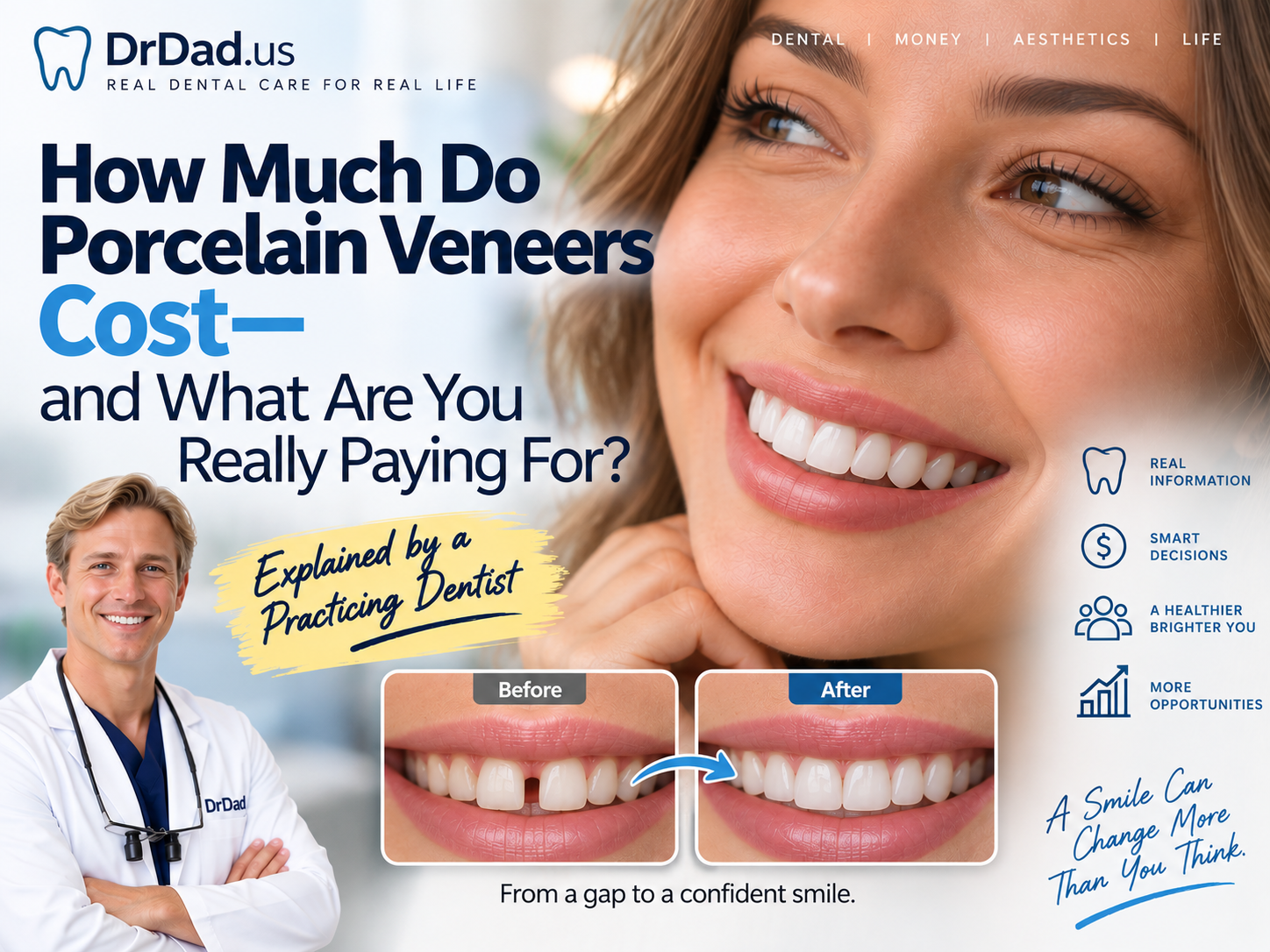
If you’re searching for porcelain veneers cost, let’s start with the number you probably came here for.
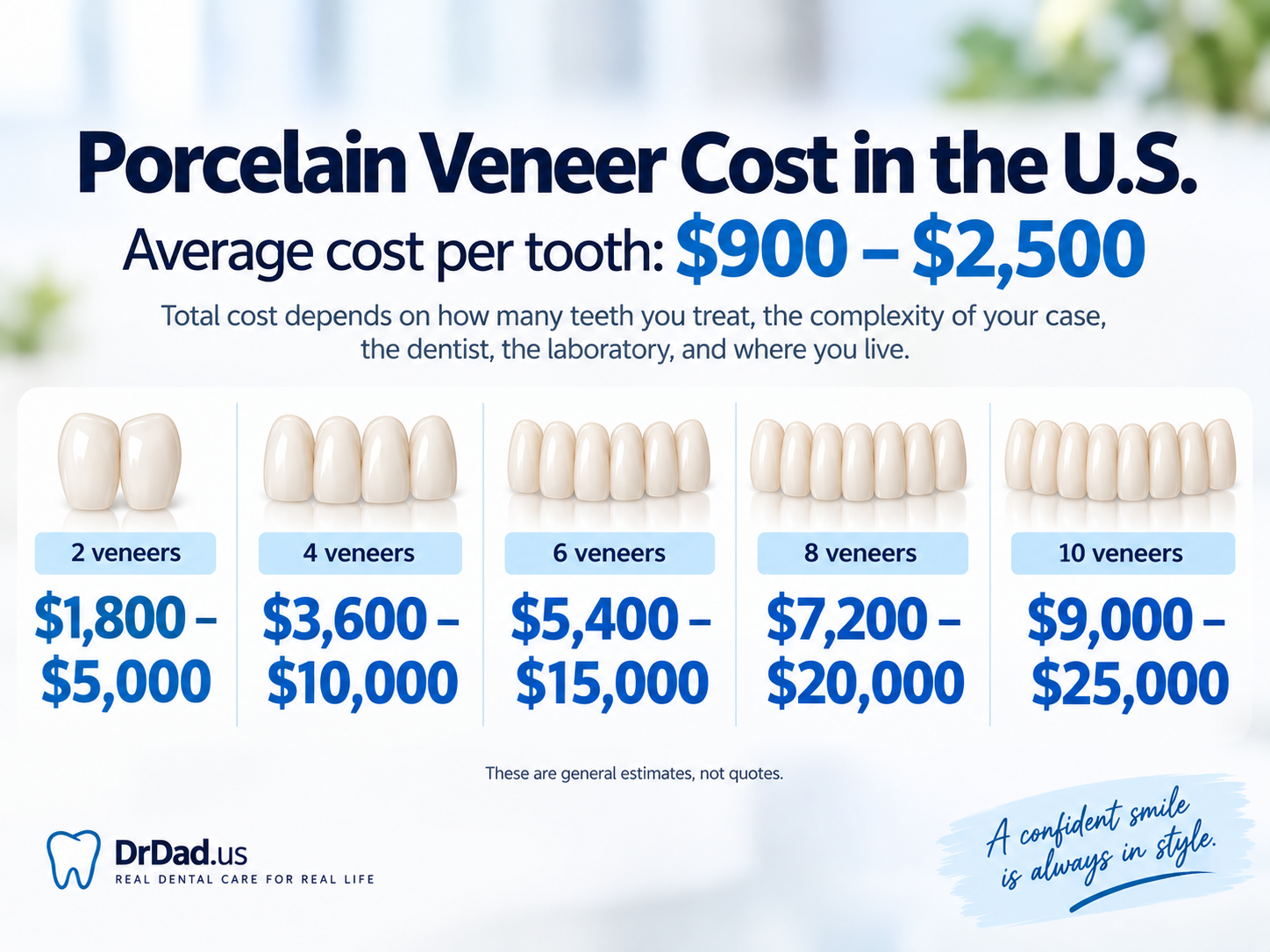
Porcelain veneers in the U.S. commonly cost about $900 to $2,500 per tooth.
Actual fees can be lower or higher depending on where you live, the dentist, the dental laboratory, the complexity of your case, and how many teeth are being treated.
Quick Porcelain Veneer Cost Estimate
| Number of Veneers | Approximate Cost |
|---|---|
| 2 veneers | $1,800–$5,000 |
| 4 veneers | $3,600–$10,000 |
| 6 veneers | $5,400–$15,000 |
| 8 veneers | $7,200–$20,000 |
| 10 veneers | $9,000–$25,000 |
These are general estimates, not quotes.
But here’s the question a price chart can’t answer:
How do you know whether you actually need 2, 4, 6, or 8 veneers?
One of my first veneer patients came in wanting only two. I recommended four. And the reason explains a lot about what you’re really paying for when you get porcelain veneers.
My First Veneer Patient Wanted Only Two
She was a mother with a noticeable gap between her two upper front teeth, something dentists call a diastema.
Her teeth were healthy. She wasn’t coming to me because of decay, broken teeth, or pain. The gap simply bothered her.
She was self-conscious about her smile, and she also felt that the space affected the way she pronounced certain sounds. She wanted to change it.
And she knew exactly what she wanted: Two veneers on her two front teeth.
That made perfect sense from her perspective. The gap was between two teeth. Veneers are priced per tooth. Why pay for four when the problem involves two?
But when I evaluated her, I wasn’t looking only at those two teeth. I was looking at her smile.
Why I Recommended Four Veneers Instead of Two
When she smiled naturally, her two lateral incisors—the teeth immediately next to the two large front teeth—were clearly visible.
If we placed porcelain only on the two central incisors, we would be changing their color, shape, proportions, and surface characteristics while leaving the neighboring teeth untouched. That can create another cosmetic problem.
You close the gap, but now the two front teeth may look different from the teeth beside them.
Natural teeth aren’t simply “white.” They have translucency, texture, subtle color variations, and different ways of reflecting light. Porcelain can reproduce those characteristics beautifully.
But matching two porcelain veneers perfectly against neighboring natural teeth can sometimes be more challenging than designing four teeth to work together.
So I explained what I was seeing and why I thought treating the four upper front teeth visible in her smile would create a more harmonious result. Ultimately, we completed four veneers.
The gap disappeared. Her smile looked more natural. She told me that she felt her speech improved, and more importantly, she seemed much more comfortable smiling.
Later, she came back and told me she had landed a good job. Did veneers get her the job? Of course I can’t say that. But I could see that she felt more confident after treatment.
I still remember that case because it taught me something early in my career: Cosmetic dentistry may involve individual teeth, but people see the entire smile.
And that’s why comparing veneer prices only by the cost per tooth can be misleading.
What Are You Really Paying For?
A porcelain veneer is a very thin restoration. So patients understandably wonder: Why can something so small cost $1,000, $1,500, $2,000, or more?
Because ideally, you’re not paying just for the porcelain. You’re paying for the process that determines what happens to the porcelain—and to the tooth underneath it.
- Diagnosis and treatment planning
- Smile design
- Determining how many teeth actually need treatment
- Tooth preparation
- Digital scans or impressions
- Temporary restorations when needed
- Dental laboratory and ceramist work
- Shade and shape selection
- Try-in and adjustments
- Bonding
- Bite evaluation
- Follow-up care
And there is one thing that is difficult to put on a price sheet: Clinical judgment.
My first patient didn’t need four pieces of porcelain because four was somehow a magic number. She needed a treatment plan that considered the four teeth visible in her particular smile.
Another patient may need two. Another may need six. And another may not need veneers at all.
Why Do Porcelain Veneer Prices Vary So Much?
Two dental offices may both advertise “porcelain veneers,” but that doesn’t necessarily mean you’re comparing identical treatments.
The dentist and treatment planning
The dentist has to decide what should be changed—and what should be left alone. Color? Shape? Spacing? Alignment? Tooth length? Proportions? Your bite? Your gum line?
Good cosmetic dentistry isn’t simply making teeth whiter. The teeth have to work with each other and with the patient’s face.
The dental laboratory
Patients usually meet the dentist. They may never meet the dental ceramist who creates the restorations. But laboratory work can be an important part of the final result.
A ceramist may be working with subtle differences in translucency, texture, shape, characterization, and shade. The goal isn’t simply to create a white tooth. The goal is to create porcelain that doesn’t immediately look like porcelain.
The complexity of the case
Closing one small space is different from changing the shape, position, color, and proportions of several teeth. Some patients have straightforward cases. Others require much more planning. That can affect the cost.
Where you live
Dental fees also vary geographically. The cost of operating a dental practice in one U.S. city can be very different from another. That’s another reason there is no single national veneer price.
How Many Veneers Do You Actually Need?
This may be more important than the veneers cost per tooth.
Suppose one dentist charges $1,200 per veneer and recommends eight veneers. Another charges $1,600 and recommends four. Which treatment is cheaper? More importantly: Which treatment is appropriate?
You cannot answer that question from the price alone.
There is no rule saying a smile needs 4, 6, 8, or 10 veneers. The number depends on your smile line, natural tooth color, tooth position, anatomy, cosmetic goals, and which teeth are visible.
And I want to be very clear about something. My first patient’s story does not mean that someone who asks for two veneers should be sold four.
Sometimes two veneers are exactly the right treatment. Sometimes one may be appropriate. Sometimes six may make sense. There should be a reason for every tooth being treated.
Before You Get Veneers, Ask: Do I Need Veneers at All?
This is especially important when the teeth are healthy.
My first patient’s teeth were healthy. We were performing elective cosmetic treatment. That changes the conversation.
Depending on what bothers you, there may be alternatives. If the main concern is color, teeth whitening may be enough. If the concern is tooth position or spacing, orthodontic treatment may sometimes make more sense. For certain changes in shape or small spaces, composite bonding may be an option.
And sometimes the right answer is: Do nothing.
Veneers can produce beautiful results. But healthy tooth structure deserves respect. Depending on the case and technique, placing veneers may require removal of some natural tooth structure. Once tooth structure is removed, you cannot put it back.
That’s why I think the question shouldn’t only be: “Can veneers fix this?” It should also be: “Are veneers the best way to fix this?”
Porcelain vs Composite: Is the Cheaper Option Better?
Composite resin can sometimes be used to change tooth shape, close spaces, and improve appearance at a lower initial cost than porcelain.
But porcelain and composite aren’t identical treatments. They differ in appearance, material properties, stain resistance, repairability, maintenance, and expected longevity.
I wouldn’t automatically choose porcelain because it costs more. And I wouldn’t automatically choose composite because it costs less.
The better question is: Which material makes sense for this particular tooth and this particular patient?
Does Insurance Cover Porcelain Veneers?
Usually, patients should be prepared for the possibility that they will be paying for veneers themselves.
Porcelain veneers are often performed primarily for cosmetic reasons, and cosmetic dental procedures are commonly excluded from dental insurance coverage. However, insurance plans and clinical situations vary.
Before treatment, check your specific benefits and ask the dental office what is—and is not—included in the treatment estimate.
How Long Do Porcelain Veneers Last?
If you’re spending thousands of dollars, this is a reasonable question.
There isn’t a guaranteed expiration date. How long veneers last can depend on your bite, grinding or clenching, oral hygiene, habits, trauma, the underlying tooth, the quality of the restoration, the bonding procedure, and ongoing dental care.
Porcelain veneers can last many years, but I don’t tell patients to think of any dental restoration as guaranteed for life. Your mouth changes. Your teeth change. Dental work eventually may need maintenance, repair, or replacement.
That future cost belongs in the conversation too.
We Live in a One-Person, One-Camera World
I think there’s another reason cosmetic dentistry gets so much attention today.
Almost everyone carries a camera all day. Your phone has a camera. Your laptop has a camera. Then there’s Zoom, FaceTime, Instagram, TikTok, YouTube, LinkedIn, dating apps, family photos, and work videos.
We see our own faces more than previous generations ever did. And once you start seeing yourself on a screen every day, you may begin noticing things you never paid much attention to before: the color of your teeth, a small gap, uneven edges, a rotated tooth, asymmetry.
I understand why people care about these things. And veneers can be a powerful cosmetic option.
But there is a danger here too. Don’t let a bad selfie convince you that healthy teeth need irreversible treatment.
Natural teeth aren’t supposed to look digitally perfect. Sometimes improving a smile makes someone feel much better about themselves. Sometimes the perceived “problem” doesn’t need treatment at all.
A good cosmetic consultation should be able to discuss both possibilities.
Don’t Shop for Veneers Like You Shop for a TV
If you call five dental offices and ask, “How much is one porcelain veneer?” you may get five different prices. But you still don’t know which treatment is right for you.
Instead of comparing only the price, ask:
- Why are you recommending veneers?
- Why are you recommending this number of teeth?
- Are there more conservative alternatives?
- How much natural tooth structure will be removed?
- Who makes the veneers?
- What is included in the quoted cost?
- What happens if the shade or shape needs adjustment?
- How will my bite be evaluated?
Those answers tell you much more than the price alone.
The cheapest veneer isn’t automatically the best value. But the most expensive veneer isn’t automatically the best dentistry either. Price is information. It isn’t the entire treatment plan.
DrDad Tips
If you’re considering porcelain veneers, start with the price. There’s nothing wrong with that. You should know what you’re going to pay.
But don’t stop at the price.
Ask why each tooth is being treated. Ask whether there is a more conservative alternative. Ask what is being done to your natural teeth. Ask about the laboratory, the process, the bite, and what happens after the veneers are placed.
And remember something my first veneer patient taught me: The tooth that bothers you may not be the only tooth that matters to your smile.
She came to me thinking about two teeth. I was looking at four teeth because I was looking at her entire smile.
For another patient, my recommendation might be completely different. That’s what you’re really paying for when cosmetic dentistry is done thoughtfully.
Not just porcelain.
You’re paying for the decisions made before, during, and after that porcelain ever touches your tooth.
Disclaimer
This article is based in part on the author’s professional and personal clinical experience as a practicing dentist and dental practice owner in the United States and is provided for general educational and informational purposes only. The patient story has been presented without identifying information and is intended to illustrate general treatment-planning considerations; individual experiences and outcomes vary. This article is not individualized dental, medical, financial, insurance, or other professional advice. Veneer candidacy, treatment options, number of teeth treated, preparation requirements, costs, insurance coverage, risks, benefits, and expected longevity vary by patient, dentist, laboratory, location, and clinical circumstances. A comprehensive examination by a qualified dental professional is necessary before making treatment decisions.